
TL;DR — The 60-Second Brief
- A burial shroud is a biodegradable fabric wrap used in place of (or sometimes inside) a casket — the simplest, most natural form of human burial.
- Cost is dramatically lower than a casket: basic cotton or linen shrouds run $100–$500, while many traditional caskets cost $2,000–$10,000+.
- Materials must be biodegradable: cotton, linen, hemp, wool, and silk are the most common choices accepted by Green Burial Council–certified cemeteries.
- Deep religious roots: Jewish tachrichim, Muslim kafan, and early Christian linen wrappings all use shrouds — symbolizing humility, equality, and a return to the earth.
- Pair the shroud with a digital memorial so the story endures even when the body returns to the soil. A digital memorial page tied to a small QR plaque keeps photos, stories, and tributes alive forever.
What Is a Burial Shroud, Really?
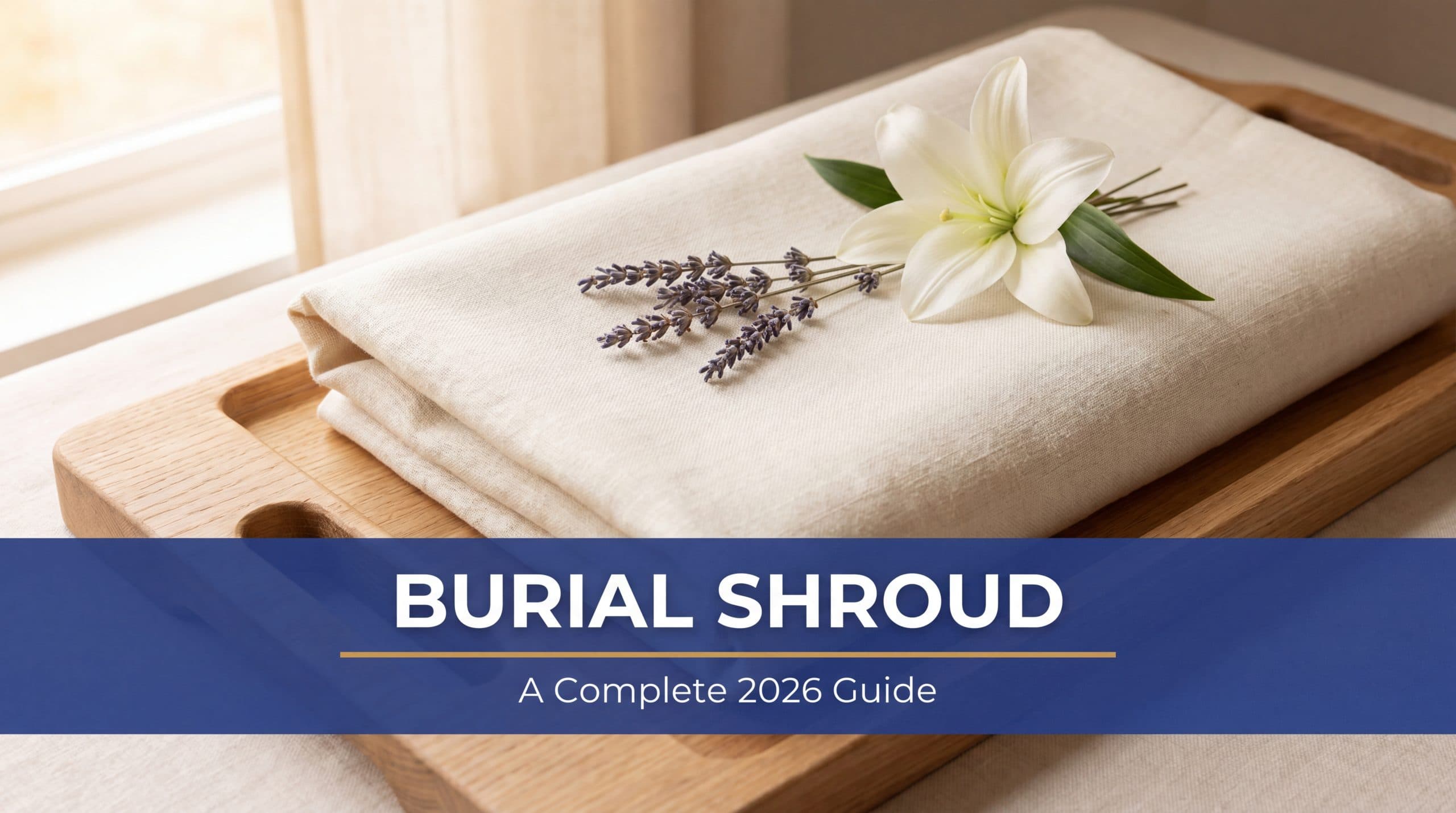
For thousands of years, before there were caskets, vaults, or embalming chemicals, families wrapped their dead in cloth. That ancient practice is quietly making a comeback. A burial shroud is a length of biodegradable fabric — usually cotton, linen, wool, or hemp — used to dress the body for burial. Some shrouds are simple rectangular sheets. Others are tailored, sewn into closed pouches with carrying straps, or quilted with handles for pallbearers. What unites them all is intention: a body returned to the earth in something that will decompose alongside it, without leaving toxins or hardware behind.
In the United States, this approach is now the centerpiece of the green burial movement. According to the National Funeral Directors Association, the U.S. cremation rate is projected to reach 63.4% in 2025, while the burial rate continues to fall to roughly 31.6%. Within that smaller burial segment, however, demand for natural and shroud-only burials is climbing fast — driven by environmental concern, cost, and a renewed desire for simplicity. If you are weighing your options, our cremation vs. burial guide is a useful companion read.
A note on language: “Shroud burial,” “natural burial,” and “green burial” overlap but are not identical. A shroud is the cloth itself. A natural burial is the practice of returning the body to the earth without embalming, vaults, or non-biodegradable containers. Green burial is the broader environmental ethic that often involves both.
Burial Shroud Materials: A Practical Comparison
Not every piece of fabric qualifies as a burial shroud. The Green Burial Council — the leading certification body for natural funeral products in North America — requires that any certified shroud, casket, or urn be made from materials that are plant-derived, natural fibers, animal-derived, or unfired earthen substances, with no toxic dyes, glues, or finishes. Below is how the most common shroud fabrics compare.
Cotton
The most widely available and least expensive choice. Soft, breathable, fully biodegradable in roughly 1–5 months in active soil. Look for organic, undyed muslin or unbleached cotton sheeting. Cotton is also the traditional fabric of Muslim kafan and a frequent choice for Jewish tachrichim.
Linen
Stronger than cotton, with a clean, dignified drape that many families find aesthetically meaningful. Linen has been the burial cloth of choice across Jewish, Christian, and Mediterranean traditions for millennia. Cost runs slightly higher than cotton ($150–$400 for a basic shroud).
Hemp
The most durable and ecologically friendly option. Hemp requires less water to grow than cotton and biodegrades completely. Increasingly popular with Green Burial Council–certified cemeteries because the entire supply chain is low-impact. Expect $200–$500 for a finished shroud.
Wool
Naturally insulating, durable, and beautifully traditional — wool was the historic shroud fabric of Britain and northern Europe. Especially meaningful for cooler climates and families with farming or pastoral heritage. Wool felt shrouds typically run $300–$700.
Silk
Less common but occasionally chosen for personal or cultural reasons. Silk is biodegradable but slower to decompose than plant fibers. Cost ranges widely depending on weave and source.
Typical cost range for a basic burial shroud — a fraction of a traditional casket
How Much Does a Burial Shroud Cost?
This is where the math becomes startling. A traditional metal casket typically retails for $2,000 to $10,000 (or far more for hardwood and bronze models). A burial vault, which most conventional cemeteries require, adds another $700 to $3,000. A burial shroud, by contrast, costs $100 to $500 for a basic cotton or linen wrap, or $300 to $1,200 for a hand-quilted or premium hemp shroud with built-in carrying straps. Many families even sew their own from a few yards of unbleached linen, bringing the material cost close to zero.
The savings extend further. Shroud burials at certified green cemeteries usually don’t require embalming (which runs $700–$1,200), a vault, or a grave liner. When you stack everything together, a full shroud burial at a natural burial ground often lands in the $1,500–$4,000 range, compared with $8,000–$15,000+ for a conventional casket burial. For broader pricing context, our coffin cost guide walks through every line item families typically encounter.
Sample Cost Comparison Table
Burial Shrouds Across Religious Traditions
Shrouds are not a modern eco-trend — they’re one of the oldest funeral practices known to humanity. Three of the world’s largest faith traditions use them in nearly identical ways, and that shared heritage is part of why families across belief systems find the practice so meaningful. If scripture comforts your family during planning, our roundup of bible verses for the death of a loved one offers passages many find grounding.
Jewish Tradition — Tachrichim
In traditional Jewish practice, the deceased is dressed in tachrichim: a simple set of hand-stitched white linen or muslin garments including a tunic, pants, belt, and head covering. There are no pockets, no buttons, and no machine-sewing — symbolizing that we carry nothing material into the next world and that all are equal in death. Embalming is prohibited, caskets are typically plain pine, and burial happens as quickly as possible after death. Many Jewish families today choose simple shroud-and-pine-casket combinations that align perfectly with modern green burial standards.
Muslim Tradition — Kafan
Islamic burial requires the body to be washed (ghusl), perfumed, and wrapped in a plain white cotton or linen kafan: traditionally three large pieces of cloth for men and five for women. The Prophet Muhammad himself was buried this way, and the practice has remained essentially unchanged for fourteen centuries. The kafan reflects the core Islamic values of modesty, equality before God, and immediate return to the earth. Burial occurs as soon as possible — ideally within 24 hours.
Christian Tradition
The Gospels describe Jesus being wrapped in a linen shroud after the crucifixion (the Shroud of Turin, contested as a relic, is the most famous example of this textile imagery). Early Christian communities continued the practice for the first thousand years of the church, and many monastic and Orthodox communities still bury their dead in plain linen. The Catholic Church explicitly permits shroud burial, and the Church of England now actively promotes green burial as theologically aligned with the doctrine of returning “ashes to ashes, dust to dust.”
Secular and Cultural Adoption
You don’t need to be religious to choose a shroud. Many secular and humanist families pick shrouds precisely because they strip funerals back to their most essential, dignified form: the body, the cloth, the earth, the gathering of loved ones. The ritual carries weight without requiring doctrine.
Bridging old and new: Many families today combine an ancient shroud burial with a modern digital memorial — preserving the simplicity of the body’s return to the earth while ensuring the loved one’s stories and photographs are never lost. Learn how a digital memorial works alongside a traditional or natural burial.
How a Shroud Burial Actually Works
Many families considering a shroud have never seen one used. Here is what to expect, step by step.
1. Confirm the Cemetery’s Policy
Not every cemetery permits shroud-only burial. You’ll want a natural burial ground or a hybrid cemetery with a green section. Use the Green Burial Council’s online directory to find certified options near you. Some hybrid cemeteries allow shrouds but require a simple carrier board or rigid tray for handling and lowering.
2. Choose the Fabric and Style
Decide whether you want a flat sheet shroud (the simplest option), a tailored pouch with closure ties, or a quilted shroud with sewn-in handles and a carrying board. Families often choose meaningful fabrics: a grandmother’s tablecloth, a wedding bedsheet, or fabric in the loved one’s favorite color. Custom embroidery — the deceased’s name, a verse, a sprig of rosemary — is increasingly common.
3. Wrap the Body
The funeral home, hospice, or a designated family member washes and dresses the body (often in simple clothing the loved one liked), then wraps it in the shroud. Many natural burial grounds offer family-led washing and shrouding ceremonies — an experience that, while emotionally intense, many families later describe as one of the most healing moments of their grief.
4. Transport and Lowering
The shrouded body is transported on a board or in a simple wicker carrier. At the graveside, pallbearers (or, increasingly, family members using ropes) lower the shroud directly into the grave. There is no vault. The earth is replaced by hand, often with the help of mourners taking turns with a shovel — a profound, participatory ritual.
5. Mark and Remember
Natural burial grounds typically use flat, native stone markers or GPS-tagged memorial trees rather than upright headstones. This is where modern remembrance technology earns its place: a small QR memorial plaque embedded in a flat stone, or even attached to a memorial tree, lets visitors scan to access photos, stories, audio messages, and family tributes — a living archive that complements the most natural form of burial imaginable.

Burial shroud essentials: materials, cost, traditions, and the shroud burial process at a glance.
How to Choose the Right Shroud: A 6-Question Framework
If you’re researching shrouds for yourself, a pre-need plan, or a recent loss, work through these six questions. They map directly onto the decisions a funeral director or natural burial ground will ask you to make.
- Where will the burial happen? Confirm the cemetery is certified or willing to accommodate a shroud. This single answer drives every other choice.
- Does the cemetery require a carrier board? Many hybrid sites do. Ask about dimensions and material requirements.
- Which fabric fits your values and budget? Cotton or linen for cost and simplicity; hemp or wool for durability and ecological footprint; family heirloom fabric for meaning.
- Will the shroud be plain, embroidered, or personalized? Custom embroidery typically adds $50–$300 and lead time of 2–6 weeks — plan ahead if it matters to you.
- Who will wash and wrap the body? Family-led, funeral-home-led, or community-led (common in Jewish and Muslim traditions). This decision shapes the entire experience.
- How will you mark the grave and preserve the story? Natural marker plus a digital memorial is the most popular modern combination. Consider a QR code memorial for permanent story preservation.
Combining a Shroud Burial With a Digital Memorial
The deepest tension in modern memorialization is this: the natural burial movement asks us to leave nothing permanent behind, while the human heart longs for somewhere to return. A digital memorial resolves that tension elegantly. The body returns to the earth as nature intended, while the story — the photos, voice recordings, written tributes, family tree, even old video clips — lives in a permanent online memorial accessible from anywhere.
Families who choose this hybrid often follow a simple pattern: shroud burial in a natural burial ground, a small native-stone marker etched with a discreet QR code, and a curated digital memorial page populated over the first year of grief by family members worldwide. The result is the most ecologically gentle goodbye possible, paired with the richest possible record of a life lived. Our walkthrough of how to create a digital memorial page covers what to include and how to invite family contributions.
Approximate time for a human body in a natural-fiber shroud to fully return to the soil — while a digital memorial preserves the story forever
Planning a Shroud Funeral Service
The simplicity of a shroud burial doesn’t mean the service has to be minimal. Many families build deeply personal ceremonies around the wrapping and lowering. Common elements include readings (from scripture, secular poetry, or the loved one’s favorite passages), live music or recorded songs — our memorial service songs guide has 100+ suggestions — and a graveside committal where mourners take turns adding earth.
If you’re planning a separate gathering before or after the burial, the same care that goes into choosing the shroud applies to the broader event. Practical guides on celebrations of life, the structure of a funeral wake, and even appropriate funeral attire can help orient family members who haven’t planned a service before. For a printed handout that ties the day together, our funeral program template guide walks through every section.
Practical tip: If multiple generations of family are involved, write a one-page “what to expect” brief before the service. Shroud burials feel unfamiliar to anyone whose only experience is conventional funerals. A clear explanation up front turns confusion into reverence.
Where to Buy a Burial Shroud
You have three main paths.
Certified vendors. Companies like Kinkaraco, Esmerelda, Passages International, and Interra Green Burial sell Green Burial Council–certified shrouds in cotton, linen, hemp, and wool. Prices typically range from $200 to $1,200. Many include carrier boards and the option to embroider the loved one’s name.
Funeral homes that specialize in green burial. An increasing number of independent funeral homes stock shrouds. Ask whether yours offers a green burial package; if not, ask whether they’ll accept a family-provided shroud (most will).
DIY and heirloom fabric. Many families sew their own shroud using unbleached linen, organic cotton sheeting, or a meaningful heirloom textile. The Green Burial Council’s published material standards give you a clear specification to follow. This approach can be deeply healing — an act of love made by hand, the way it has been done for millennia.
Common Concerns and Misconceptions
“Will the shroud hold up during transport?”
Yes — properly made shrouds, especially quilted styles with reinforced seams and integrated handles, are designed to bear the weight of an adult body. Carrier boards add even more rigidity for cemeteries that require them.
“Is a shroud burial legal in my state?”
In every U.S. state, no specific casket is required by law for burial. Some states require a rigid container for transport, which a carrier board satisfies. Always confirm with the specific cemetery, since their rules are usually stricter than state law.
“Can the body be viewed before a shroud burial?”
Yes. Many families hold a viewing or visitation with the deceased in simple clothing, then wrap the body in the shroud just before the burial — sometimes as part of the service itself.
“What about decomposition timelines?”
Natural-fiber shrouds break down completely within months in active soil, while the body returns to the earth over roughly 8 to 25 years depending on soil composition, climate, and depth. This is the entire point: a true return to the natural cycle.
Frequently Asked Questions
Is a burial shroud cheaper than a casket?
Yes, substantially. A basic burial shroud costs $100–$500, while traditional caskets typically cost $2,000–$10,000. When you add the avoided costs of embalming and a burial vault (often required with conventional caskets), total shroud-burial costs can be one-third to one-half of a conventional funeral.
What materials are accepted for a green burial shroud?
The Green Burial Council certifies shrouds made from natural fibers such as cotton, linen, hemp, wool, and silk, provided no toxic dyes, glues, or synthetic finishes are used. Plant-derived and undyed fabrics are the safest choice for certified cemeteries.
Do Jewish and Muslim traditions require a shroud?
Yes. Traditional Jewish burial uses tachrichim — a simple set of white linen or muslin garments — and prohibits embalming. Islamic burial requires washing the body and wrapping it in a plain cotton or linen kafan. Both traditions emphasize simplicity, equality, and a swift return to the earth.
Can I be buried in a shroud in a conventional cemetery?
Sometimes. A growing number of conventional cemeteries have a hybrid or natural section that permits shroud burial, often with a rigid carrier board. Pure conventional sections usually require an outer burial container or vault, which is incompatible with shroud-only burial. Always confirm directly with the cemetery.
How do families remember a loved one buried in a shroud without a headstone?
Natural burial grounds typically use flat native-stone markers, GPS-tagged plots, or memorial trees rather than upright headstones. Many modern families pair these subtle physical markers with a digital memorial page accessed via a small QR code — preserving photos, stories, and tributes forever even though the physical footprint stays minimal.
The Quiet Power of a Shrouded Goodbye
A shroud burial isn’t only an environmental choice. It’s a return to something elemental: the body, the cloth, the soil, the hands of family. Every ancient tradition that buries its dead in fabric understood that simplicity itself is a form of reverence. Modern green cemeteries, certified materials, and even gentle technology like digital memorials don’t replace that simplicity — they support it. Whether you are pre-planning for yourself, walking through a recent loss, or simply curious about the alternatives to the conventional funeral, the burial shroud deserves a place in your conversation.
If you’re building a memorial for someone you love and want their story to outlast the cloth and the earth, we’d be honored to help you preserve it.