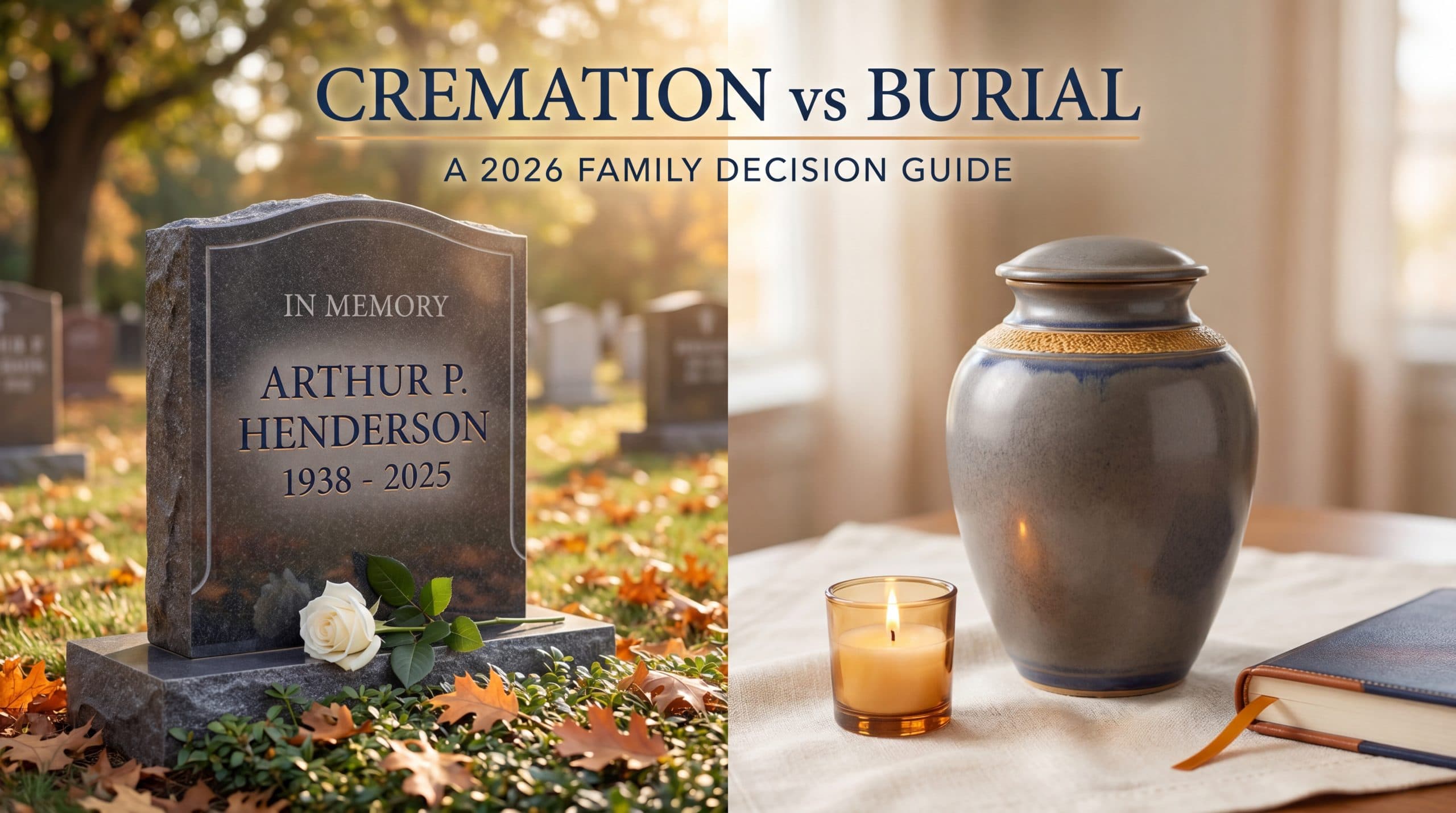

TL;DR — The Short Answer
- Cremation now outpaces burial in the U.S. 63.4% of Americans chose cremation in 2025; the NFDA projects 82.3% by 2045.
- Cost is the headline difference. Median full-service cremation runs about $6,280; a traditional burial averages $9,995 with a vault, before cemetery plot fees.
- Direct cremation is the cheapest path, typically $600 to $2,500 nationwide, with no viewing or ceremony.
- Environmental footprint favors cremation by roughly 31% in CO₂-equivalent, but green burial and water cremation now offer lower-impact alternatives.
- Faith, family wishes, and how you want to be remembered matter as much as price. A QR memorial preserves the story permanently, no matter which path you choose.
Cremation vs Burial: A 2026 Decision Guide for Families
For the first time in modern American history, more families now choose cremation than burial. The National Funeral Directors Association’s 2025 Cremation & Burial Report puts the cremation rate at 63.4%, with traditional burial at 31.6%. By 2045, the NFDA projects cremation will outnumber burials by more than six to one. Yet the question families actually face at the kitchen table isn’t a statistic. It’s a quiet, often urgent choice: What would they have wanted? What can we afford? What will give us a place to come back to?
This guide is written for the families and caretakers doing that thinking right now, often on short notice. We’ll walk through cost, process, faith, environment, and the long arc of remembrance, and we’ll be honest about the trade-offs. Both paths are dignified. Both honor a life. The right answer is the one that fits your loved one’s wishes, your traditions, and the way your family wants to grieve and remember in the years that follow.
A quick note on terminology. Burial in this guide means a traditional in-ground burial with a casket and usually a vault. Cremation means flame-based cremation unless otherwise noted. We’ll also touch on green burial, water cremation (aquamation), and entombment, all of which families increasingly consider alongside the two main paths.
The Cost Comparison: What You’ll Actually Pay in 2026
Cost is the single biggest reason cremation has overtaken burial. The gap is real, but it narrows fast when you add ceremony, viewing, and the kind of permanent memorial place many families still want. Here’s where the dollars actually go.
average savings of full-service cremation vs. traditional burial in 2026
2026 Average Costs Side by Side
| Option | Typical 2026 Price | What’s Included |
|---|---|---|
| Direct cremation | $600 to $2,500 | No viewing, no ceremony. Transport, cremation, basic container, return of remains. |
| Cremation with viewing & service | $6,280 median | Viewing, ceremony, rental casket, urn, professional services, transportation. |
| Traditional burial (no vault) | $7,848 median | Casket, viewing, ceremony, hearse, embalming, professional services. |
| Traditional burial with vault | $9,420 to $9,995 | All of the above plus a concrete or metal burial vault. |
| Cemetery plot | $1,000 to $4,000+ | Add-on for burial. Higher in urban areas; lower in rural and municipal cemeteries. |
| Headstone or monument | $1,000 to $5,000+ | Add-on for burial. Granite upright stones run $2,000 to $4,000 nationally. |
The takeaway: a full traditional burial with a vault, plot, and headstone often lands between $12,000 and $18,000 all in. A full-service cremation with an urn and a small memorial service typically lands between $5,000 and $8,000. Direct cremation, the most affordable end of the spectrum, can keep total costs under $2,500. For a deeper breakdown by region and inclusions, our complete cremation cost guide and our coffin cost and casket pricing guide have line-by-line ranges.
Hidden Costs to Watch For
Three line items catch families off guard. First, cemetery fees beyond the plot such as opening and closing the grave, perpetual care, and the burial vault required by most cemeteries can add $2,000 to $4,000. Second, urn upgrades: the basic container included with direct cremation is plain, and families often want a permanent urn, which can run $50 to $1,500 or more. Our cremation urns guide covers materials, sizing, and what works for scattering, home display, or columbarium placement. Third, memorial service add-ons: catering, flowers, programs, and a venue can easily add $1,000 to $3,000 to either path. Don’t let any of these surprise you on a price sheet at the funeral home, the FTC’s Funeral Rule entitles you to itemized pricing and to decline any package you don’t want.
How Each Process Actually Works
Cost is concrete. Process is where the choice starts to feel personal, because each path shapes the days right after a death very differently.
The Cremation Process Step by Step
After transport from the place of death, the body is held in refrigerated care while paperwork is completed. State law typically requires a 24- to 48-hour waiting period before cremation, plus a signed authorization from the legal next of kin and a permit from the medical examiner. The cremation chamber itself heats to between 1,400°F and 1,800°F for two to three hours. Remains are then processed into a fine consistency and returned to the family in a temporary container, ready for transfer to a permanent urn, scattering, or interment in a columbarium niche.
If you choose cremation with a viewing first, the body can be temporarily embalmed and presented in a rental casket, with a service held before the cremation itself. If you choose simple direct cremation, the cremation happens within a few days of death, with no viewing, no embalming, and no immediate ceremony, freeing the family to plan a memorial on their own timeline weeks or months later.
The Traditional Burial Process Step by Step
Burial typically begins with embalming and cosmetic preparation (about $700 to $1,200 in 2026), which preserves the body for viewing. A visitation or wake is usually held in the day or two before the funeral. Our funeral wake traditions guide explains what to expect and how to plan one. The funeral service follows, either at a place of worship, a funeral home chapel, or graveside. After the service, the casket is transported to the cemetery for committal, where it is lowered into a vault and the grave is closed. The headstone or marker is usually installed several weeks later once the ground settles.
Time pressure note: Burial generally needs to happen within 3 to 7 days of death to avoid extended preservation costs. Cremation gives families weeks or months to plan a memorial service. If your family is spread across the country or needs time to travel, that flexibility matters.
Environmental Impact: The 2026 Picture
Environmental footprint is now a primary decision factor for a meaningful share of families, especially under-50 caretakers. Here’s what the data actually shows.
Traditional burial produces roughly 146 kg of CO₂-equivalent per service, mostly from casket manufacturing, vault production, and the long lifecycle of embalming chemicals. It also consumes land at a rate 69% higher than cremation, and embalming fluid (formaldehyde and glutaraldehyde) can leach into surrounding soil and water over decades.
Flame cremation produces about 101 kg of CO₂-equivalent per service, a 31% reduction over burial. Each cremation generates approximately 534 pounds of carbon dioxide, primarily from natural gas combustion in the cremation chamber. There are also air-quality concerns from mercury released by dental amalgam fillings, though modern crematories increasingly use filtration to manage this.
increase in green burial demand reported by U.S. cemeteries since 2020
Lower-Impact Alternatives Worth Knowing About
Three options now sit between flame cremation and traditional burial on the impact scale.
Green or natural burial skips embalming, uses a biodegradable casket or shroud, and forgoes the concrete vault. The body returns to the soil over years. There are now more than 500 green burial cemeteries across the U.S. and Canada, up from about 100 in 2015. A 2025 NFDA study found more than 60% of Americans over 40 are interested in exploring natural burial. Costs vary widely but often land between $2,000 and $4,000 plus the plot, well below traditional burial. The Green Burial Council certifies cemeteries that meet specific environmental standards.
Water cremation (aquamation) uses heated water and potassium hydroxide instead of flame, cutting energy use by roughly 90% and producing no direct emissions. It’s now legal in more than 25 U.S. states. Our water cremation (aquamation) guide covers availability, cost, and the family experience in detail.
Mushroom or composting (natural organic reduction) is the newest option, now legal in Washington, Oregon, Colorado, Vermont, California, and a few other states. The body is converted to nutrient-rich soil over 30 to 60 days. Costs run $5,000 to $7,000.
Faith and Tradition: What Religions Say
For many families, the decision is settled the moment they consider their loved one’s faith. Here’s a respectful overview of where major traditions stand in 2026.
| Faith Tradition | Position on Cremation | Position on Burial |
|---|---|---|
| Catholic | Permitted since 1963. Vatican guidance requires remains to be interred in a sacred place (church cemetery or columbarium), not scattered or kept at home. | Preferred by Church tradition. |
| Protestant Christian | Generally accepted across most denominations. Some conservative branches still prefer burial. | Traditional and widely practiced. |
| Orthodox Christian | Generally prohibited. Burial of the intact body is required. | Mandatory under Orthodox tradition. |
| Jewish (Orthodox/Conservative) | Prohibited. Halakha (Jewish law) requires the body to be buried intact, in the ground, as soon as possible. | Required, typically within 24 to 48 hours. |
| Jewish (Reform) | Increasingly accepted as a personal choice. Many Reform rabbis officiate at both. | Traditional and widely practiced. |
| Muslim | Prohibited under Islamic law. Cremation is considered a violation of the body’s dignity. | Required, ideally within 24 hours, facing Mecca. |
| Hindu | Required for most adults. Cremation releases the soul for its next journey. | Typically reserved for infants and certain holy figures. |
| Buddhist | Common and culturally significant in most traditions. | Also acceptable; varies by tradition. |
If you’re weighing whether your faith truly forbids cremation, our companion guide on religious views on cremation goes deeper into scripture, denominational rulings, and how to talk to your clergy.
Emotional and Practical Trade-offs
The cost spreadsheets and process timelines hide what the decision is really about: how a family wants to grieve, gather, and remember in the years ahead. Both options have genuine emotional advantages.
Why Families Choose Burial
Burial gives loved ones a permanent place to visit, a specific patch of earth and a stone that says they were here. For many families, the cemetery becomes part of their rhythm: visits on birthdays, anniversaries, holidays, the slow accumulation of meaning over decades. A headstone or monument can become a generational anchor. Our headstone ideas and designs guide covers shapes, materials, symbolism, and the modern QR memorial plaque that turns a stone into a window to a full digital story.
Burial also follows a familiar ritual structure: viewing, funeral, committal at the graveside. For grieving families who find comfort in tradition, that structure can be healing in itself.
Why Families Choose Cremation
Cremation offers flexibility that resonates with how modern families actually live: spread across cities and continents, juggling work and travel, sometimes needing weeks before they can gather. Remains can be kept at home, scattered in a meaningful place, divided among family members in keepsake urns or memorial jewelry, interred in a columbarium, or buried in a small plot. The memorial service can happen the next week or six months later, on the timeline that works for everyone who loved the person.
For families uncertain about long-term cemetery upkeep, cremation also removes the worry of a grave going untended in a generation when grandchildren move away.
It doesn’t have to be either/or. Many families now combine both. A small portion of ashes is buried in the family plot, scattered at a meaningful place, or placed in keepsake jewelry, while the bulk is interred in an urn next to other relatives. A pet’s ashes can rest at home or be buried with a family member, as our pet cremation guide explains for animal companions.

Cremation vs Burial at a Glance: 2026 Family Decision Snapshot
A 7-Step Decision Framework for Families
If you’re making this choice right now, here’s the framework professional planners and grief counselors actually use. Move through it in order. You’ll usually know your answer by step 5.
Step 1: Check for Stated Wishes
Look for a pre-need funeral contract, a section in the will, a healthcare directive, or even a written note. Many people leave clear instructions. Honor them if you find them. If wishes were stated verbally, gather siblings and confirm what each of you heard.
Step 2: Confirm Faith Requirements
If your loved one practiced a faith that requires or prohibits cremation, that often settles the decision. Consult clergy if you’re uncertain about denominational stance, especially for Catholic, Orthodox, Jewish, and Muslim families.
Step 3: Set the Budget Ceiling
Decide what the family can afford without taking on debt. Life insurance, prepaid funeral plans, and estate funds may cover part of the cost; the remainder usually falls on next of kin. Be realistic. Funeral debt is one of the most common financial regrets families report after a loss.
Step 4: Think About the Memorial Place
Ask: where will we go to remember in 5, 10, 25 years? If a cemetery visit feels essential to your family’s grief, burial or columbarium placement gives you that anchor. If you’re more comfortable with a home, a scattered place in nature, or a digital memorial page that the whole family can visit from anywhere, cremation offers more flexibility.
Step 5: Consider Logistics and Timing
Burial typically needs to happen within a week. Cremation gives you months. If family is traveling internationally, if the death was unexpected, or if there are legal or estate complications, the breathing room cremation provides can matter enormously.
Step 6: Get Itemized Quotes from Two or Three Providers
Under the FTC Funeral Rule, every funeral home must provide a General Price List on request, in person or by phone. Compare line by line. Prices for the same service can vary by $2,000 to $5,000 across providers in the same metro area.
Step 7: Talk Through It as a Family
If the decision still feels split, hold one conversation with everyone in the room (or on a call). Surface what each person needs. Sometimes a hybrid (cremation plus a small burial of ashes, or burial plus a digital memorial) gives everyone a piece of what they need.
The Modern Memorial: Why the Physical/Digital Bridge Matters
Whichever path your family chooses, the question that lingers long after the service is the same: how do we make sure they’re remembered, not just buried or scattered?
A traditional headstone holds a name, two dates, and maybe a short inscription. An urn on a mantel holds ashes, but no story. Both fall short of what most families actually want to preserve: the photos, the voice recordings, the family tree, the milestone moments, the stories that grandchildren born after their grandparent’s death will otherwise never hear.
This is where a QR memorial changes the calculation. A small etched code on a headstone or a card kept with an urn opens a complete digital memorial page when scanned with any smartphone (no app required). Photos, videos, GEDCOM family tree, written tributes from across the family, and even voice recordings live there permanently. Our guide on what to put on a memorial web page walks through what families typically include, and cemetery QR codes explores how cemeteries themselves are adopting the technology.
For families choosing burial, the QR plaque mounts on the headstone, durable for 50+ years, so visitors at the graveside in 2076 can still scan and see the full story. For families choosing cremation, the QR code can be etched on the urn, included on memorial cards handed out at the service, or simply printed on a small card kept at home. Either path, the same outcome: the story lives on, not just the marker.
A Note for Monument Dealers and Funeral Directors
If you’re a monument dealer or funeral home reading this, the shifting cremation/burial ratio creates both pressure and opportunity. Families increasingly want both options on the menu and increasingly want a digital memorial layer that works regardless of which path they choose. Our guide for monument dealers covers how to add QR memorial services as a partner, and how dealers and funeral homes are using digital memorials to deepen family relationships and lift average ticket value without taking on inventory risk.
Frequently Asked Questions
Which is cheaper, cremation or burial?
Cremation is significantly cheaper in nearly every scenario. The 2026 median for full-service cremation is about $6,280; for traditional burial with a vault, it’s $9,420 to $9,995, before cemetery plot fees ($1,000 to $4,000+) and a headstone ($1,000 to $5,000+). Direct cremation is the cheapest option overall, often under $2,500 nationwide.
Can you still have a funeral if you choose cremation?
Yes. Many families hold a traditional viewing and funeral first, then proceed with cremation afterward. Others choose direct cremation followed by a memorial service weeks or months later. Cremation does not limit your ability to gather, grieve, and honor a life with ceremony.
Is cremation more environmentally friendly than burial?
Yes, modestly so. Cremation produces about 31% less CO₂-equivalent than traditional burial and uses dramatically less land. However, both have environmental costs. Green burial, water cremation (aquamation), and natural organic reduction (composting) are now widely available lower-impact alternatives, with green burial cemetery options growing 72% in demand since 2020.
Does my religion allow cremation?
Catholic, most Protestant, Reform Jewish, Hindu, Buddhist, and Sikh traditions permit cremation. Orthodox Christian, Orthodox and Conservative Jewish, and Muslim traditions generally prohibit it and require traditional burial. If you’re uncertain, talk to your clergy — practice varies by community.
How do I preserve my loved one’s story if we choose cremation and have no headstone?
A digital memorial page is the most common modern answer. Linkora creates a permanent online memorial with photos, videos, written tributes, and a family tree, accessible via a QR code etched on the urn, printed on memorial cards, or shared with relatives anywhere in the world. No app required; the page lives on indefinitely under the family’s control.