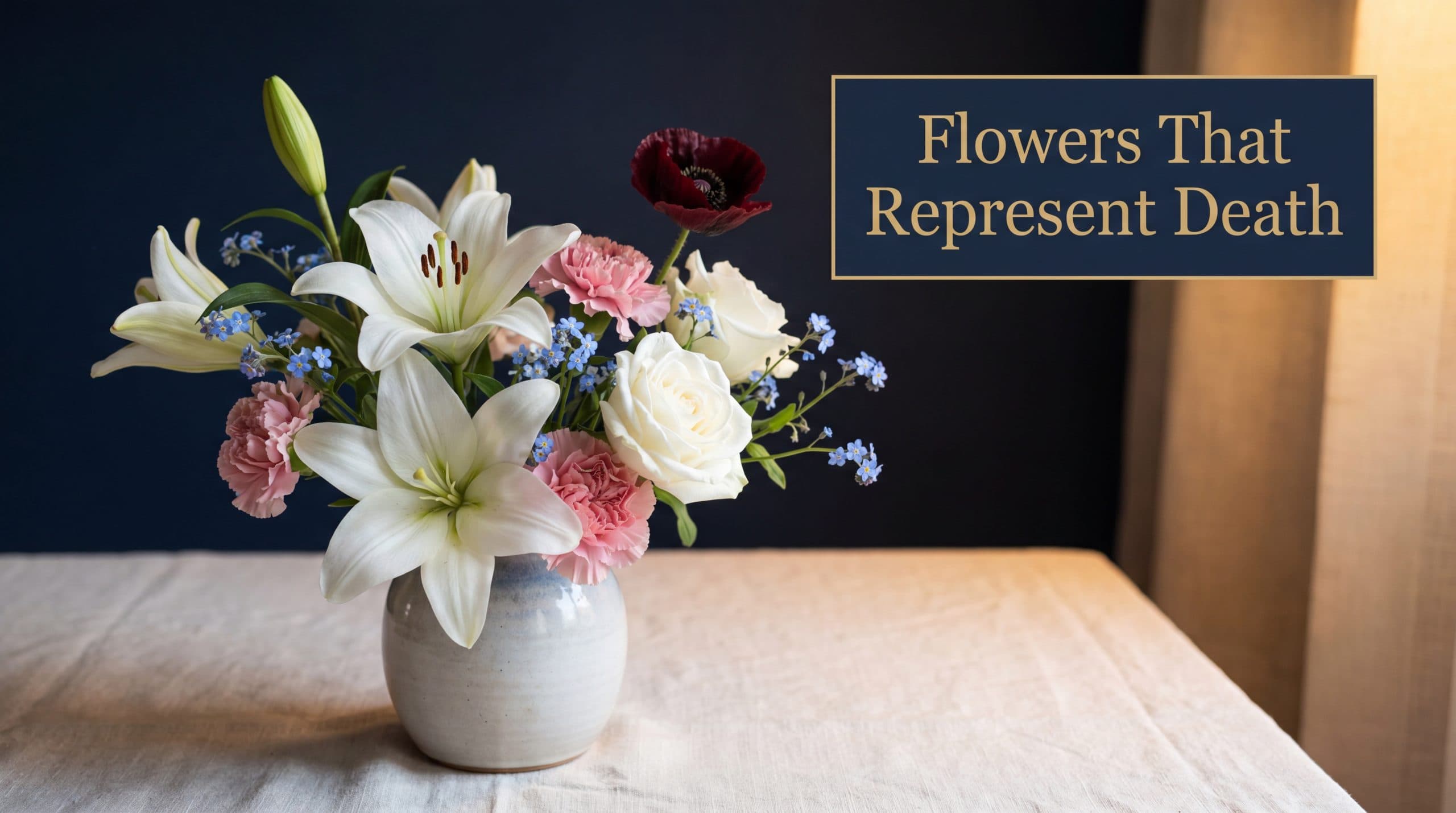

TL;DR — The Flowers That Carry the Language of Loss
- Lilies, chrysanthemums, and white roses are the three most widely recognized flowers associated with death across Western, European, and East Asian cultures.
- Flower meanings shift by color (white speaks to purity and rest, red to deep love and remembrance, purple to dignity) and by tradition (chrysanthemums are joyful in the US but funereal across France, Italy, and Japan).
- The red poppy remains the global emblem of soldiers lost in war, while forget-me-nots have become the modern flower of remembrance for any loved one.
- For Linkora families, traditional floral tributes pair beautifully with a QR code memorial — the flowers honor the moment, the digital memorial honors a lifetime.
- This guide walks through every major mourning flower, what it means, when to send it, and how to combine flowers with lasting digital remembrance.
Why Certain Flowers Came to Represent Death
For at least 60,000 years, humans have placed flowers beside the dead. Archaeologists studying Shanidar Cave in northern Iraq found Neanderthal burials surrounded by clusters of yarrow, cornflower, and hollyhock pollen — the earliest physical evidence that grieving with flowers is older than written language itself. The flowers that represent death today are not modern inventions. They are inheritances.
The flowers we associate with death now carry centuries of layered meaning. Victorian “floriography” turned every bloom into a coded message of love, loyalty, or sorrow. Catholic and Orthodox traditions assigned the white lily to the Virgin Mary and so to purity in passing. East Asian cultures wove the chrysanthemum into ancestor ritual. Modern families, navigating the seven stages of grief, often choose flowers without realizing they are speaking a language their great-grandparents would have understood at a glance.
This article is the field guide to flowers that represent death — every bloom commonly sent in mourning, what it means, where the meaning came from, and how thoughtful families today are pairing the traditional funeral bouquet with something even more enduring: a digital memorial that keeps a loved one’s story alive long after the last petal has fallen.
A note on intent. No flower is “wrong” at a funeral. If a bloom mattered to the person being honored — their wedding bouquet, their garden, the lilac their mother grew on the porch — it belongs. The meanings below are starting points, not rules.
The Ten Flowers That Represent Death Across Cultures
1. Lily — Purity, Innocence, and the Restored Soul
The white lily, especially the Lilium longiflorum or Easter lily, is the single most universal funeral flower in the Western world. In Christian iconography it represents the soul of the departed returned to a state of innocence. Catholic and Episcopal services often place lilies at the altar; many funeral homes use lilies as their default arrangement because the symbolism is widely understood and gives no offense.
Stargazer lilies (deep pink with white edges) lean toward “ambition fulfilled” and “sympathy” rather than purity, which makes them a thoughtful pick for an older relative who lived a full life. Calla lilies suggest beauty and majesty, and are common at Celebration of Life services where the tone is dignity over sorrow. If you are planning the service yourself, our Celebration of Life planning guide walks through every floral decision in detail.
2. Chrysanthemum — The Flower of the Dead in Most of the World
Outside the United States, the chrysanthemum is the funeral flower. In France, Italy, Belgium, Spain, Poland, Hungary, Croatia, and much of Latin America, chrysanthemums are reserved almost exclusively for cemeteries and All Saints’ Day. Bringing a potted chrysanthemum as a dinner gift in Paris is considered a serious faux pas for this reason.
In Japan and Korea, the white chrysanthemum (kiku) symbolizes lamentation and grief, while the yellow chrysanthemum represents the imperial family and is used in court funerals. In China, white and yellow chrysanthemums are placed on graves during Qingming, the spring tomb-sweeping festival. Americans, who associate “mums” with cheerful fall porch displays, are often surprised to learn that the same flower carries the weight of an entire continent’s mourning rituals.
3. Rose — A Color-Coded Conversation
Roses speak more than almost any other flower, and at a funeral the color is the entire message:
- White roses — innocence, reverence, a heavenly bond. Sent for the loss of a child, a young person, or anyone whose memory the family wishes to keep pure.
- Red roses — deep love, respect, courage. Traditional for a spouse, a romantic partner, or a fallen first responder or service member.
- Pink roses — gratitude, gentleness, and admiration. A common choice when mourning a mother, grandmother, or close female friend.
- Yellow roses — friendship and the warmth of shared memory. Often sent by colleagues, neighbors, and lifelong friends.
- Dark crimson or burgundy roses — mourning itself. The deepest red roses carry the weight of grief in Victorian floriography.
- Black (very deep purple) roses — farewell, finality, and the closing of a chapter.
A single rose placed on a casket is one of the most enduring funeral gestures in the West. If you are sending sympathy from a distance and aren’t sure what to say alongside the flowers, our guide on what to say after a loss pairs naturally with whichever color you choose.
4. Carnation — Affection That Lasts
Carnations are the workhorse of funeral floristry. They are inexpensive, they hold their shape for over a week, and their symbolism is unambiguous. Pink carnations are said to have sprung from the tears of the Virgin Mary at the foot of the cross, which is why they are tightly associated with mothers and Mother’s Day. White carnations represent pure love and innocence. Red carnations communicate admiration and a love so strong it survives the death of the beloved.
5. Gladiolus — Strength of Character and Moral Integrity
Gladioli, with their tall spires and dignified shape, are a quiet favorite for the funeral of someone admired for their character — a veteran, a teacher, a community leader, a parent who held the family together. The name comes from the Latin gladius, meaning sword, and the flower is meant to honor a person of conviction. Gladioli appear in the standing sprays you see beside the casket in American funeral homes and are common at services for older men.
American families send flowers as their primary act of sympathy after a loss, according to industry florist surveys.
6. Orchid — Eternal Love and the Memory That Will Not Fade
Orchids represent everlasting love, refinement, and the quiet beauty of a life well lived. Pink and white orchid plants (rather than cut sprays) are an increasingly popular sympathy gift because they last for weeks, often months — a living tribute that the grieving family can keep on a windowsill long after the service ends. Phalaenopsis (moth) orchids in white are the most common funeral choice; cymbidium orchids appear in upscale arrangements.
7. Hyacinth — Sorrow, Regret, and the Grief of Things Left Unsaid
In Greek mythology, Hyacinthus was a young man accidentally killed by the god Apollo, and the flower that bears his name sprang from his blood. Purple hyacinths in particular carry the meaning of “I am sorry” and “please forgive me” — making them the traditional flower for the funeral of someone with whom there were unresolved tensions, or as part of a wider mourning bouquet for any deep loss. The fragrance is unmistakable and many families find it deeply tied to memory.
8. Forget-Me-Not — The Modern Flower of Remembrance
The forget-me-not (Myosotis) has, in the last two decades, become the unofficial flower of remembrance for anyone who has lost a loved one to Alzheimer’s disease, dementia, or memory-related illness. The flower is also worn on Remembrance Day in parts of Newfoundland and is a global symbol of enduring memory. Small clusters of forget-me-nots tied with a ribbon make a quiet, deeply personal sympathy gift — and they translate beautifully into a remembrance tattoo or a photograph on a digital memorial page.
9. Iris — Faith, Hope, and the Messenger to the Afterlife
In Greek mythology, Iris was the goddess who guided the souls of women to the afterlife, and the flower planted on women’s graves was meant to summon her safely. Today, blue and purple irises are common in funeral arrangements for women, especially in southern Europe and the American South. The iris also represents faith and hope, which makes it a frequent choice for services that lean spiritual or religious.
10. Poppy — The Flower of the Fallen Soldier
The red poppy is the most globally recognized symbol of military death. The association comes from the World War I battlefield poem “In Flanders Fields” by John McCrae, and the practice of wearing poppies on Remembrance Day (Commonwealth nations) and Memorial Day (United States) is now over a century old. A red poppy at a veteran’s funeral is among the most powerful single-flower tributes in modern Western mourning. The black-centered “Flanders poppy” is the specific variety associated with this meaning.
Which Flowers Represent Death in Different Cultures?
The flowers that represent death are not universal — they shift sharply across faiths and regions. Sending the “right” flower to a family from a different cultural background means knowing what their tradition expects and what it forbids.
When in doubt, ask. If you do not know the family’s tradition, a brief note to the funeral home asking “Are flowers welcome?” is always appropriate and never offends. Funeral directors handle this question every day.
Color Meanings: What Each Color Communicates
Across most Western traditions, the color of a funeral flower can carry as much weight as the species itself.
White — Purity, Innocence, Peace
White is the universal Western funeral color. It speaks to the soul at rest, to a life lived with grace, and to the wish that the departed be at peace. Send white for the loss of a child, a young adult, a person of faith, or anyone the family wishes to remember in spiritual terms.
Red — Deep Love, Sacrifice, and Lasting Devotion
Red is the color of the heart and of blood — and so of love that does not fade and of lives given for others. Use red for a spouse, a romantic partner, a parent who was deeply adored, or a fallen first responder, soldier, or veteran.
Pink — Gratitude, Tenderness, Maternal Love
Pink softens the conversation. It is the color of gentleness, of motherhood, of the quiet thanks a child wishes to send to a mother or grandmother. Pink is also the most forgiving color when you do not know the deceased well — it conveys care without claiming intimacy.
Purple — Dignity, Honor, and Spiritual Reflection
Purple is the color of royalty, of bishops, and of mourning in Catholic liturgy. It signals that the life being honored was one of dignity and meaning. Purple irises and purple hyacinths are particularly common in services for older relatives and for people of faith.
Yellow — Friendship, Warmth, and the Light of a Life Remembered
In the West, yellow at a funeral represents the warmth of friendship and the brightness a person brought to others’ lives. In East Asia, yellow chrysanthemums specifically signal grief — context matters.
Blue — Tranquility, Faith, and Peaceful Passage
Blue funeral flowers (delphinium, blue iris, hydrangea) are a modern and increasingly popular choice. Blue communicates peace and faith, and is a comforting choice for any service that does not lean to a specific religious symbolism.

The ten flowers most commonly sent in mourning, their cultural meanings, and color symbolism at a glance.
How to Choose the Right Flower for a Specific Loss
If you are sending flowers to a service or to a grieving family, the choice does not need to be elaborate. A thoughtful five-minute decision will land better than a $300 spray made without thought.
For the Loss of a Parent
White lilies, pink roses, or pink carnations are the safest and most traditional choices. If the deceased had a known favorite flower or a beloved garden, sending what they grew is more meaningful than anything from a florist’s catalogue. Many families pair flowers with a written tribute — our sympathy messages for the loss of a father and condolence messages for the loss of a mother guides offer hundreds of phrasing options.
For the Loss of a Child or Young Person
White flowers only, traditionally. White lilies, white roses, white lisianthus, or baby’s breath communicate innocence and grief without claiming knowledge of how the family is processing. Avoid bright colors and large, ostentatious arrangements.
For the Loss of a Spouse or Romantic Partner
Red roses are the traditional and most powerful single statement. A dozen red roses placed at the casket or grave is one of the oldest gestures of romantic love in the Western canon.
For a Veteran or Service Member
Red poppies, white lilies, or any arrangement incorporating the colors of the country’s flag. Many veterans’ services include a single poppy laid by each attendee.
For a Pet
Forget-me-nots, daisies, and small posies of garden flowers are gentle and appropriate. Many families now hold a brief ceremony at home rather than at a service.
For Someone You Did Not Know Well
A simple sympathy plant — a peace lily, an orchid, or a sympathy basket — communicates respect without overstepping. The plant continues to grow long after cut flowers fade, which many families find quietly meaningful.
Beyond Flowers: How Modern Families Pair Floral Tributes With Digital Memorials
A cut bouquet, no matter how beautiful, lasts seven to ten days. A potted plant lasts months, perhaps a year if well cared for. But the average family wants to remember a loved one for a generation, two generations, longer.
This is the gap that QR code memorials were designed to fill. A small, weather-proof QR code is etched into the headstone or memorial plaque. A visitor scans it with any smartphone — no app required — and is taken to a private memorial page where the family has gathered photographs, video tributes, written stories, the eulogy, the favorite recipes, the songs from the service, and (more and more often) high-resolution photographs of the very flowers placed at the funeral.
Linkora families routinely upload pictures of the funeral arrangements directly to the memorial page so that future visitors — children, grandchildren, the cousin who could not fly in — can see what the service looked like, what flowers were chosen, and read why. A bouquet of white lilies becomes part of the permanent story rather than a single afternoon’s beauty. To see this in practice, take a moment to view a demo Linkora memorial.
A small ritual that families love. Many of our families take a single photograph of the funeral flowers before the petals fall, then upload it to the Linkora memorial page with a one-sentence caption explaining why those particular flowers were chosen. Years later, the photograph still tells the story.
If you have lost someone and the funeral flowers feel like the last physical thing tying you to that day, consider preserving the moment digitally. You can claim a memorial in minutes, upload the photographs, and add new tributes from family members as they arrive. The flowers fade. The story does not have to.
A Brief History of the Flowers That Represent Death
The earliest known funeral flowers in the archaeological record come from Raqefet Cave in modern Israel — a 13,700-year-old Natufian burial in which the body was laid on a bed of flowering sage and mint. By Egyptian, Greek, and Roman antiquity, flowers were a standard part of burial: garlands of roses and violets covered the bodies of the wealthy, and laurel wreaths honored fallen soldiers.
The modern Western funeral flower tradition crystallized in the 19th century. Funerals in cities had grown large and the smell of embalming was difficult; massive floral arrangements were initially practical as much as ceremonial. The Victorians, obsessed with the symbolic meaning of every flower, formalized which blooms belonged with which messages — and that language survives in funeral floristry today. When you send a sympathy spray of white lilies in 2026, you are sending the same message a Victorian widow would have understood without explanation in 1862.
Practical Etiquette: Sending Funeral Flowers Today
When to Send Them
Flowers should arrive at the funeral home or the family’s address at least two hours before the service begins. If you can only send flowers after the funeral, send them to the home with a handwritten note rather than to the funeral home, where they may not reach the family.
What to Write on the Card
Keep the message short. “With deepest sympathy, the Riley family” is enough. If you want something warmer, our heartfelt condolence message examples offer dozens of options that work on a small floral card.
If the Family Has Requested “No Flowers”
Respect the request. A “no flowers” line in an obituary is often paired with a request for charitable donations in the deceased’s name. A donation, however small, honors the family’s wishes far more than flowers ever would.
What to Do With Funeral Flowers After the Service
Many families now press and dry a few stems from the funeral arrangement as a keepsake. Others donate the arrangements to hospitals, nursing homes, or hospice facilities — funeral homes will often arrange this on the family’s behalf if asked. A growing number of families photograph the flowers and add the images to a digital memorial page so the floral tribute is preserved permanently.
Frequently Asked Questions
What flower most universally represents death?
The white lily is the most universal Western symbol of death and mourning, representing the soul restored to innocence. Outside the United States — across most of Europe, Latin America, and East Asia — the chrysanthemum holds that position and is reserved almost exclusively for funerals, graves, and All Saints’ Day.
Are red roses appropriate at a funeral?
Yes — red roses are deeply traditional at the funeral of a spouse, a romantic partner, or a parent who was profoundly loved. A single red rose placed on the casket is one of the most enduring gestures in Western mourning. For non-romantic relationships, pink or white roses are a softer choice.
Are there flowers I should not send to a funeral?
Avoid bright, celebratory mixed bouquets (sunflower-and-daisy summer arrangements, tropical birds-of-paradise, balloons) unless the family has specifically asked for a “celebration of life” tone. For Jewish, Muslim, and some Buddhist services, flowers are not traditionally sent at all — a charitable donation or a meal is the expected gesture. When in doubt, call the funeral home and ask.
What does a black rose mean?
“Black” roses are almost always very deep burgundy or crimson varieties rather than true black, which does not occur in nature. Symbolically the black rose represents farewell, the end of a chapter, and the closing of a loved one’s earthly story. It is a powerful but unusual choice — typically used as a single stem rather than a full arrangement.
Can I preserve funeral flowers as a keepsake?
Yes, and many families now do. The most common methods are pressing individual blooms in a heavy book between sheets of parchment, air-drying small bunches upside down in a dark room, or sending the bouquet to a professional flower-preservation service that resin-casts the petals into paperweights or jewelry. A simpler and increasingly popular option is to photograph the arrangement and upload the image to a digital memorial page where the flowers live alongside the rest of the loved one’s story.
Honor the Moment. Preserve the Story.
Flowers carry the weight of a single afternoon. The right flower, chosen with care, can say what words cannot — and for centuries that has been enough. But the families we work with at Linkora often want both: the traditional bouquet on the day, and a permanent place where the photographs, the eulogy, the stories, and yes, an image of those very flowers, live for the generations who will follow.