
TL;DR
- A funeral director guides families through every step after a death — planning the service, handling legal paperwork, coordinating care of the body, and offering steady emotional support during one of life’s hardest weeks.
- The U.S. has roughly 11,000 funeral homes, and funeral directors earn about $50,000–$61,000 a year on average, depending on licensing and location.
- Becoming one takes an associate’s degree in mortuary science, a 1–3 year apprenticeship, and a state licensing exam — requirements vary by state.
- When choosing a director, ask for the General Price List (required by the FTC Funeral Rule), compare costs, and confirm they support the kind of service — burial, cremation, or celebration of life — your family wants.
- Modern directors increasingly help families extend remembrance online, pairing the service with a digital memorial that keeps a loved one’s story present for years to come.
What a funeral director actually does
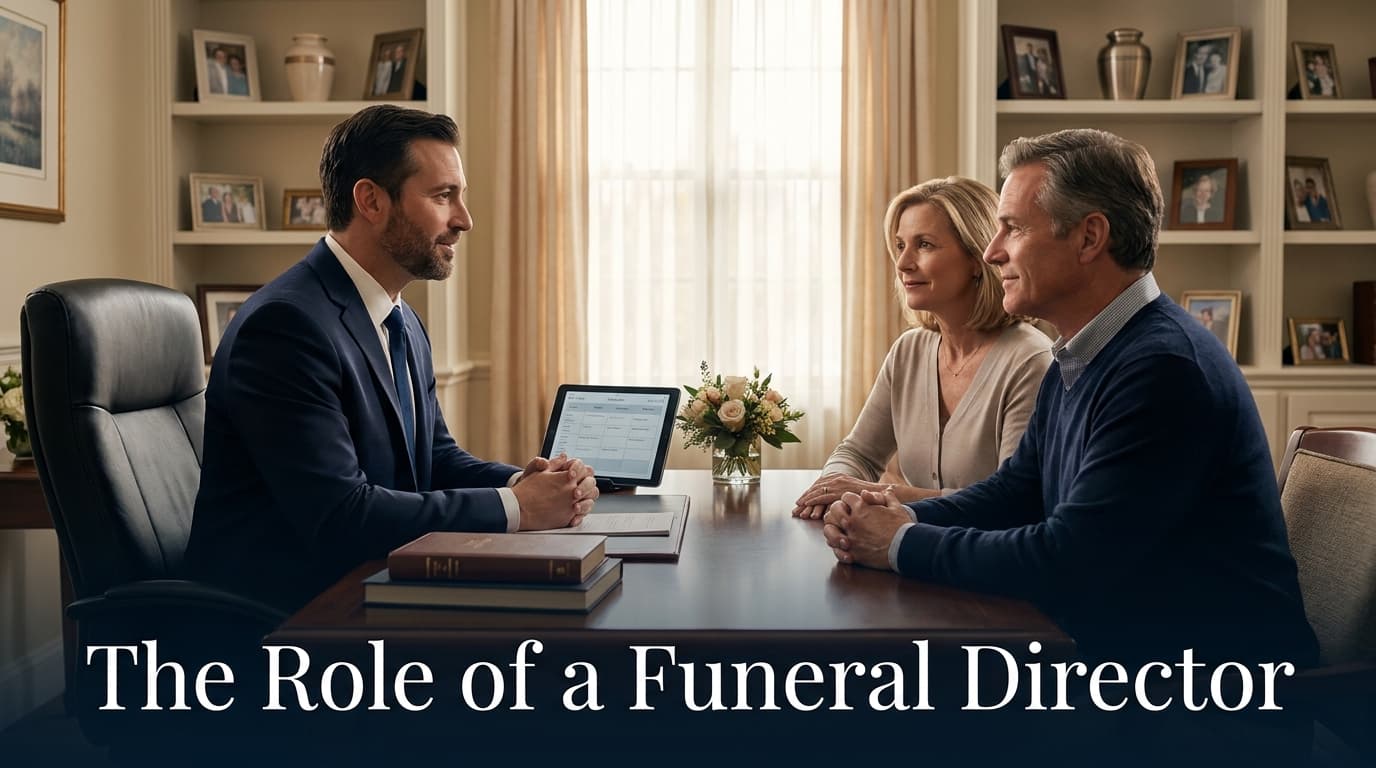
A funeral director is the professional who steps in when a family is least equipped to handle logistics — the days right after a death. Part coordinator, part caretaker, and part quiet counselor, a funeral director takes responsibility for the dozens of moving pieces a funeral involves, so the family can focus on grieving and on each other. They are the steady hand guiding you from the first phone call to the final goodbye, and often well beyond it.
In the United States there are roughly 11,000 funeral homes, and the National Funeral Directors Association represents about 20,000 members across them. Behind those numbers is a profession most of us only meet a handful of times in a lifetime — usually at our most vulnerable. Understanding what a funeral director does, what it costs, and how to choose one can turn an overwhelming experience into a manageable one.
funeral homes operate across the United States, staffed by roughly 20,000 NFDA member directors
If you’re reading this because you’ve recently lost someone, our guides on how to write an obituary and creating a funeral program pair naturally with this one — a funeral director can help with both, but it helps to know what to expect.
The core responsibilities of a funeral director
No two days look exactly alike, but a funeral director’s work clusters into a few essential roles.
1. Planning and coordinating the service
From the first consultation, the director helps the family decide on the shape of the farewell — a traditional funeral, a graveside service, a cremation with a memorial, or a more personal celebration of life. They coordinate the venue, scheduling, clergy or celebrant, music, and the order of service, weaving the family’s wishes into a coherent plan.
2. Caring for and preparing the deceased
Funeral directors oversee the respectful transport, sheltering, and preparation of the body — which may include embalming, dressing, casketing, and cosmetic restoration so the family can have a viewing if they wish. In many states this preparation is performed or supervised by a licensed embalmer, a role that often overlaps with the funeral director’s.
3. Handling legal and administrative paperwork
This is one of the most valuable — and least visible — parts of the job. Directors file the death certificate, secure burial or cremation permits, coordinate with the medical examiner when needed, and help families with paperwork for benefits, veterans’ honors, and insurance. Their fluency with local laws and regulations spares grieving families a maze of bureaucracy.
4. Guiding merchandise and personalization choices
Caskets, urns, vaults, flowers, register books, and memorial keepsakes — a director walks families through the options without pressure, helping them honor a life and a budget at the same time. Increasingly that personalization extends to digital touches like memorial slideshows, livestreamed services, and QR codes that link a physical marker to an online tribute.
5. Offering emotional support and aftercare
Perhaps the quietest responsibility is also the most human. A good funeral director offers compassion and a calm presence throughout, then continues to help afterward — returning cremated remains, completing final paperwork, and pointing families toward grief counseling and support resources. Many build relationships that last well beyond the service itself.
Modern funeral directors are also part technologist. They now routinely use planning software, manage digital records, livestream services for distant relatives, and help families set up online memorials. The job has always been about preserving memory — technology simply gives that memory a longer life. Explore the shift in our look at funeral technology trends for 2026.
Funeral director vs. mortician vs. embalmer
These titles are often used interchangeably, which causes plenty of confusion. Here’s how they actually relate.
| Title | Focus | Notes |
|---|---|---|
| Funeral director | Arranging and overseeing services; supporting families | The family-facing coordinator; licensed in every state |
| Mortician / undertaker | General, older umbrella term | Usually means the same as funeral director; “undertaker” is now dated |
| Embalmer | Preparing and preserving the body | A separate license; many professionals are dual-licensed |
In short: every embalmer prepares the body, every funeral director arranges the service, and “mortician” is the catch-all word for someone who often does both. In smaller funeral homes, one person frequently wears all of these hats.
How much does a funeral director earn — and what do services cost?
It’s natural to wonder about both sides of the ledger: what the profession pays, and what families pay for it.
On the career side, a funeral director in the U.S. earns roughly $51,600 per year on average, while a licensed funeral director averages closer to $61,000. The Bureau of Labor Statistics put the median wage near $49,800 in its May 2024 data, with the top earners exceeding $68,000. Pay rises with licensing, experience, ownership stake, and region.
On the family side, the director’s fee is one line item within the total cost of a funeral. As of 2026, the median cost of a funeral with viewing and burial is about $8,300, while a funeral with cremation and a service runs closer to $6,280. A direct cremation — the simplest, lowest-cost option — typically falls between $1,000 and $3,000. For a fuller breakdown, see our guides on coffin and casket costs and cremation costs.
of Americans chose cremation in 2025 — a rate the NFDA projects will reach 82.3% by 2045, reshaping what funeral directors do
That cremation shift matters because it changes the director’s role. As more families choose cremation over burial, directors increasingly focus on memorial services, personalization, and helping families decide what to do with cremated remains — rather than coordinating traditional graveside burials.

What a funeral director does, what the role pays, and what families can expect to spend in 2026.
How to become a funeral director
For those drawn to the profession, the path is more rigorous than many realize. While requirements vary significantly from state to state, the general route looks like this:
- Earn an associate’s degree in mortuary science. Accredited programs cover ethics, grief counseling, funeral service, business law, embalming, and restorative techniques. A two-year degree is the typical minimum.
- Complete an apprenticeship. The American Board of Funeral Service Education requires a supervised apprenticeship of one to three years, which can come before, during, or after schooling depending on the state.
- Pass the licensing exam. Most candidates take the National Board Examination administered through the International Conference of Funeral Service Examining Boards, then meet any state-specific requirements.
- Meet general requirements. Most employers require applicants to be at least 21 years old, with supervised training and a passing exam score.
- Keep your license current. Most states require ongoing continuing-education credits to stay licensed.
One important caveat: there are no uniform national licensing laws for funeral service. Each state sets its own rules — the length of apprenticeship, the amount of college, and the order in which requirements must be met all vary. Always check your specific state board before mapping out a career path.
How to choose the right funeral director: a simple roadmap
Choosing a funeral home is one of the few major purchases people make while grieving and under time pressure. A little structure protects both your finances and your peace of mind.
- Ask for the General Price List (GPL). Under the FTC Funeral Rule, every funeral home must give you an itemized price list when you ask in person — and quote prices over the phone. This is your foundation for comparing options.
- Compare at least two or three homes. Prices for identical services can vary widely. A few phone calls can save thousands.
- Confirm they offer what you want. Burial, cremation, green burial, a wake or visitation, or a personalized celebration of life — make sure your director supports your chosen path.
- Ask about hidden fees. Watch for markups on cash-advance items like death certificates and flowers, and charges for evening or weekend services. Remember: you have the legal right to buy a casket from any third-party retailer, and the home cannot charge a handling fee.
- Trust the relationship. You’ll work closely with this person during an emotional time. Warmth, patience, and clear communication matter as much as price.
- Plan for lasting remembrance. Ask whether the home supports digital memorials, livestreaming, or QR-linked markers so loved ones near and far can take part — and keep taking part long after the service ends.
Where the funeral director’s work meets lasting memory
A funeral director’s job is, at its heart, about memory — helping a family mark a life with dignity and care. But a service lasts a day; the love behind it lasts a lifetime. That’s the gap modern remembrance technology is built to close, and forward-thinking directors are embracing it.
That’s what Linkora was built for. A QR code memorial connects a physical marker — a headstone, bench, or plaque — to a full digital memorial page that anyone can visit with a simple scan, no app required. Families preserve photos, videos, stories, and tributes in one private place, with complete control over who sees them. It’s free to claim, easy enough for every generation to use, and gives a loved one’s story somewhere to live for the long run.
Or view a demo memorial first to see how photos, stories, and tributes come together on one private page.
Frequently Asked Questions
What does a funeral director do?
A funeral director plans and coordinates funeral and memorial services, oversees the respectful care and preparation of the deceased, handles legal paperwork such as the death certificate and burial or cremation permits, guides families through merchandise and personalization choices, and provides emotional support before, during, and after the service. They act as the family’s single point of contact through the entire process.
What is the difference between a funeral director and a mortician?
The terms are largely interchangeable. “Mortician” (and the older “undertaker”) is a general umbrella term for the professional who handles funeral arrangements and body preparation, while “funeral director” specifically describes the licensed person who arranges services and supports families. An embalmer, by contrast, holds a separate license focused on preparing and preserving the body. In many funeral homes, one dual-licensed person performs all of these roles.
How much does a funeral director cost?
The funeral director’s professional services fee is one part of the total funeral cost. As of 2026, the median funeral with viewing and burial costs about $8,300, and a funeral with cremation and a service about $6,280; direct cremation runs roughly $1,000 to $3,000. By law, the funeral home must give you an itemized General Price List so you can see exactly what the director’s services and each add-on cost.
How do you become a funeral director?
You typically need an associate’s degree in mortuary science, a supervised apprenticeship lasting one to three years, and a passing score on a state licensing exam (most often the National Board Examination). Most candidates must be at least 21 years old, and most states require ongoing continuing education to keep the license current. Because there are no uniform national rules, the exact requirements vary from state to state.
What questions should I ask a funeral director?
Start by asking for the General Price List and a clear breakdown of all costs, including any cash-advance or weekend fees. Confirm they offer the type of service you want (burial, cremation, or celebration of life), ask whether you can supply your own casket or urn, and find out what aftercare and memorialization options — including digital memorials and livestreaming — they support. Comparing two or three homes on these points helps you make a confident, informed choice.
A gentle closing
A funeral director carries a quiet, demanding responsibility: helping families say goodbye with dignity, and lifting a thousand logistical burdens at the worst possible moment. Knowing what they do — and how to choose one well — lets you lean on that expertise with confidence rather than confusion.
And when the service is over, the remembering goes on. A digital memorial from Linkora gives a loved one’s story a permanent home — for you, for your family, and for the generations who’ll want to know them too.
Are you a funeral professional? See how a digital memorial partner program can add value for the families you serve.