
TL;DR — Headstone Inscriptions in 2026
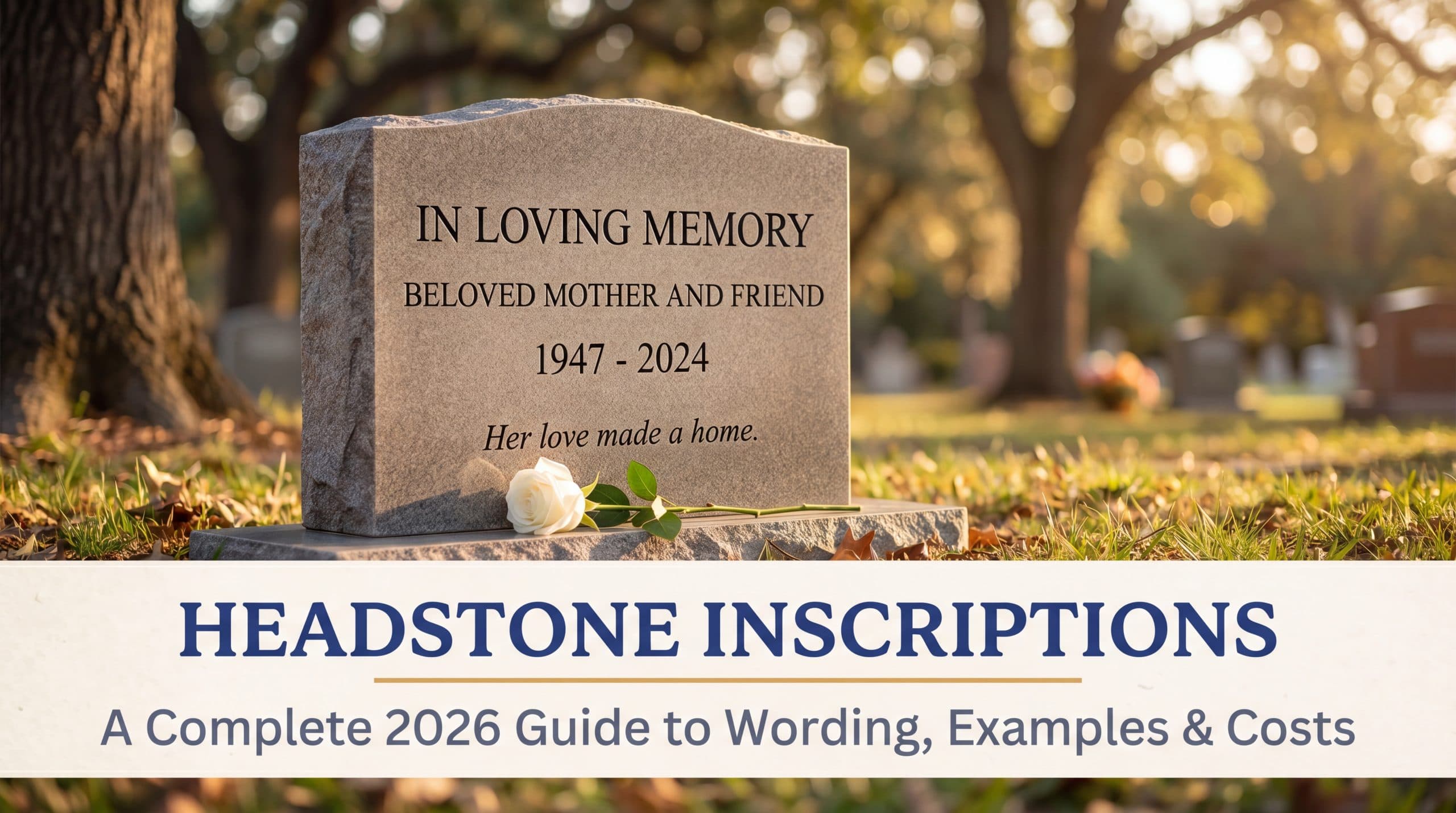
- A headstone inscription is the engraved text on a grave marker. Most include name, dates, relationship, and an epitaph of 1 to 4 lines.
- Engraving costs $8 to $35 per character at most monument dealers. A 50-character epitaph adds $400 to $1,500 to a basic stone.
- Cemeteries cap inscriptions for legibility. Aim for under 150 to 200 total characters, no more than 4 to 6 lines, and always get written cemetery approval before engraving.
- The best inscriptions are short, true to the person, and timeless. Wait 3 to 6 months before finalizing wording so the choice comes from clarity, not grief.
- Modern families are pairing a short stone inscription with a QR code on the headstone that opens a full digital memorial — letting the marble carry a name while the memory keeps growing.
Why the Right Headstone Inscription Matters
A headstone inscription is one of the very few things about a person that will still be readable in a hundred years. Furniture gets donated, houses change hands, photos fade. The words carved into stone are meant to outlast all of that, which is exactly why families agonize over them.
The pressure is real, but it is also workable. Almost every headstone inscription, from a Civil War tablet to a 2026 granite upright, follows the same quiet pattern: a name, a span of years, and a sentence or two that says this is who they were to us. Once you understand the anatomy and the rules, the writing itself becomes much easier. This guide walks through the structure, costs, cemetery regulations, more than 75 wording examples by category, and a six-step process families use to land on words they will not regret.
And because remembrance no longer stops at the stone, we also cover how families are pairing classic inscriptions with QR code memorials, so the marker carries the timeless words while a digital memorial carries the full story.
The 3-to-6-month rule. Monument dealers across the U.S. consistently advise families to wait at least 3 to 6 months before finalizing inscription wording. The first weeks of grief are not the right time to make a 100-year decision. Most cemeteries allow a temporary marker in the meantime — there is no reason to rush.
The Anatomy of a Headstone Inscription
Almost every modern inscription is built from the same five elements. You do not have to use all of them, but knowing what each one does makes it easier to decide what to keep and what to leave off.
1. The Name
The full legal name is the most common choice and the one most cemeteries require for their records. Some families add a nickname in quotes — Robert “Bobby” J. Carter — when the nickname is how the person was actually known. Initials work for middle names when space is tight.
2. The Dates
Birth and death dates appear as either full years (1947 — 2024) or the full date in numerals (March 14, 1947 — November 2, 2024). The dash between them is sometimes called the “dash that holds a life,” which is why some families build the epitaph around what was lived in that small mark.
3. The Relationship Line
One short line that names the role the person held in the family. Beloved Husband, Father, and Grandfather. Devoted Mother and Friend. This is usually the most-read line on a stone because visitors scan it instinctively to confirm they are at the right grave.
4. The Epitaph
The epitaph is the heart of the inscription — a short phrase, verse, or saying that captures something true. It can be religious, literary, personal, or even gently humorous. Most epitaphs are between 3 and 15 words. We have collected more than 75 examples by category further down.
5. Religious or Personal Symbols
Crosses, Stars of David, military insignia, masonic emblems, doves, roses, and increasingly QR codes are all options. Symbols are usually engraved separately from the text but should be planned together so the overall composition feels balanced.
How Much Does a Headstone Inscription Cost?
Inscription pricing is one of the biggest surprises families run into. Many monument dealers quote a base price for the stone (often $1,500 to $5,000 for an upright) and then add a separate per-character fee for everything that gets engraved.
Typical per-character engraving cost in 2026
Across multiple industry sources, the going rate is roughly $8 to $35 per character, with most dealers landing at $15 to $20. Engravers count every letter, number, space, and punctuation mark, so “Beloved mother” is 15 characters, not 14. A few practical examples of what that translates to:
Adding an inscription to an existing headstone is often more expensive than the first inscription because the engraver typically has to work in the cemetery rather than the workshop. Plan on $500 to $2,500 for an in-place addition, plus any cemetery access fees. If the stone has to be removed and re-set, costs can climb past $3,000.
Online retailers like SilkStone Memorials and a handful of others now include unlimited custom engraving in the base price of the stone, which can save a few thousand dollars on a long inscription. The trade-off is you usually do not get to see the finished engraving in person before it ships.
For a full picture of the broader purchase — types, materials, granite vs. bronze, and ongoing care — pair this guide with our headstone ideas and designs guide and our breakdown of total burial costs.
Cemetery Rules and Character Limits
Almost every cemetery has written rules about what can and cannot appear on a stone. These rules exist for legibility, maintenance, and (in religious cemeteries) doctrinal reasons. They vary widely, but the patterns are predictable.
Common Inscription Rules to Expect
- Character or line caps. Many cemeteries limit inscriptions to 150 to 200 total characters or 4 to 6 lines of text. National cemeteries (managed by the VA) have their own strict templates.
- Approved fonts and lettering. Religious and historic cemeteries may restrict you to a short list of approved serif fonts and ban scripts or all-caps headings.
- Name and date matching. The name and dates on the stone must match cemetery records exactly. Discrepancies are the single most common reason a stone gets rejected on delivery.
- Symbol restrictions. Some religious cemeteries prohibit symbols from other faiths or any symbol not on a pre-approved list. Some municipal cemeteries block commercial logos, profanity, or politically charged messages.
- Written approval required. Almost every cemetery requires written sign-off on the final layout before engraving begins. Changes after installation can cost $500 to $2,000 to correct.
Before you sign anything: ask the cemetery for the inscription guidelines in writing, submit a clear drawing of the proposed layout, and only approve production once the cemetery has approved the drawing in writing too. This single habit prevents the vast majority of post-installation regret stories monument dealers hear.
75+ Headstone Inscription Examples by Category
The list below is grouped by relationship and tone. None of these need to be used word-for-word — they are starting points to react to, which is often easier than staring at a blank page.
Short, Universal Inscriptions (under 30 characters)
- Forever in our hearts
- Gone but never forgotten
- Rest in peace
- Always loved, never forgotten
- Loved beyond measure
- A life well lived
- Home at last
- Until we meet again
- Forever loved, forever missed
- In loving memory
For a Mother
- Her love made a home
- She cared for us in a thousand ways
- Kindness was her legacy
- A mother’s love never ends
- Loved by all who knew her
- Gentle in life, gentle in rest
- Her hands taught us love
- A life of quiet strength
- Mother. Friend. Light.
- She loved us into who we are
For a Father
- A father’s love is a quiet thing
- Steady, strong, and ours
- He showed us how to live
- Loving husband, devoted father
- His word was his bond
- A man of faith and family
- Forever our hero
- He made every room warmer
- Beloved Dad. Best friend.
- A good man, well loved
For a Spouse or Partner
- Together always
- My beloved, my friend
- Two hearts, one love
- Forever yours
- Love never dies
- Half of my heart
- Until we meet again, my love
- The love of my life
For a Child or Young Person
- Too beautiful for earth
- Held for a moment, loved forever
- An angel here too briefly
- Small life, infinite love
- Forever our little one
- Loved before, loved still
- Safe in God’s hands
Religious and Scriptural Inscriptions
- “The Lord is my shepherd” — Psalm 23:1
- “I have fought the good fight, I have finished the race” — 2 Timothy 4:7
- “Blessed are the dead who die in the Lord” — Revelation 14:13
- “I am the resurrection and the life” — John 11:25
- Safely home with the Lord
- Asleep in Jesus
- In God’s eternal care
- Beloved child of God
- “Well done, good and faithful servant” — Matthew 25:23
- May perpetual light shine upon them
For deeper scriptural options to read before deciding, our roundup of Bible verses for the death of a loved one lists 60+ verses with context on tone and tradition.
Personal, Lighter, or Signature Phrases
- She loved a good story
- The garden was her church
- He never met a stranger
- “That’s all, folks.” (Mel Blanc’s actual epitaph)
- “The best is yet to come.” (Frank Sinatra)
- “I had a lover’s quarrel with the world.” (Robert Frost)
- Lived loud, loved louder
- Always the first to laugh
- A life of music and friends
- He left the world kinder than he found it
For Veterans and Military Service
- Served with honor
- Soldier. Father. Friend.
- Duty, honor, country
- “Semper Fidelis”
- A grateful nation remembers
- Forever on watch
- He answered the call
Couple or Shared Headstones
- Together in life, together in rest
- Two lives, one love
- Joined forever
- Beloved husband and wife
- Their love story continues
- Hand in hand, always

The five elements of a modern headstone inscription, with cost ranges and character counts.
How to Choose the Right Words: A 6-Step Process
Most regret around inscriptions comes from rushing or from trying to say too much. The process below is what monument dealers walk experienced families through, condensed into six steps you can work through over a few weeks.
Step 1 — Wait at least 3 months
The first weeks after a death are not the time to compose words meant to last for generations. Set the decision aside until the rawest grief settles. Most cemeteries are fine with a temporary marker for 6 to 12 months.
Step 2 — List the person’s actual qualities
Before you look at any examples, write down 10 to 15 short phrases that capture who they really were: “made everyone feel welcome,” “fixed everything in the house,” “first to volunteer,” “could make my mom laugh.” This list will quietly do most of the work for you.
Step 3 — Choose a tone
Pick one: reverent, warm, personal, humorous, or scriptural. Mixing tones almost always reads worse on a stone than on the page. If you cannot decide, default to warm and simple — it ages the best.
Step 4 — Draft three short options
Write three candidate epitaphs, each under 15 words. Read them aloud. Imagine a stranger reading them in 50 years. Cross off anything that sounds like a Hallmark card or a LinkedIn bio.
Step 5 — Test with one or two family members
Not the whole family — that turns into design-by-committee. Two people who knew the deceased well is the right number. If both pause at the same phrase, fix that phrase.
Step 6 — Get the cemetery’s written approval
Submit the final layout to the cemetery in writing. Get their approval in writing. Only then send to the monument dealer for engraving. This one habit prevents the vast majority of expensive corrections.
Multi-generational tip: Read your draft to someone outside the immediate family — an in-law, a longtime neighbor, a cousin who lives far away. They are the closest stand-in for the strangers who will read the stone decades from now. If your line still feels true to them, it will hold up.
The Modern Trend: Inscriptions Plus a QR Code Memorial
Headstones have always had to compress a whole life into a few square inches of stone. The constraint is partly what makes inscriptions beautiful, but it is also what makes them hard. In 2026, more families are solving that tension by leaving a short, timeless inscription on the stone and adding a small QR code that opens a full digital memorial page.
According to recent industry coverage, QR-enabled headstones are spreading from boutique monument dealers into mainstream cemeteries. Early in 2026, American Legion Post 108 launched a QR-code historian project at Lutz Cemetery in Florida, attaching codes to veterans’ headstones that link to biographies written by local Cub Scouts. Across the country, families are doing the smaller-scale version of the same thing — using the stone for the name, the dates, and one line that captures the person, then letting a QR memorial plaque carry photos, video, voice recordings, and the longer story.
It is a quietly elegant pairing. The stone keeps doing what stone has always done — sit there, weather, hold a name. The QR code on the headstone opens a page that can grow over time: grandchildren add photos, cousins record a memory, and on anniversaries the family adds new tributes. Nothing competes with the inscription, but nothing is lost either.
Families exploring this hybrid model usually start with one of three approaches:
- Engrave the QR code directly into the stone, so it cannot be removed and looks intentional from day one. Best for new headstones.
- Attach a discreet QR plaque to an existing headstone with marine-grade adhesive or screws. Best for adding digital tributes to an older grave.
- Add the QR code to a memorial bench or marker nearby in shared family plots. This avoids touching the original stone and works well in historic cemeteries that restrict alterations.
For a deeper look at what to put on the digital side once the stone is set, see our guide on what to include on a memorial web page and our roundup of the best digital memorial platforms compared. And if you want to see what a real Linkora memorial looks like end-to-end, you can explore a live demo memorial here.
Mistakes to Avoid When Choosing an Inscription
- Trying to include everything. A headstone is not a biography. If you cannot bear to leave something out, that is what the digital memorial is for.
- Using a phrase that was trendy this year. Imagine the inscription read in 2076. Internet slang and current-decade phrasing rarely survive.
- Choosing under acute grief. Wait the 3 to 6 months. Stones can be re-cut, but at significant cost and emotional toll.
- Ignoring the cemetery’s written rules. Approve the layout with the cemetery in writing before engraving. This is the single most common preventable mistake.
- Skipping a proof. Reputable monument dealers always provide a digital proof of the layout. Read every character, every punctuation mark, every date. Spelling errors on stone are heartbreaking and expensive.
- Forgetting the people not yet born. A great-grandchild may one day stand at this stone. The inscription should still feel welcoming and human to them.
One more thing about writing: if drafting words for the stone feels overwhelming, sometimes it helps to write the longer version first. Putting together a full tribute, an obituary, or a draft eulogy first will often surface the exact phrase that belongs on the stone. The inscription is usually hidden in the longer piece, waiting to be found.
A Note on Famous Epitaphs
Studying epitaphs that have lasted is one of the most useful exercises a family can do before choosing wording. Some classics:
- William Shakespeare — “Good friend, for Jesus’ sake forbear, to dig the dust enclosed here.” Carved at Holy Trinity Church, Stratford-upon-Avon, and famously credited with keeping his bones in place for 400 years.
- Robert Frost — “I had a lover’s quarrel with the world.” Selected by Frost from one of his own poems.
- W.B. Yeats — “Cast a cold eye on life, on death. Horseman, pass by.” Written by Yeats in his last poem and carved exactly as published.
- Mel Blanc — “That’s all folks.” The voice of Bugs Bunny, signing off.
- Frank Sinatra — “The best is yet to come.”
- Dorothy Parker — “Excuse my dust.” Wit, even at the end.
What unites these is not cleverness — it is fit. Each one sounds exactly like the person it belongs to. That is the only standard worth chasing.
Frequently Asked Questions
How long should a headstone inscription be?
Most cemeteries cap inscriptions at 150 to 200 total characters or 4 to 6 lines. From a readability standpoint, the strongest inscriptions are short: a name, dates, a relationship line, and an epitaph of 3 to 15 words. Anything longer often reads better as part of a digital memorial than carved in stone.
How much does it cost to add an inscription later?
Adding text to an existing headstone is usually more expensive than the original inscription because the engraver works on-site. Typical costs run $500 to $2,500, with most families spending around $1,000 to $1,500 for a few lines added to a finished stone. If the stone must be removed, costs rise above $3,000.
Can a headstone inscription be changed after it is engraved?
Carved text is essentially permanent. Errors can sometimes be polished out and re-engraved, but the surface usually shows the repair, especially on polished granite. Correcting a single word can cost $300 to $1,500. This is why cemeteries insist on written approval of the layout before engraving begins.
Should I include a Bible verse or a personal quote?
Both are excellent options when chosen for the person, not for the family. If faith was a central part of their life, scripture honors that directly — Psalm 23, John 11:25, and Revelation 14:13 are timeless choices. If the person had a signature phrase that family and friends instantly recognize, that personal line will often feel truer than any scripture. The test is whether the words sound like them out loud.
Can I add a QR code to the inscription?
Yes, and a growing number of families are doing exactly this in 2026. A QR code can be engraved directly into the stone or attached as a small weather-resistant plaque, and it opens a full digital memorial page when scanned with any modern smartphone — no app required. The stone keeps its short, classic inscription while the digital memorial carries the photos, videos, life story, and tributes that no headstone could fit. See our QR memorial plaque guide for materials and placement options.
Bringing the Inscription and the Story Together
A headstone inscription is meant to do one job extremely well: hold a name and a single true line that lasts. It is not meant to carry the whole life. That is where families have always had to choose — until recently, the constraints of stone forced the story to live somewhere else: in scrapbooks, in spoken memory, in funeral programs that get lost.
Linkora exists to give that fuller story a permanent home. Families pick a short, beautiful inscription for the stone, and pair it with a QR code that opens a private, family-controlled memorial page — photos, videos, written memories, even a funeral program, all preserved together. Privacy stays with the family. The stone stays timeless. And the memory stays alive in a way carved letters alone never could.