
TL;DR – Memorial Cards for a Funeral, at a Glance
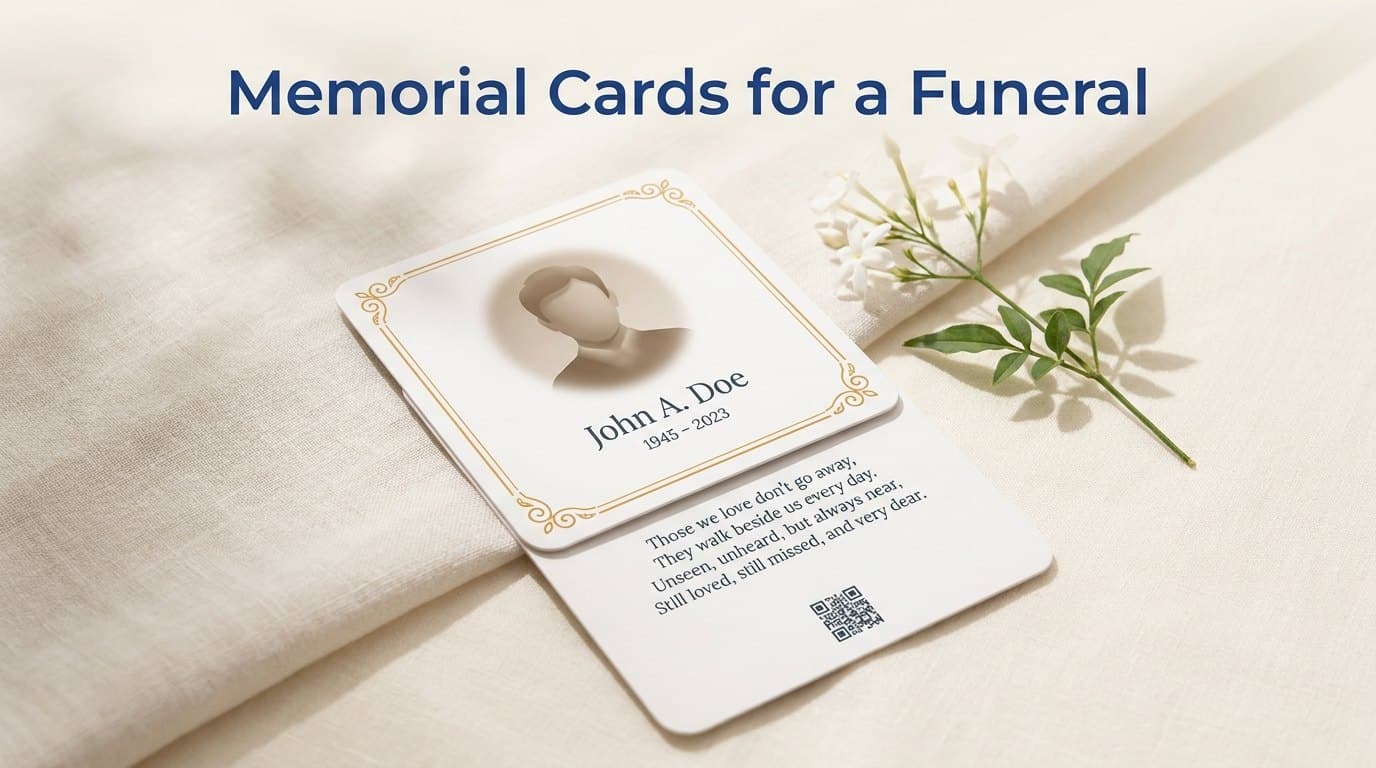
- Memorial cards for a funeral are small printed keepsakes handed to guests at a service, usually holding a photo, the person’s name, their birth and death dates, and a short verse, prayer, or quote.
- Most cards are wallet-sized, around 2.25 by 4.25 inches, so the wording has to be brief. One well-chosen line almost always reads better than a paragraph.
- Order roughly 10 to 20 percent more cards than your expected guest count, so you have extras to mail to people who could not attend and to keep as family keepsakes.
- You can make them yourself in Word or Canva, or have a funeral home or printer produce them on heavier cardstock with a matte finish for a more lasting feel.
- A growing number of families now add a QR code to the card, turning a single keepsake into a doorway to a full digital memorial of photos, videos, and stories that can grow for years.
What Are Memorial Cards for a Funeral?
Memorial cards for a funeral are the small printed cards a family hands to guests at a service to remember the person who has died. If you have ever left a funeral holding a little card with someone’s photo on the front and a prayer or poem on the back, you have held a memorial card. They are one of the oldest and gentlest funeral traditions still in wide use, small enough to slip into a wallet or a Bible and keep for decades, and quietly powerful because they give every guest something to carry the memory home in.
People search for memorial cards for a funeral at one of the hardest moments in life, usually while planning a service and trying to get every detail right on a short timeline. The good news is that this is one of the simpler decisions you will make. A memorial card only needs a few things to do its job well, and once you understand what belongs on it and what to leave off, the choice becomes far less daunting. This guide walks through the types of cards, exactly what to include, how many to order, wording that lands, and how modern families are extending a small paper card into a lasting online tribute.
Memorial Cards, Prayer Cards, and Keepsakes: What’s the Difference?
The words around funeral cards get used loosely, and that is a common source of confusion when you are ordering them. In practice, a memorial card is the broad category: any small card given out to remember the person, religious or not. A prayer card is a specific kind of memorial card that carries a prayer, a scripture reference, or religious artwork, often an image of a saint on the front. If your family is faith-based, you are most likely looking for a prayer card. If you want something more open, a memorial card with a favorite quote or a line of poetry does the same work without the religious framing.
You may also hear the word keepsake, which simply means the card is designed to be kept rather than glanced at and thrown away. That distinction matters more than it sounds. A card printed on flimsy paper feels disposable; a card on good stock with a photo the person loved feels like a small heirloom. Memorial cards sit alongside the other printed pieces at a service, and it helps to picture them as one part of a set. The funeral program carries the order of service, the guest book gathers names, and the memorial card is the piece each guest takes with them.
Quick clarity: A memorial card is the umbrella term, a prayer card is a religious memorial card, and a keepsake is any card built to be kept. Do not get stuck on the labels. Decide first whether you want religious wording, then choose the card that fits.
What to Include on a Memorial Card
A memorial card has two sides and very little room, so every element has to earn its place. The front almost always carries a photograph of the person, chosen to read clearly at a small size, along with their full name and the birth and death dates. Many families add a nickname if that is how everyone knew them, since a card that says “Bob” can feel far warmer than one that insists on “Robert.” Some cards also add a single line here, such as “In Loving Memory” or “Celebration of Life,” to set the tone.
The back is where the personal message lives. This is usually a short verse, a prayer, a few lines of poetry, or a favorite quote that captures who the person was. If your family leans religious, a scripture passage is a natural fit, and our guide to Bible verses for the death of a loved one collects passages that families reach for most. If you would rather keep it secular, a line from a poem or a saying the person used often works beautifully; you can find gentle options in our collection of poems about grief and comforting grief quotes. Some families also include a brief note of thanks to guests, though many save that for the program.
One decision trips people up more than any other: how much to write. The instinct is to summarize the whole life, but a memorial card is not a biography. The most moving cards say one true thing well. Choose a single verse or line that sounds like the person, and let it stand. If you find yourself wanting to say more, that is a sign the fuller story belongs somewhere with more room, which is exactly where a linked online memorial comes in later in this guide.
The simplest formula is also the most enduring. Say a little, and say it in words that sound like them.
Standard Sizes for Memorial Cards
Size shapes almost everything about memorial cards for a funeral, from how much you can write to how much they cost. The most common size by far is the wallet card, roughly 2.25 by 4.25 inches or 2.5 by 4.25 inches. It is the classic prayer-card shape, easy to slip into a wallet or a purse, and the most affordable to print in quantity. If you want a little more room for a photo or a longer verse, families often step up to a folded note-card size of about 4.25 by 5.5 inches, sometimes called A2, or a flat postcard size of 4 by 6 inches.
There is a simple trade-off at work. Smaller cards are cheaper and easier for guests to keep on them, while larger cards give you space for a fuller design but cost more per card and are more likely to be set down and forgotten. For most services, the wallet size is the safe and traditional choice. Larger formats make sense when the photograph is the heart of the card or when you want it to double as a display piece. Whatever size you choose, keep the text large enough for older guests to read comfortably, since a card no one can read is a card no one keeps.
| Card size | Dimensions | Best for |
|---|---|---|
| Wallet / prayer card | 2.25" x 4.25" | The traditional, budget-friendly choice guests can carry |
| Folded note card (A2) | 4.25" x 5.5" | More room for a photo and a longer verse or prayer |
| Postcard | 4" x 6" | A photo-forward keepsake that can also be displayed |
How Many Memorial Cards Should You Order?
The most common regret families report when ordering memorial cards for a funeral is not ordering enough. It is a small item at a busy time, and it is easy to guess low. A reliable rule is to order 10 to 20 percent more than the number of guests you expect. If you are planning for a hundred people, order about a hundred and twenty cards. The extras are never wasted. You can mail them to friends and relatives who could not travel, tuck one into thank-you notes, and set several aside for the family to keep, since these cards have a way of becoming treasured years later.
Ordering a few too many also protects you against the reality that funeral guest counts are hard to predict. Word spreads, coworkers and neighbors appear, and services often draw more people than the family first imagined. Printing a second small batch later usually costs more per card than including them the first time, so it pays to round up. If you are still working out the scale of the service itself, our funeral planning checklist can help you estimate attendance and keep the printed pieces in step with the rest of the plan.

Memorial cards for a funeral at a glance: what to include, what size to choose, how many to order, and how to make one last.
Wording Ideas for Memorial Cards
Choosing the words is the part families think about most, and it is worth slowing down for. The wording on a memorial card should sound like the person, not like a greeting-card default. Start by asking what they believed, what they loved, and how they spoke. A woman who never went to church without her rosary calls for a very different card than a man who quoted Johnny Cash lyrics. The best line is the one that makes the people who knew them nod and say, yes, that was them.
For religious families, short scripture works well, such as “The Lord is my shepherd; I shall not want” or “Well done, good and faithful servant.” Traditional prayers like the Prayer of Saint Francis or a simple “Eternal rest grant unto them” are common on Catholic prayer cards. For a secular card, a single line of poetry, a favorite saying, or a phrase the person used often can carry more warmth than any formal verse. Lines such as “Those we love don’t go away, they walk beside us every day” appear on countless cards because they are gentle and true. If you are also writing a spoken tribute for the service, the process overlaps, and our collection of heartfelt eulogy examples can spark language that works on the card too.
A few small choices lift the wording. Read it aloud before you print it, because words that look fine on a screen sometimes sound stiff in the room. Keep it short enough that the eye takes it in at a glance. And resist the urge to explain; a memorial card suggests a life rather than documenting it. The card is the opening line of the story, and it does its best work when it leaves the reader wanting to know more.
Should You Make Memorial Cards Yourself or Order Them?
You have three realistic paths, and each suits a different family. The do-it-yourself route uses free tools like Microsoft Word, Google Docs, or Canva, which all offer funeral card templates you can drop a photo and text into and print at home or a local shop. This is the cheapest option and gives you complete control, which appeals to families who find comfort in doing this last task by hand. The trade-off is time and finish quality, since home printers rarely match professional stock and trimming.
The second path is to have your funeral home handle the cards as part of the service package. This is the easiest option when you are overwhelmed, because the director coordinates the design and printing alongside everything else. The third path sits in between: order from an online memorial printer, which gives you polished templates, heavier cardstock, and sharp photo reproduction without designing from scratch. If you go this route, choose a heavier stock with a matte or soft-touch finish. Matte reads calmly under the mixed lighting of a funeral home and does not show fingerprints, while gloss can look sharp but catches glare and smudges. Whichever path you take, order a single proof or print one test card first, so you catch a wrong date or a low-resolution photo before the full run.
A gentle tip on photos: The single biggest quality issue with memorial cards is a blurry image. Use the highest-resolution photo you have, and if the only good picture is a group shot, a printer can often crop and clean it. A clear, well-loved photo does more for a card than any font or border.
Modern Memorial Cards: Adding a QR Code to a Keepsake
The hardest limit of a memorial card is also its charm: there is only room for a little. A photo and a line of verse can hint at a person, but they cannot hold a life. This is where a growing number of families are quietly changing the tradition. By printing a small QR code on the back of the card, they turn a single keepsake into a doorway. A guest scans it with a phone camera and lands on a full online memorial, where the few words on the card open into hundreds of photos, home videos, recordings of the person’s voice, and stories written by everyone who loved them.
The appeal is simple. A memorial card with a QR code becomes something people keep rather than discard, because it stays useful long after the service. Relatives who could not attend can scan the card mailed to them and feel included. Grandchildren can revisit the page for years. And unlike the printed card, the memorial behind the code is never finished; family members can keep adding photos and memories over time, so the tribute grows instead of fading. If you have seen how QR codes on headstones work, this is the same idea in your pocket rather than in the cemetery. It is worth understanding what to put on a memorial web page so the page behind the code is as thoughtful as the card in front of it.
Setting this up is more approachable than it sounds. With Linkora, you create the online memorial first, filling it with photos, videos, and tributes, and the platform generates a QR code you can place on the card, the program, or later on the monument itself. There is no app for guests to download; they simply point a camera and the page opens. Our walkthrough on how to create a digital memorial page covers the steps, and the broader guide to QR code memorials explains how the printed and digital pieces work together as one lasting tribute.
Putting It Together: A Simple Plan for Memorial Cards
If you are working on a short timeline, here is a straightforward way to handle memorial cards for a funeral, step by step. First, pick the best high-resolution photo you can find, since everything else builds around it. Second, decide on religious or secular wording, then choose one verse, prayer, or quote that sounds like the person rather than a paragraph that summarizes them. Third, choose a size, defaulting to the wallet format unless the photo deserves more room. Fourth, settle on how to produce the cards, whether that is a template you fill in yourself, your funeral home, or an online printer on matte stock.
Fifth, count your expected guests and add 10 to 20 percent, then place the order early enough to proof it. And finally, if you want the card to last beyond the service, create the online memorial and add its QR code to the design before you print, so the finished keepsake carries both the words on the front and the whole story a scan away. Handled in that order, memorial cards become one of the calmer parts of planning a service, and often one of the most quietly meaningful. For more ways to keep a memory present long after the day itself, our list of meaningful ways to remember someone who passed away offers gentle ideas the whole family can share, and the celebration of life guide can help shape the service the cards belong to.
Frequently Asked Questions About Memorial Cards for a Funeral
What is the difference between a memorial card and a prayer card?
A memorial card is the broad term for any small card given out at a funeral to remember the person, whether religious or not. A prayer card is a specific kind of memorial card that includes a prayer, a scripture reference, or religious artwork such as an image of a saint. If your family is faith-based, you likely want a prayer card; if you prefer secular wording, a memorial card with a quote or poem does the same job.
How many memorial cards should I order for a funeral?
Order about 10 to 20 percent more than your expected guest count. If you anticipate a hundred guests, order roughly a hundred and twenty cards. Extras let you mail cards to people who could not attend, include them with thank-you notes, and keep several as family keepsakes. Reprinting a small second batch later usually costs more per card, so it is better to round up the first time.
What size are funeral memorial cards?
The most common size is the wallet card, about 2.25 by 4.25 inches or 2.5 by 4.25 inches, which is easy for guests to carry and affordable to print. Families who want more room for a photo or a longer verse often choose a folded note card around 4.25 by 5.5 inches or a 4 by 6 inch postcard. For most services, the wallet size is the traditional and practical choice.
What should I write on a memorial card?
Keep it short and personal. The front usually carries the photo, full name, and birth and death dates, while the back holds one verse, prayer, poem line, or quote that captures who the person was. Choose religious wording if that reflects their faith, or a favorite saying or line of poetry for a secular card. One true line almost always reads better than a longer summary.
Can you put a QR code on a funeral memorial card?
Yes, and more families are doing it. A small QR code printed on the card links to a full online memorial with photos, videos, recordings, and written stories. Guests scan it with a phone camera, no app required, and the page can keep growing as relatives add memories over time. With Linkora, you build the memorial first and the platform generates a QR code you can place on the card before printing.