
TL;DR
- You have time, and you don’t have to choose just one. Most families combine 2–3 options — for example, scatter a portion at a favorite place, place the rest in an urn at home, and reserve a small amount for keepsake jewelry.
- Seven main paths: keep at home in an urn, scatter (land, sea, or air), inter in a columbarium niche, divide among family in keepsake urns, transform into jewelry or art, choose a green option (reef, tree, soil), or bury alongside a traditional headstone.
- US scattering laws: no federal ban on land scattering, but the EPA requires ocean scattering at least 3 nautical miles from shore and any container must be biodegradable. State and park rules vary widely — always check first.
- Cost range is huge: from $0 (scattering on your own land) to $1,599–$50,000+ for a certified memorial diamond. Most families spend $100–$1,500 across urn, jewelry, and ceremony combined.
- A digital memorial holds the story. Whatever you decide for the physical ashes, a digital memorial page linked from a QR code on the urn, plaque, or scatter-site marker keeps photos, voice clips, and tributes accessible to every family member for generations.
A Decision That Doesn’t Have to Be Rushed
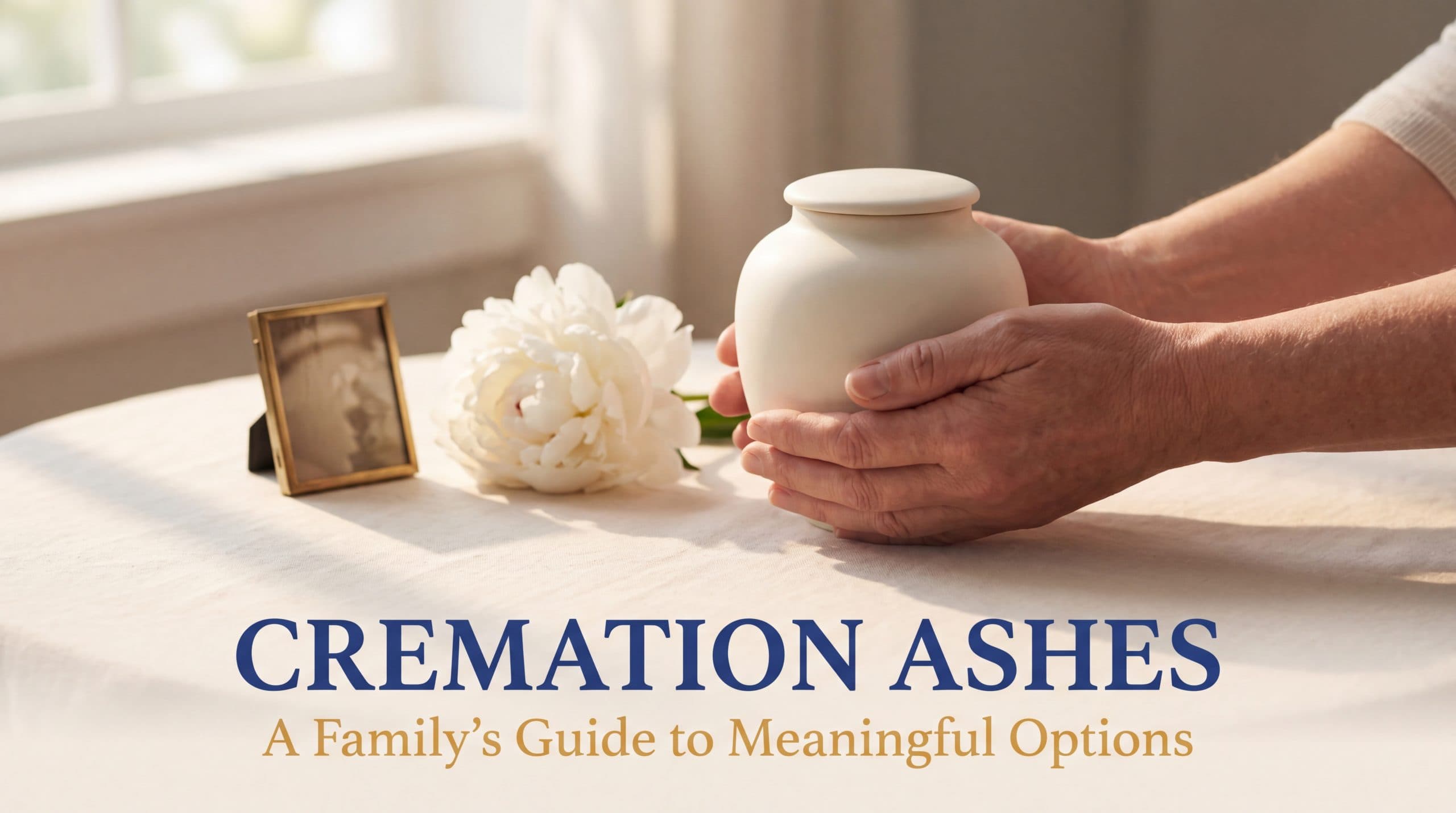
When the funeral home calls to say the cremated remains are ready, most families feel two things at once: relief that a step is complete, and quiet anxiety about the next one. The urn (or temporary container) is suddenly in your hands, and with it a question no one quite prepared you for: what now?
Take a breath. There is no universal “right” answer for what to do with cremation ashes, and the law in nearly every US state lets you take months — or years — to decide. According to the National Funeral Directors Association (2025 report), 63.4% of Americans now choose cremation, and that share is projected to reach 82.3% by 2045. With cremation now the dominant choice, the menu of meaningful options has expanded dramatically — and so has the freedom to do what feels right for your family.
This guide walks through every credible path for cremated remains in 2026: who each option suits, what it typically costs, the rules to know, and how to combine choices when one isn’t enough. We’ll close with a simple 5-step decision framework and answers to the questions families ask most.
of Americans now choose cremation — projected to reach 82.3% by 2045 (NFDA, 2025)
The “all or nothing” myth. A single set of cremated remains is roughly 4–8 cups, and almost every option below uses only a small portion. You can keep most of the ashes in a primary container, scatter some, place a pinch in a piece of jewelry, and reserve a teaspoon for a future grandchild. Combining options is the norm, not the exception.
Path 1: Keep the Ashes at Home in an Urn
The most common choice. The Cremation Association of North America estimates that roughly 1 in 4 US households currently has at least one set of cremated remains at home — a private, daily presence that helps many families feel their loved one is still near. A decorative urn rests on a fireplace mantel, a quiet corner shelf, or a dedicated memorial table, and becomes a focal point for small daily rituals: a fresh flower, a candle on the birthday, a quiet hello.
What an urn typically costs
Urns range from simple wooden boxes at $40–$80 to hand-blown glass, hand-carved stone, bronze, or fully custom pieces that run several hundred dollars or more. Many funeral homes include a temporary container at no extra cost, which gives you time to choose a permanent urn without pressure.
When this path fits
- You want a private, daily presence rather than a place to visit.
- The home will stay in the family for the foreseeable future.
- You’re still deciding and want a respectful resting place while you think.
One quiet consideration: ashes kept at home are tied to that home. Families sometimes revisit the decision a generation later, when a house is sold or a caretaker passes, which is one reason many people pair the home urn with a small keepsake portion in jewelry or a permanent columbarium niche.
Path 2: Scatter the Ashes at a Meaningful Place
Scattering returns a loved one to a landscape that mattered: the lake cabin, the trail they hiked every Sunday, the family farm, the ocean off a hometown coast. It is often the most emotionally powerful single act a family takes — and one of the most affordable, because the cost is largely your travel and a small ceremony.
Three common scattering methods
- Casting — pouring ashes downwind into the air or across the surface of water. The most familiar approach.
- Trenching — digging a shallow trench (often in the shape of a heart, initial, or circle), placing the ashes in it, and gently covering them with soil. Especially meaningful for garden burials.
- Ringing — pouring the ashes in a circle around a meaningful object: a favorite tree, a rock formation, a beach cairn. Family members often stand inside the ring during the ceremony.
EPA minimum distance from shore for ocean scattering (notify EPA within 30 days)
What the law actually says
There is no federal ban on scattering cremated remains on land, and cremated remains are not classified as a biohazard. But where you scatter changes the rules:
- Your own private property: generally allowed in every state. A courtesy heads-up to neighbors is good practice, especially if the scatter site is near a property line.
- Someone else’s private property: always get written permission from the landowner.
- Public land (parks, forests, beaches): rules vary by state and parcel. The National Park Service typically requires a free Special Use Permit; many state parks require advance notice.
- Ocean: the EPA’s Marine Protection, Research, and Sanctuaries Act requires scattering at least 3 nautical miles from shore. Any biodegradable container is fine; plastic and metal urns are not. Notify the EPA within 30 days via their online form.
- From an aircraft: the FAA has no rule specifically about cremated remains, but does prohibit dropping anything that could endanger people or property below. Most charter pilots handle the release themselves to stay compliant.
- State quirks to know: California limits land scattering to designated scattering gardens or with written permission and prohibits scattering from beaches and piers. Texas requires that ashes be removed from any non-biodegradable container before release on land or water.
Plan the ceremony, not just the scatter. A short ritual — a poem read aloud, a song from a meaningful memorial playlist, a moment of silence, a final toast — turns scattering from a logistical step into a memory the family will carry. If young children are present, give each one a small biodegradable shell or flower to release alongside the ashes.
Path 3: Inter in a Columbarium Niche
A columbarium is a wall, structure, or garden designed specifically to hold cremation urns. Each compartment, called a niche, holds one or two urns and is sealed with a faceplate that can be engraved with a name, dates, and a short inscription. Columbaria sit inside cemeteries, churches, memorial gardens, and even some larger funeral homes.
Why families choose a niche
A niche gives you something a home urn or a scatter site cannot: a permanent, maintained address that any family member, in any generation, can visit. The cemetery handles upkeep and the public location means no single household carries the responsibility forever. For families who want the tradition of a cemetery visit without the cost of a full burial plot, it is often the best of both worlds — and an increasingly popular pairing with a QR code on the niche faceplate that opens a digital memorial page.
What a columbarium niche typically costs
Niche pricing varies enormously by region and cemetery prestige. As a rough guide, expect $750–$2,500 for a single niche in a community columbarium, $1,500–$5,000 for a niche in a cemetery’s main wall, and $5,000+ for a private family niche or one in a high-demand urban cemetery. Engraving is typically $200–$600 extra.
Path 4: Divide the Ashes Among Family Members
Grief is rarely shared evenly. Adult siblings live in different states; a parent and a partner may want to remember in different ways; some family members want a daily presence, others a yearly visit. Dividing the ashes — formally, into smaller keepsake urns — lets each person grieve in the way that fits their life.
How division usually works
A standard adult cremation produces 4–8 cups of cremated remains. A keepsake urn typically holds 3–20 cubic inches (roughly 2 tablespoons to 1 cup), so the same set of ashes can comfortably be divided among 4–10 family members with a generous primary portion remaining. Most funeral homes will divide the ashes for you for a small fee; many families do it themselves at home with a clean funnel and a quiet hour.
A practical etiquette note
Decide on division before ordering urns or jewelry, and as a family rather than individually. Sibling tension around ashes is one of the most common avoidable conflicts in the months after a loss. A written plan — even one paragraph in a shared note — prevents misunderstandings later.
Path 5: Transform the Ashes Into Jewelry or Art
Memorial jewelry has become one of the fastest-growing categories in modern remembrance. A small portion of ashes — usually a quarter teaspoon or less — becomes a wearable, permanent keepsake.
The four main types of cremation jewelry
If this path interests you, our full cremation rings and memorial jewelry guide walks through every option in detail. The short version:
| Type | How it works | Typical price |
|---|---|---|
| Fillable chamber | Hollow pendant, ring, or locket you fill at home and seal | $40–$250 |
| Resin inlay | Ashes suspended in clear or tinted resin set into a ring or pendant | $150–$700 |
| Glass bead | Ashes melted into hand-blown glass — each bead is unique | $100–$400 |
| Memorial diamond | Carbon extracted from ashes, lab-grown into a certified diamond | $1,599–$50,000+ |
Typical amount of ashes needed for a single piece of memorial jewelry
Beyond jewelry, the same small portion of ashes can be turned into blown-glass art objects ($150–$600), ceramic memorial sculptures ($200–$1,200), or even custom oil paintings where the ashes are mixed into the pigment ($300–$2,000).
Path 6: Creative and Unconventional Memorials
For families whose loved one was anything but conventional, the last decade has produced a remarkable set of options.
Memorial reef
A small portion of ashes is mixed into a marine-grade concrete cast that becomes part of an artificial reef system off the coasts of Florida, Texas, the Carolinas, or New Jersey. The reef restores marine habitat while creating a permanent underwater memorial that family can dive to or watch on live video. Expect $3,000–$8,000 depending on cast size and reef location.
Memorial diamond
A laboratory extracts the carbon from approximately half a cup of cremated remains, then grows it under heat and pressure into a real, certifiable diamond over 7–10 months. The result is a unique heirloom that can be set into any ring, pendant, or earring. Pricing starts at $1,599 for smaller yellow diamonds and climbs to $50,000+ for larger, colorless stones; both Eterneva and Saint Diamonds publish current price guides.
Vinyl record
About a teaspoon of ashes is pressed into a vinyl record that can hold any audio your loved one recorded — a voicemail, a favorite song, a wedding speech, a lullaby for the grandchildren. UK-based And Vinyly pioneered the service; pricing typically runs $1,200–$3,500 USD depending on quantity. The record is fully playable on any standard turntable.
Space launch
A symbolic gram of ashes is sent on a suborbital flight or, in some packages, into permanent Earth orbit aboard a commercial rocket. Pricing ranges from about $1,300 for a suborbital memorial to $12,500+ for orbital missions.
Memorial tree or living urn
Biodegradable urns mix the ashes with soil and a tree seedling — oak, maple, birch, pine, or a fruit tree of your choice. Within a year the urn dissolves and the tree grows from the spot. Pricing runs $130–$300 for the urn plus the cost of the planting site (often the family’s own garden, at no extra cost). For a related ritual, many families also commission a memorial tattoo with ashes mixed into the ink.
Fireworks
A few ounces of ashes are packed into the shells of a professionally fired fireworks display. The release coincides with a family gathering and is often paired with music or a brief eulogy. Pricing typically starts at $3,500 for a small private display.
Path 7: Bury the Ashes in a Cemetery Plot
If your family already owns a cemetery plot — or wants the tradition of a headstone visit — cremated remains can be buried just like a casket. Many cemeteries offer smaller, less expensive “cremation plots” or allow an urn to be placed in an existing family plot at minimal cost. The result is a traditional headstone or memorial marker with a permanent, public address, often at half the price of a full burial.
This path is especially natural for families that want a cemetery presence but were drawn to cremation for cost, environmental, or personal-belief reasons. For a deeper comparison, see our cremation vs burial guide.

The six most common paths for cremation ashes — with portion sizes and typical costs (Linkora, 2026)
A 5-Step Framework for Deciding as a Family
The best decisions about cremation ashes are made unhurriedly, together, and in writing. Here is the framework we recommend to families navigating this for the first time.
Step 1: Wait long enough to think clearly
The first weeks after a death are not when major irreversible decisions should be made. Funeral homes will store ashes safely for months at no charge; some will keep them up to a year. Give the family at least 30 days before committing.
Step 2: Ask “what would they have wanted?” — then “what do we need?”
Sometimes the loved one left clear wishes. More often, the family has to interpret. Both questions matter: the deceased’s values should anchor the decision, but the living family’s grief needs to be honored too. A daughter who needs to feel her father near her every day is not wrong to want a small portion in a locket, even if Dad was a “scatter me at sea” man.
Step 3: Combine, don’t choose
Almost no family today picks a single option. A typical modern arrangement: scatter half at a meaningful place, keep a portion in a primary urn at home (or a columbarium niche), reserve a small amount for one or two pieces of jewelry, and consider a memorial tree or reef. Combining is normal and respectful.
Step 4: Write the plan down
Even a one-paragraph note in a shared family group chat prevents misunderstanding. Include: who gets what portion, what each portion is for, what the ceremony will be, and when it will happen. If keepsake jewelry is involved, name the recipient of each piece.
Step 5: Anchor the physical memorial to a digital one
Whatever you decide about the physical ashes, the story — the photos, the voice clips, the family tree, the small things only a few people knew — lives in a different place. A digital memorial page linked from a QR code on the urn, plaque, niche, or scatter-site marker keeps that story accessible to every relative, in every generation, no matter where the physical ashes ended up.
One practical tip: if you’re dividing ashes among siblings, do the division at the funeral home or with one trusted family member present. A photo of the labeled keepsake urns, taken at the moment of division, ends every “did I get my fair share?” question before it can start.
Where the Story Lives: Pairing Ashes With a Digital Memorial
An urn, a scattered handful, a ring, a reef — each is a physical anchor. None of them, on their own, holds the story. The photos a grandchild has never seen, the voicemails saved on an old phone, the recipes in a handwritten cookbook, the eulogy a grandchild will one day be asked to read at their own children’s weddings: these live in a different kind of memorial.
A digital memorial page, built around the person rather than the place, becomes the long-term home for that story. At Linkora we’ve helped families preserve more than 12,000 photos across hundreds of memorials, and the pattern is consistent: families who pair a physical memorial (urn, niche, scatter site, tree) with a digital one report far higher satisfaction a year later, because the story stays accessible no matter what happens to the house, the cemetery, or the family schedule. For a closer look at what to include, see our guide to what to put on a memorial web page and our gallery of beautiful memorial page ideas.
A small QR code, etched into the underside of an urn or onto a discreet plaque at a scatter site, is all it takes to link the physical to the digital. Visitors scan with any phone — no app required — and the full memorial opens.
Frequently Asked Questions About Cremation Ashes
How much do cremated remains weigh, and how much volume do they take up?
A standard adult cremation produces approximately 3–9 pounds of cremated remains (typically 4–6 lbs), occupying about 4–8 cups (roughly 200 cubic inches). The volume is closely tied to bone density rather than body weight, so two people of very different sizes can produce similar amounts.
Is it legal to scatter cremation ashes in the US?
Yes, with conditions. There is no federal ban on land scattering, and ashes are not classified as a biohazard. However, you need landowner permission for any private property that isn’t your own, a Special Use Permit for most National Parks, and compliance with EPA rules for ocean scattering (3 nautical miles from shore, biodegradable container, notify within 30 days). State and local rules vary — California, for example, restricts where land scattering can take place.
How long can you wait before deciding what to do with the ashes?
Indefinitely. Cremated remains are sterile, inert, and stable. Most funeral homes will hold the ashes for 30–365 days at no charge, and once you take them home there is no legal time limit. Many families wait a year or longer before scattering or interring, so the decision can be made when grief has settled.
Can you fly with cremation ashes?
Yes. The TSA allows cremated remains in both carry-on and checked baggage, provided the container can be screened by X-ray. Wood, fabric, and most plastics screen cleanly; metal and stone urns may not, in which case the bag will be denied. The Postal Service is the only carrier permitted to ship cremated remains domestically, via USPS Priority Mail Express with the special Cremated Remains label.
Can a digital memorial replace a physical one?
A digital memorial isn’t a replacement — it’s a companion that makes the physical memorial dramatically more meaningful. A QR code on an urn or niche faceplate opens to photos, voice clips, family tree, written tributes, and stories that no engraving could ever hold. The combination keeps the story accessible to grandchildren, distant relatives, and family members who can’t visit in person.
For monument dealers, funeral homes, and cemeteries adding digital memorial services to their offerings.
A Final Thought
There is no perfect choice for what to do with cremation ashes — there is only the choice that feels true to who your loved one was and what your family needs now. Most modern families combine two or three of the paths above, take their time, and let the story keep growing long after the physical ashes are placed. Whatever you decide, decide as a family, write it down, and give the story a home that can outlive any urn.