
A celebration of life is exactly what it sounds like: a gathering that focuses on the life someone lived rather than the loss the family is carrying. There are no fixed rules. No required venue. No expected dress code. Families choose the music, the words, the food, and the tone. That freedom is the whole point, and it is also why so many people feel a little lost the first time they have to plan one.
This guide walks through the full picture, from the definition to the practical checklist. It covers what a celebration of life actually is, how it differs from a traditional funeral, how to plan one without overwhelming yourself, dozens of ideas to make it meaningful, what to wear, how to word invitations, songs and poems and quotes that families return to, and how to pair the gathering with a digital memorial page so the stories shared in the room do not vanish when the room empties.
TL;DR. A celebration of life is a personalized memorial gathering that emphasizes who the person was, not the formality of saying goodbye. You can hold one anywhere, dress how the family asks, share food and stories the person actually loved, and skip the parts of a traditional funeral that do not feel right for your family. Most planners follow the same six steps: pick a date and venue, send invitations, build a simple program, gather music and photos, plan a few moments of sharing, and create a way for guests to keep contributing memories afterward, usually through a digital memorial page.
What Is a Celebration of Life?
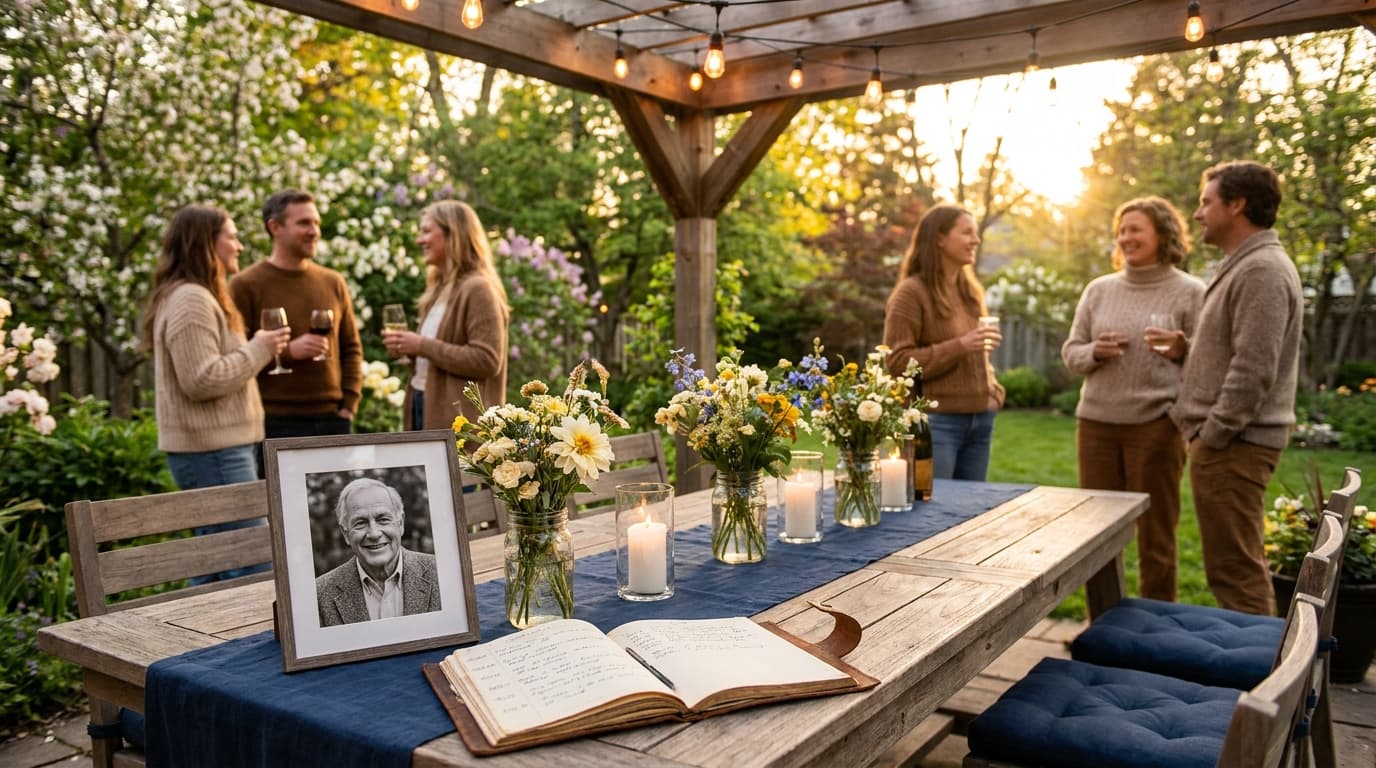
A celebration of life is a memorial gathering centered on the personality, stories, and meaning of the person who passed, rather than on religious or funereal formality. It can happen days, weeks, months, or even a year after the death. It can be held in a chapel, a backyard, a brewery, a beach, a community hall, a vineyard, a hiking trail, or a living room. It can include a religious officiant, or it can include a friend reading a poem off their phone. It can be a hundred people in dark suits, or twelve people in Hawaiian shirts because that was what dad wore every Saturday.
The defining quality is intentional personalization. Where a traditional funeral typically follows a set liturgical or cultural script, a celebration of life is built around the specific person being remembered. The decisions around music, attire, food, location, and program flow are made by the family, often with input from the person before they passed, so that every choice points back to a real life that was lived.
Celebration of Life vs Funeral: How Are They Different?
The two terms are sometimes used interchangeably, but they are not the same thing. Knowing the difference helps families decide which format, or which combination of formats, fits their loved one.
| Element | Traditional Funeral | Celebration of Life |
|---|---|---|
| Tone | Solemn, often religious | Personal, often joyful |
| Timing | Within a week of passing | Anytime, often weeks or months later |
| Body or remains | Casket or urn typically present | Often held after burial or cremation |
| Venue | Funeral home, place of worship, cemetery | Anywhere meaningful: home, park, restaurant, beach |
| Attire | Black, formal | Whatever the family requests, often colorful |
| Program | Liturgy, readings, eulogy, committal | Storytelling, music, photos, food, open mic |
| Officiant | Clergy or funeral director | Family member, friend, celebrant, or none |
| Length | 45 to 60 minutes | 1 to 4 hours, sometimes a full afternoon |
Many families do both. A small graveside service or funeral mass within the week, then a celebration of life weeks later when out-of-town family can travel and grief has shifted enough to make storytelling possible. Neither replaces the other. They serve different needs.
Six Steps to Plan a Celebration of Life
Most celebrations of life come together inside a few weeks if the family follows a simple sequence. Here is the framework planners and funeral celebrants tend to use.

A six-step framework for planning a celebration of life.
1. Pick the date and the venue
Date first, then venue. Pick a date that gives close family enough time to travel, and pick a venue that fits the personality of the person. Common choices include the family home, a public park or pavilion, a community hall, a country club, a brewery or restaurant, a place of worship, a beach, a winery, or a museum. Outdoor venues are popular for spring and summer celebrations because they make space for kids to move and for guests to spread out into smaller conversations.
2. Send invitations
Two weeks of lead time is comfortable. One week works if the guest list is local. Invitations can be printed, mailed, emailed, or sent through a group text. The wording does not need to be formal, but it should clearly answer five questions: who is being remembered, when and where the gathering is happening, what the dress code is, whether to RSVP, and whether to bring anything. Skip the temptation to over-design. Plain works.
3. Build a simple program
A celebration of life program is shorter than a funeral order of service. The classic shape is welcome, two or three short tributes, a song or musical interlude, an open-mic moment for guests, a closing thought or prayer, and then food and conversation. If you want a printed keepsake, a half-fold program with a photo on the cover, the schedule inside, and a few favorite quotes on the back is enough. Our funeral program template guide has structures that adapt cleanly to a celebration of life.
4. Gather the music, photos, and stories ahead of time
This is the part families wish they had started earlier. Make a shared folder. Ask three or four close friends and relatives to drop in two photos and one story each. Build a slideshow that runs on a loop in the corner. Pull together a playlist that captures their actual taste, not just somber chapel music. We have a deep list of memorial service songs that work well at celebrations of life across genres and faiths.
5. Plan a small number of intentional moments
Two or three is plenty. Pick the moments that fit the person. A toast. A reading. A short slideshow. A favorite hymn or favorite Springsteen song. A shared act, like writing a memory on a card and dropping it in a jar. A child or grandchild reading something they wrote. The mistake first-time planners make is trying to script every minute. Resist that. The conversation between the moments is where the real grieving and the real laughing happens.
6. Create a way to keep contributing after the day
This is the step that has changed the most in the last decade. The day of the celebration is one moment, but the stories, photos, and tributes that surface during it are too important to leave on a folding table or a phone camera roll. Families increasingly create a digital memorial page ahead of the gathering and share the link in the program, so guests can upload their own photos, write tributes, and revisit the page on birthdays and anniversaries for years afterward.
of families now hold a celebration of life rather than a traditional funeral, according to NFDA reporting on personalization trends
12 Celebration of Life Ideas That Make the Day Feel Like Them
The gatherings that guests still talk about a year later have one thing in common: they feel like the person who passed. Below are celebration of life ideas grouped by personality archetype, but mix and match freely.
For someone who loved the outdoors
- Hold the gathering at a state park, lake, or trailhead they hiked often.
- Plant a memorial tree, with a small plaque or QR code marker visitors can scan to read tributes.
- Release biodegradable lanterns or wildflower seed paper at sunset.
- Hand out small bags of native seeds for guests to plant at home.
For someone who lived for music
- Build the program around their playlist. Open with their first dance song, close with their favorite road-trip track.
- Invite friends who played with them to perform a song or two.
- Create a collaborative playlist guests can keep adding to, then embed it on the memorial page.
For someone who loved to host
- Hold the celebration in a backyard or restaurant they loved, with their actual recipes catered or potluck-style.
- Print their signature dish on a recipe card as the takeaway favor.
- Set out their favorite drink with a sign that reads “Have one with [name] one more time.”
For someone who lived for sports or games
- Tailgate format with their team’s colors and music in the parking lot of their favorite venue.
- Card-game tournament in their honor, with a small trophy named after them.
- Memory bingo, where each square is a quirk only the people who knew them would catch.
What to Wear to a Celebration of Life
The single most-asked guest question. The honest answer: follow whatever the family put on the invitation, and when in doubt, wear what feels respectful for that person specifically. Many families now request something other than black to match the personalized tone.
Common celebration of life dress code options families ask for:
- Casual. Jeans, button-down or blouse, comfortable shoes. The default if no dress code is given for outdoor or backyard gatherings.
- Smart casual. Khakis or a sundress, collared shirt, no tie required. Works for venue-based gatherings.
- Wear color. The family explicitly asks guests to skip black and wear bright colors, the loved one’s favorite color, or a specific team or themed color.
- Themed. Hawaiian shirts, sports jerseys, vintage band tees, the loved one’s signature look. The family signals the tone with the request.
- Traditional dark or formal. If the family is holding a funeral plus a celebration of life, the funeral typically stays formal even when the celebration loosens up.
If the invitation is silent on attire, default to smart casual in muted tones. Avoid loud logos, club gear, or anything that would not feel right next to a slideshow of the person.
Celebration of Life Invitations: How to Word Them
The hardest part of an invitation is the first sentence. Here are five wording patterns that work, ordered from most traditional to most personal.
Pattern 1, traditional. “The family of [Name] invites you to join us for a celebration of [his/her/their] life on [date] at [time], at [venue]. We will share food, stories, and music in [his/her/their] memory.”
Pattern 2, warm. “Please join us as we remember [Name] and the life [he/she/they] lived. [Date], [time], [venue]. Bring a story, a photo, or just yourself.”
Pattern 3, personal. “[Name] would have hated a sad funeral. So we are not having one. Come share a meal, a memory, and a [favorite drink] with us on [date].”
Pattern 4, themed. “Hawaiian shirts encouraged. Black optional. We are gathering to celebrate [Name]’s life on [date] at [venue], because [he/she/they] would not have it any other way.”
Pattern 5, with a digital memorial link. “Join us in celebrating the life of [Name] on [date] at [venue]. Stories, photos, and tributes can also be shared anytime at [memorial-page-link].”
Whichever pattern you pick, the invitation should always include the date, start time, venue with address, dress code or theme, RSVP method, and any “in lieu of flowers” donation request. Most families also include the link to the memorial page so out-of-town guests who cannot attend can still leave a tribute.
Songs for a Celebration of Life
Music does more emotional lifting at a celebration of life than almost any other element. Lean into the actual taste of the person being remembered. A 78-year-old who loved Sinatra deserves Sinatra. A 42-year-old who loved Pearl Jam deserves Pearl Jam. The all-purpose hymns that work at funerals can feel generic at a celebration of life unless the person had a real connection to them.
A starter shape that works at most gatherings:
- One song playing as guests arrive, ideally upbeat and authentic to the person.
- One quieter song during a photo slideshow or candle-lighting moment.
- One signature song the family or the person identified as “their song.”
- One closing song that lifts the mood as guests transition to food and conversation.
For a much longer list of options across genres, faiths, and tones, see our compiled list of 100+ memorial service songs that honor a loved one.
Celebration of Life Programs and Memorial Cards
A printed program is optional but appreciated. The standard celebration of life program includes a cover photo and the loved one’s full name with birth and passing dates, an inside spread with the order of service, a section listing the people speaking and the songs being played, a panel with a favorite poem or quote, and a back panel with a photo collage or a thank-you note from the family.
Memorial cards, also called prayer cards or remembrance cards, are smaller takeaways. They typically pair a portrait with a short quote, a poem stanza, or a Bible verse. Increasingly, families add a small QR code on the back that links to the digital memorial page, so the card becomes a permanent gateway to photos, tributes, and stories that grow over time. The QR memorial plaque guide covers durability and material choices that apply just as well to memorial cards meant to last on a refrigerator or in a wallet.
Celebration of Life Quotes and Poems
The right quote can carry an entire program. These are the lines families return to most.
Short quotes that work on cards and slides.
“Those we love don’t go away, they walk beside us every day.”
“What we have once enjoyed deeply we can never lose. All that we love deeply becomes a part of us.” — Helen Keller
“To live in hearts we leave behind is not to die.” — Thomas Campbell
Poems often read aloud at celebrations of life.
- “She Is Gone” (Remember Me) by David Harkins, often misattributed to the Queen Mother, beloved for its “smile because [he/she] lived” framing.
- “Do Not Stand at My Grave and Weep” by Mary Elizabeth Frye, a perennial favorite for outdoor and nature-themed celebrations.
- “The Dash” by Linda Ellis, on the meaning of the dash between two dates on a tombstone.
- “When I Am Gone” by Lyman Hancock, often used to close ceremonies on a forward-looking note.
For more language to use in tributes, eulogies, and toasts, our guide to beautiful things to say when someone dies is built around exactly these moments.
Where to Hold a Celebration of Life
The venue should match the person, the guest count, and the season. The most common celebration of life venues:
- The family home or yard. Free, intimate, and often the most authentic. Best for groups under 50.
- Community halls and clubhouses. American Legion halls, VFW posts, HOA clubhouses, and community centers tend to be inexpensive and have kitchens.
- Restaurants and breweries. Many private rooms are free if the food and drink minimum is met. Works well for tight friend groups and adult-only gatherings.
- Outdoor parks and pavilions. Public parks often have permitted pavilions for under $200. Bring sound, since most do not have it.
- Funeral homes with reception spaces. Increasingly common, since many funeral homes now offer flexible event rooms specifically for celebration-style services.
- Places of worship. Many faith communities welcome celebrations of life even when the family wants the tone less formal than a funeral.
- Wineries, vineyards, and golf clubs. A favorite for retirees and for families whose loved one had strong ties to one specific place.
Pairing the Celebration With a Digital Memorial
The day of a celebration of life is, by design, finite. Three or four hours, then the room empties and the leftovers go home in foil. The stories that surfaced, the photos that guests took out of their pockets, the recordings of speeches, the toast that someone gave that no one will ever quite remember word for word, those are the things that matter long after the gathering ends. They should not live on a folding table or in a single phone.
This is where a digital memorial earns its place. A modern memorial page is a permanent, family-controlled space online where photos, tributes, audio, video, and family-tree context all live together. Guests who attended can upload what they captured. Out-of-town family who could not make it can still leave a message. Future generations can revisit the page on birthdays and anniversaries and watch the slideshow that played in the room. Linkora connects this digital memorial to a physical QR code that can be added to a headstone, plaque, memorial card, urn, or tree marker, so the bridge between the gathering and the lasting memorial stays intact.
If you are weighing options, the comparison of digital memorial platforms walks through the major choices, and the guide to what belongs on a memorial web page covers the content side. Families who want to understand the underlying technology should start with the complete guide to QR code memorials.
A Note on Grief Around the Day
Planning a celebration of life is a grief task. It looks like logistics, but it sits on top of fresh loss, and the fatigue catches up to most planners about three days in. Build small breaks into the planning week. Delegate photo collection. Ask one person to handle the playlist and one person to handle the venue logistics so you do not own everything. If grief feels heavier than usual, the 7 stages of grief guide covers the emotional arc most planners move through, and the overview of grief technology covers tools that help families process loss together.
If you or someone helping you plan is struggling with thoughts of self-harm, please reach out to the 988 Suicide & Crisis Lifeline or the American Psychological Association grief resources.
Frequently Asked Questions
What is a celebration of life service?
A celebration of life service is a personalized memorial gathering that focuses on the personality, stories, and meaning of the deceased rather than on traditional funeral formality. It can be religious or secular, indoor or outdoor, somber or upbeat, and it is typically built around the specific tastes and preferences of the person being remembered.
How is a celebration of life different from a funeral?
A traditional funeral typically follows a religious or cultural script, happens within a week of the death, and centers on the body or remains. A celebration of life is more flexible: it can happen anytime, anywhere, with any tone the family chooses, and it focuses on storytelling and personalization rather than liturgy.
How long after the death should we hold a celebration of life?
There is no single right answer. Many families hold the celebration two to six weeks after the passing, which gives time for travel, planning, and the first wave of grief to settle. Some families wait three to twelve months and hold the gathering on a meaningful date such as a birthday or anniversary.
What is the typical length of a celebration of life?
Most celebrations run between one and four hours. A short program of formal moments such as tributes, songs, and slideshow usually takes 45 to 75 minutes, and the remaining time is reserved for food, drinks, and unstructured conversation among guests.
Do you bring a gift or flowers to a celebration of life?
Follow the invitation. Many families request donations to a charity in lieu of flowers. If nothing is specified, a sympathy card with a written memory or photo of the loved one is always welcome and is often more meaningful to the family than flowers.
Can you hold a celebration of life and a funeral?
Yes, and it is increasingly common. Families often hold a small private funeral or graveside service within the week, then host a larger celebration of life weeks or months later when out-of-town family can travel and the tone has shifted from immediate grief to remembrance.
Closing Thought
A celebration of life is, in the end, an invitation. To remember out loud. To laugh in the same room as the grief. To say the things you did not get to say. The day matters because the person mattered, and because the gathering, properly cared for, becomes part of the memory that the family will hold for the rest of their lives.
If you are planning one now, start small. Pick a date. Send the invitation. Make the playlist. Set up the memorial page so the stories shared in the room have somewhere permanent to live afterward.
For monument dealers, funeral directors, and cemetery administrators who want to offer celebration-of-life support and digital memorial pages to the families they serve, the Linkora B2B partner program is here. Become a Partner.