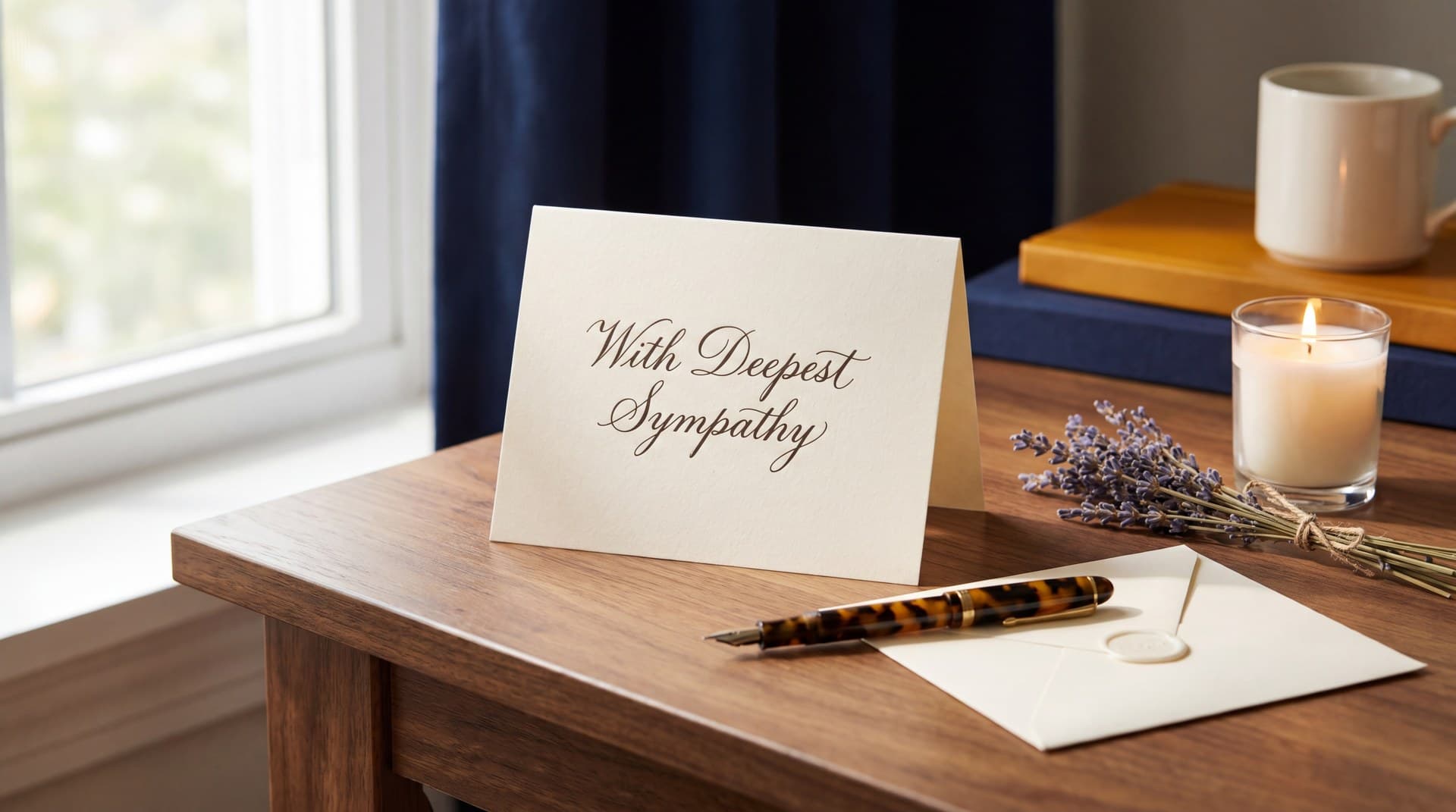

TL;DR — The Sympathy Card Essentials
- Sympathy cards still matter because grief is long, and a written message becomes a keepsake the recipient can return to.
- The 5-part formula: name the person, name the loss, share a memory, offer specific help, close with warmth.
- Short and specific beats long and generic. Twenty-five sincere words land harder than three pages of platitudes.
- Send within two weeks if you can, but a late sympathy card is often the most meaningful one.
- Digital sympathy cards and memorial-page tributes have become a real, respectful alternative — especially for distant family and friends.
What Is a Sympathy Card and Why Sending One Still Matters
A sympathy card is a brief written message sent to someone after the death of a loved one. It is one of the oldest and quietest ways human beings comfort one another. In a culture that increasingly defaults to a quick text, a tagged photo, or a heart emoji, the simple act of choosing a card, writing inside it, and putting it in the mail still carries unusual weight.
Bereavement researchers — including organizations like Hospice Foundation of America and GriefShare — consistently find that grief is not a 72-hour event. The first wave of phone calls, casseroles, and flower deliveries fades within two weeks, while the actual loneliness of loss often peaks weeks or months later. Sympathy cards arrive on a schedule that grief itself respects. They show up on a Tuesday in March, three months after the funeral, when the recipient is sorting mail and is suddenly reminded that someone, somewhere, still remembers their person.
The cardinal rule of sympathy cards: the goal is not to fix anyone’s grief or find the perfect words. It is simply to make sure the bereaved person knows they are not alone, and that the person they lost is remembered.
This guide walks through the entire process: when to send a sympathy card, how to choose one, what to write inside, more than 50 ready-to-adapt sympathy card messages by relationship, and modern digital options for people who can no longer rely on the post. If you also want broader help with what to say in person, our guide to heartfelt condolences messages covers spoken and written notes side by side.
When to Send a Sympathy Card (And When It’s Too Late)
The short answer: there is almost no such thing as a sympathy card that is too late. The longer answer depends on what you are trying to accomplish.
The first one to two weeks after the death
This is the conventional window. A card that arrives during the funeral week joins the first wave of support and acknowledges the loss publicly within the family’s social circle. If you can put a card in the mail within seven to ten days of hearing the news, that is the easiest path.
After the funeral, when most people have gone quiet
One of the most powerful uses of a sympathy card is to deliberately send it later. Three weeks, two months, six months. The recipient has typically been alone with the loss for a while, and a card at this stage signals: I haven’t forgotten, and I’m still here. A card that arrives after the immediate flurry is often the one that gets read three times and saved in a drawer.
Anniversaries, birthdays, and grief milestones
The first birthday after a death, the first anniversary of the death itself, Mother’s Day or Father’s Day, the holidays — these are landmines for grieving people. A short note acknowledging the date can mean as much as anything sent in the first week. For a deeper look at this kind of intentional remembering, see our guide on marking memorial anniversaries.
If you missed the moment entirely
If you only just heard about a loss that happened months or even a year ago, you can absolutely still send a sympathy card. Open with one short sentence acknowledging the gap: “I just learned about your father’s passing and I’m so sorry I’m only writing now.” Then continue as you would with any other sympathy card. The person on the other end is far more likely to feel grateful than judgmental.
How to Choose the Right Sympathy Card
Walk into any card aisle and the sheer number of sympathy cards can be paralyzing. A simple decision tree helps.
Match the recipient’s relationship to the deceased
A card “on the loss of your mother” feels personal in a way a generic “with sympathy” card does not. If you know the relationship, choose a card that names it. If you do not, a more open design (“thinking of you,” “with deepest sympathy”) gives you room to be specific in the handwritten note.
Religious vs. secular vs. spiritual
Choose a card that matches the recipient’s beliefs, not your own. A card with “in God’s hands” sent to a deeply secular friend can feel jarring; a strictly religious image sent to a family of a different faith can feel tone-deaf. When you are unsure, lean secular and add any spiritual language you want in the handwritten message. Hallmark sympathy cards, Papyrus, and most major brands offer wide selections in each category.
Tone: formal, personal, or hopeful
For a colleague or distant relation, a more formal card is appropriate. For a close friend, a personal, even warm-and-imperfect card lands better. Cards focused on hope and healing (“the love remains”) fit later sympathy cards more than the immediate aftermath, when the recipient is often in shock.
Premade message vs. blank inside vs. handwritten
Premade messages are fine. They become memorable when you add even one or two lines in your own handwriting. A blank-inside card forces you to write more, which is uncomfortable but produces the most meaningful keepsake. Consider blank-inside for close relationships, and premade-with-a-note for everyone else.
What to Write in a Sympathy Card: The 5-Part Formula
If a blank card is paralyzing, this is the simplest framework that works for almost any sympathy card message:
- Open with the person’s name. “Dear Sarah,” or “Dear Mr. Patel,” anchors the card in the relationship rather than abstract sympathy.
- Acknowledge the loss directly. Use the deceased’s name. Naming the person is one of the kindest things you can do, because grieving people often fear the world will pretend their loved one never existed.
- Share a memory or strength. A specific image — “I’ll always remember the way your mother laughed on the porch in July” — is worth a hundred general adjectives. If you didn’t know the deceased, share something you observed about how they shaped the recipient.
- Offer specific help. “Let me know if you need anything” puts the burden on the grieving person. Replace it with one concrete offer: “I’ll drop dinner off Tuesday — no need to reply.” Specific is the entire game.
- Close with warmth. “With love,” “Holding you close,” “Thinking of your whole family” — anything that lands as human and not corporate.
Quick example using the formula: “Dear Maria, I was so sorry to hear about your father. Carlos was the warmest person at every family party I ever went to — I can still hear him laughing across the yard. I’d love to bring you and the kids dinner this weekend; I’ll text you Saturday morning. Holding you all in my heart. — Anna”
50+ Sympathy Card Messages by Relationship
The messages below are ready to use, but they work much better when you adapt one or two details. Insert the deceased’s name, the recipient’s name, or a small specific memory wherever you can.
Sympathy cards for loss of mother — 10 examples of sympathy cards messages
Sympathy cards for loss of mother are some of the hardest to write. The messages below are meaningful sympathy messages drawn from the kinds of things people actually say to one another in grief.
- Your mother shaped so much of who you are. May the love she poured into you carry you through this.
- There is no one else like a mother. I am so deeply sorry for your loss, and I am here for as long as you need.
- I’ll always remember [Mom’s name] for her kindness to me. She loved you fiercely. Thinking of you every day this week.
- Losing a mother is a different kind of loss. Please don’t feel any pressure to respond — just know you and your family are on my mind.
- The world is gentler because [Mom’s name] was in it. Sending you all my love.
- Your mother’s laugh, her cooking, the way she always remembered birthdays — those things stay. So sorry, friend.
- I am holding you and your family in my heart this week, and the weeks after, when the visitors stop coming.
- Your mother was loved. I hope you can feel even a little of that love wrapped around you right now.
- No words feel right. I just want you to know I’m thinking of you, and I’ll be checking in next week.
- Mothers leave fingerprints on everything. May the ones [she] left on your life bring you comfort in the years ahead.
Sympathy cards for loss of a father (10 examples)
- Your dad was a good man. The way he showed up for you over the years showed up in how you show up for everyone else.
- I am so sorry for the loss of your father. There is no replacing a dad — only carrying him with you.
- [Dad’s name] was steady, generous, and proud of you. That doesn’t end. Sending you so much love.
- Losing a father is hard in ways nobody warns you about. Please be gentle with yourself this season.
- I always loved how your father told a story. He had a way of making everyone in the room feel seen.
- Your dad raised you to be the kind of person people lean on. Now it’s our turn to lean back.
- So sorry, friend. I’m bringing dinner over Wednesday — no need to host me, I’ll leave it on the porch.
- Whatever your relationship with your dad looked like, this loss is real and it deserves space. I’m here.
- Your father’s life touched more people than he knew. May that ripple bring you some comfort.
- Sending you a long, quiet hug across the miles. Take all the time you need.
Sympathy cards for loss of a spouse or partner (8 examples)
- There are no words for losing the person you built a life with. I am so deeply sorry.
- The love you and [Name] shared was rare. Hold onto that — it is yours to keep.
- I keep thinking of the way you two used to look at each other. That kind of love does not end.
- Please don’t try to be strong for the rest of us. I’m here for the messy, the quiet, and the unspoken.
- I am bringing dinner Tuesday and groceries Friday. You don’t need to call. I’ll just text when I’m at the door.
- The home you made with [Name] meant everything to so many of us. Sending all my love.
- There is no timeline for grief like this. Take all the time you need, and lean on us when you can.
- You are not alone in this, even when it feels that way at 2am. I love you both, always.
Sympathy cards for loss of a child (6 examples — handle with care)
A note before these messages: avoid silver linings, religious certainties, or anything that implies the loss makes sense. Acknowledge, name, and stay close.
- There are no right words for the loss of [Child’s name]. I am so sorry. I am here for as long as you need me.
- [Child’s name] was loved. Always. We will keep saying their name with you for the rest of our lives.
- Please don’t worry about replying. I just wanted you to know I am thinking of your whole family today.
- I cannot imagine. I will not pretend to. I am here in whatever way you need — quiet, loud, or anywhere in between.
- Sending love to you, [Partner’s name], and the rest of the family. We are holding you up from afar.
- [Child’s name] mattered. They will always matter. Holding all of you in the deepest part of my heart.
Sympathy cards for loss of a friend or coworker (8 examples)
- I’m so sorry to hear about [Name]. The way you spoke about your friendship told me everything about who they were.
- Friends like that are rare. The world is quieter without [Name] in it.
- Losing a friend in adulthood is its own kind of grief, and people often underestimate it. Please be patient with yourself.
- From everyone on the team — we are so sorry for your loss. Please take all the time you need.
- I’ll always remember the way [Name] could light up the office. They mattered here.
- If you’d like company, or quiet, or a long walk, just say the word. I’ll come.
- Sending you so much warmth, and so much patience, in the weeks ahead.
- Thinking of you. Take care of yourself. Coffee whenever you’re ready.
Sympathy cards for loss of a grandparent (6 examples)
- Grandparents teach us how to love. May you carry [his/her] love with you always.
- What a long, full life. So many of us are better because [Grandparent’s name] was here.
- Some of the best parts of you came from your grandparent. That doesn’t go anywhere.
- I always loved hearing stories about [Grandparent’s name]. So sorry, friend.
- Sending you love, and to your parents, and to your kids if [Grandparent’s name] knew them.
- Holding your whole family — across the generations — in my heart this week.
Sympathy cards for loss of a sibling (5 examples)
- Losing a sibling means losing a piece of your own history. There is no one else who remembers what you remember.
- [Sibling’s name] was so proud of you. Hold that close.
- I am so sorry. Please reach out, day or night, when the quiet gets loud.
- Brothers and sisters are forever. The bond doesn’t end here.
- Thinking of you, your parents, and your whole family. Sending the deepest love.

A simple visual roadmap to choosing, writing, and sending sympathy cards.
Short Sympathy Messages (Under 25 Words)
Sometimes brevity is the kindest choice. A short condolence message respects the recipient’s bandwidth and avoids the trap of over-explaining. Here are twenty short sympathy messages you can lift directly:
- So sorry for your loss. [Name] was loved. Thinking of you.
- Holding you and your family close this week.
- No words. Just love, and so much of it.
- [Name] mattered. Always will. Sending you strength.
- Thinking of you. No need to reply.
- Your family is in my heart. With love.
- So deeply sorry. Here whenever you need me.
- Sending warmth across the miles.
- [Name]’s kindness lives on in everyone who knew them.
- Quietly thinking of you all this week.
- What a life. What a loss. So sorry.
- You’re not alone in this. Not for a second.
- Hold close, breathe slow. We love you.
- [Name] was one of the good ones. Truly.
- I’ll be checking in next week. No pressure.
- So sorry, friend. Coffee whenever you’re ready.
- Saying [Name]’s name today, and tomorrow.
- Wishing you peace, slowly returning.
- Holding your whole family in my heart.
- With love and quiet support, always.
Religious and Spiritual Sympathy Messages
If you know the recipient’s faith, including a tradition-specific line can be deeply meaningful. If you do not, default to a secular message rather than guess.
Christian sympathy messages
- “May the God of all comfort surround you and your family in this time of loss.”
- “Praying that the peace that passes all understanding holds you close this week.”
- “Trusting that [Name] is at rest in the love that made them. Sending love to you all.”
Jewish sympathy messages
- “May [Name]’s memory be a blessing — zikhrono livrakha.”
- “Wishing you and your family long life. Sending love during shiva and after.”
- “May you be comforted among the mourners of Zion and Jerusalem.”
Muslim sympathy messages
- “Inna lillahi wa inna ilayhi raji’un. We belong to Allah and to Him we return.”
- “May Allah grant [Name] peace and grant your family patience and strength.”
- “Holding your family in prayer this week and in the weeks ahead.”
Buddhist and Hindu sympathy messages
- “Wishing peace and gentle release for [Name], and steady hearts for your family.”
- “May [Name]’s soul find peace, and may your family find comfort in the love that surrounds you.”
- “Sending love and lighting a candle for [Name] tonight.”
Spiritual but non-religious messages
- “Love does not end with a body. May you feel [Name] near you in the quiet.”
- “Sending light, breath, and patience for the long road of grief.”
- “Holding the whole shape of [Name]’s life in honor today.”
Sympathy Card Etiquette: Common Mistakes to Avoid
Even well-intentioned sympathy cards can land badly. The most common pitfalls are easy to avoid once you know to look for them.
- Comparing losses. “When my dog died, I felt the same way” is rarely received the way it was meant. Stay focused on the recipient’s loss.
- “They’re in a better place.” Some people will find this comforting; many will find it dismissive. If you are not sure, leave it out.
- Religious mismatch. Use the recipient’s tradition, not yours. When in doubt, secular.
- Generic platitudes. “Time heals all wounds” rarely lands. Specifics about the deceased land much harder.
- Centering yourself. “I’m so devastated, I haven’t slept all week.” It is fine to share that in person; in the card, the focus belongs on the bereaved.
- Asking how they are doing. They are doing terribly. The card is not a survey. State your love and your support, don’t ask for an update.
- Vague offers. “Let me know if you need anything” is invisible. Make it concrete — a specific meal on a specific day.
For deeper coverage of the broader behavioral norms around death, see our companion guide on funeral etiquette, which covers wakes, viewings, and the days after the service.
Free, Printable, and Digital Sympathy Cards
Not every sympathy card needs to come from a card aisle. Free, printable, and digital options have grown enormously over the last decade — and for many situations they are now the most practical and meaningful choice.
Free sympathy cards and printable sympathy cards
Most major card brands and a long list of free templates offer printable PDFs you can download, print at home, and write inside. Free sympathy cards are particularly useful when you need to send several cards from a workplace or a community group, or when you want a more customized design than the local store carries. Search for “printable sympathy cards” or “sympathy cards free printable” to find current options. The quality of the writing inside still matters more than the design on the front.
Sympathy cards online (Hallmark, Postable, and digital services)
Hallmark sympathy cards remain the most recognized brand, but sites like Postable, Lovepop, and Paperless Post also let you choose a card, write inside it, and either mail a physical version or deliver a digital one. Sympathy cards online can arrive within hours, which matters if you live overseas, were just informed of the death, or are too sick or mobility-limited to make it to a store and a mailbox. Larger services like the Hallmark sympathy collection and Postable’s mail-for-you option are convenient when time is tight.
Digital sympathy through a memorial page
One of the most meaningful modern alternatives is contributing to a digital memorial page. Instead of a single card that lives in one drawer, your message becomes part of a living tribute the family can revisit for years and share with grandchildren. You can leave a written message, upload a photo with the deceased, or record a short video story. Linkora memorials are designed exactly for this — see real memorial page examples if you’ve never seen what the format looks like.
A digital sympathy contribution doesn’t replace a card — it complements it. Many families today are receiving both: a paper card in the mail, and a written tribute on the loved one’s memorial page. The combination is unusually powerful.
Beyond the Card: Other Ways to Express Sympathy
Sympathy cards are a baseline, not the ceiling. The most loved-on grieving people receive a layered kind of support that unfolds over months.
- Memorial donations. Many families ask for donations to a charity in lieu of flowers. A note that says “I made a donation to [organization] in [Name]’s memory” gives the gift an outline.
- Meals and practical help. Cooked food, grocery deliveries, school pickups, lawn mowing, dog walking. The mundane is what gets crushed by grief, and the mundane is what most needs covering.
- Sharing a story. Write down a story about the deceased and send it. Email, text, voice memo, or a memorial-page tribute — the format matters less than the act. A guide like eulogy examples can spark ideas if you’re stuck.
- Long-term check-ins. Add a calendar reminder for one month, three months, six months, and one year after the death. A short text on each of those dates is often the single most appreciated gesture in the entire bereavement period.
- Helping with grief routines. Pointing the recipient toward simple grief-support tools — like a journal — can also help. Our grief journal prompts are written specifically for the early months.
If you’d like more context on how grief itself unfolds, our guide to the stages of grief can help you choose the right kind of support at the right time.
Frequently Asked Questions About Sympathy Cards
What do you write in a sympathy card if you didn’t know the deceased?
Center the message on the recipient. Acknowledge their loss, express care for them, and offer specific support without inventing a relationship with the person who passed. A line like “I never had the chance to meet your mother, but everything you’ve told me over the years made her real to me” is honest and warm.
Is it okay to send a sympathy card a month or more after the loss?
Yes. Late sympathy cards are often even more appreciated, because they arrive when most others have stopped reaching out and the recipient feels alone in their grief. Open with a single line acknowledging the timing, then proceed normally.
What is a meaningful short sympathy message?
“Thinking of you and holding your family in my heart. [Name] was deeply loved, and that love stays.” Brief, specific, and centered on the bereaved. Pair any short sympathy message with the deceased’s actual name to make it land.
Should you say “sorry for your loss” in a sympathy card?
It’s fine, but pair it with something specific — a memory, a strength of the deceased, or a tangible offer of help. Specificity is what turns a polite phrase into real comfort. “Sorry for your loss” alone is a placeholder; “Sorry for your loss — Carlos was the best storyteller at every party” is a sympathy card.
What’s the difference between a sympathy card and a condolence card?
They are essentially the same. “Sympathy card” is the more common American term, “condolence card” is more common in the UK and Commonwealth countries. Both are sent after a death to support the grieving, and both follow the same etiquette around tone, timing, and message length.
Can I send a digital sympathy card instead of a physical one?
Yes. Digital sympathy cards, video tributes, and memorial-page guestbooks are increasingly common — especially when distance, mobility, or time make a paper card hard to send. The right format is the one you’ll actually send. A digital tribute on a loved one’s memorial page often becomes a permanent keepsake the family can return to for years.
Turn a Sympathy Card Into a Living Tribute
A paper sympathy card lives in a drawer. A digital memorial page lives wherever the family scans the QR code. Linkora gives families a private, beautiful place to gather photos, stories, tributes, and family history — so the loved one is always one tap away.
If you are a funeral home or monument dealer who would like to offer Linkora memorial pages alongside your services, we’d love to talk — become a partner.