
TL;DR — What You Need to Know About QR Code Memorials
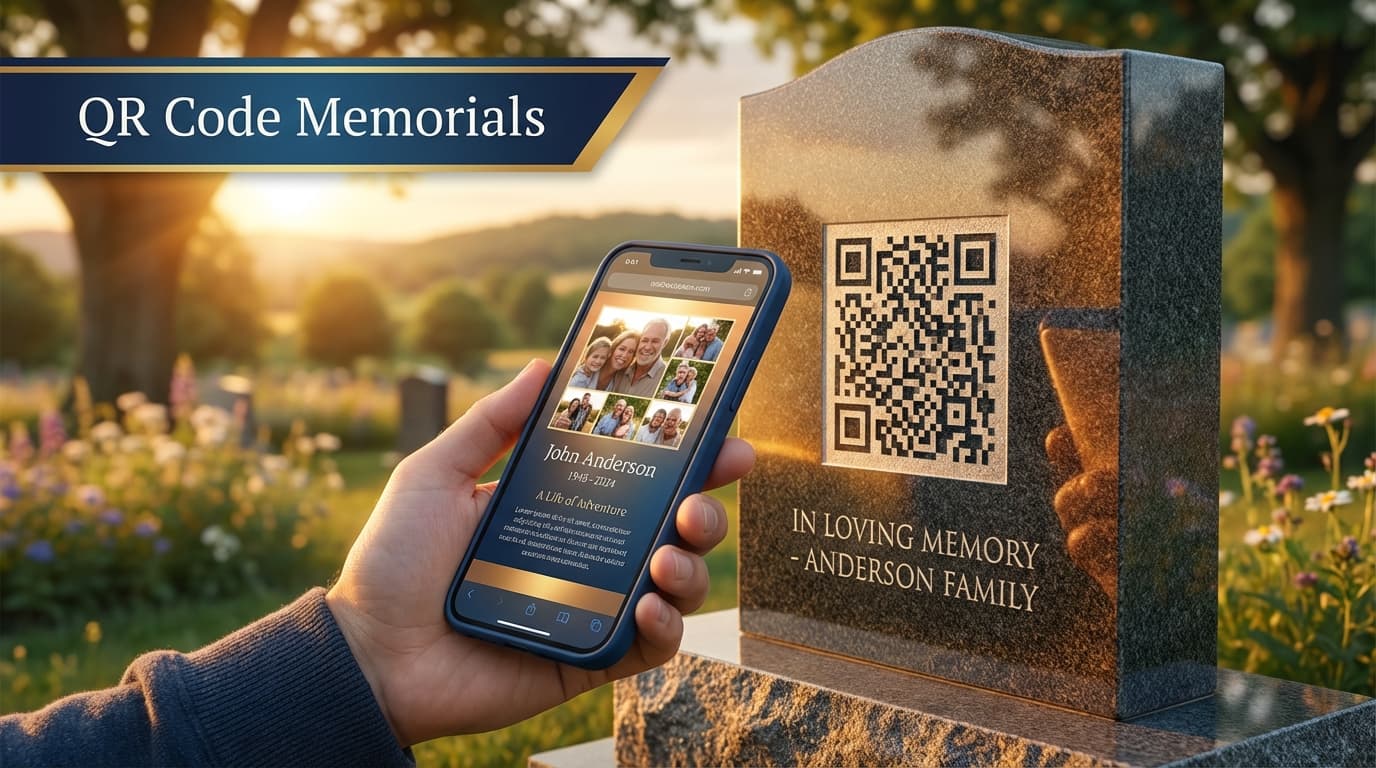
- QR code memorials transform static headstones into living digital tributes — visitors scan a code etched into the monument and instantly access photos, videos, biographies, and family stories on their smartphone.
- The global QR code tombstone market is valued at $450 million in 2024 and is projected to reach $1.2 billion by 2033, growing at a 12.5% CAGR as families increasingly embrace digital remembrance.
- No app is required — any smartphone camera can read a QR code, making these memorials accessible to visitors of all ages and technical abilities.
- Platforms like Linkora provide privacy-first memorial management with multimedia uploads, GEDCOM family tree imports, and multigenerational collaboration tools. Contact us for pricing details.
- Whether you are a family preserving a loved one’s legacy or a monument dealer adding digital services, QR code memorials represent the fastest-growing intersection of technology and remembrance today.
What Are QR Code Memorials? The Bridge Between Stone and Story
For centuries, gravestones have carried the same essential information: a name, a pair of dates, and perhaps a brief epitaph. These inscriptions tell us when someone lived, but rarely capture how they lived — the sound of their laughter, the photographs that defined family gatherings, or the stories passed down at dinner tables. QR code memorials are changing that narrative entirely.
A QR code memorial is a small, scannable code — typically etched, engraved, or mounted on a headstone, urn, memorial bench, or mausoleum wall — that connects visitors to a rich digital tribute page. When someone points their smartphone camera at the code, they are instantly transported to a curated online experience: photo galleries, video messages, written biographies, timeline milestones, and even family trees that span generations. No app download is required. No technical expertise is needed. Just a scan and a story comes alive.
This technology sits at the intersection of an ancient human need — honoring those who came before us — and the modern tools that make storytelling richer, more accessible, and more enduring than a few lines carved in granite. With the QR code tombstone market valued at $450 million in 2024 and forecast to exceed $1.2 billion by 2033, it is clear that families, funeral professionals, and cemetery administrators around the world are recognizing the power of digital memorialization.
Key Distinction: A QR code memorial is not a replacement for a traditional headstone — it is an enhancement. The physical monument remains the anchor of remembrance. The QR code simply unlocks a deeper, multimedia layer of storytelling that stone alone cannot provide.
Why QR Code Memorials Matter: The Numbers Behind Digital Remembrance
The rise of QR code memorials is not a fleeting trend — it is part of a fundamental shift in how society approaches death care and legacy preservation. Consider the broader landscape: the global death care services market is valued at $143.32 billion in 2025 and is expected to reach $217.34 billion by 2035. Within that ecosystem, digital memorial technology — often called “deathtech” — is one of the fastest-growing segments.
QR Memorial Market Value (2024)
Projected Market Value by 2033
Annual Growth Rate (CAGR)
Several forces are converging to drive this growth. First, smartphone penetration is nearly universal — over 102 million Americans are expected to scan QR codes in 2026 alone, making the technology familiar and frictionless. Second, the COVID-19 pandemic accelerated digital adoption in funeral services: 60.5% of funeral homes in the United States now offer livestreaming, up from just 21.5% in 2019 according to the National Funeral Directors Association. Families who experienced virtual funerals during lockdowns now expect digital options as a standard part of memorial services.
Third — and perhaps most importantly — there is a generational shift underway. Adult children managing their parents’ and grandparents’ memorial arrangements are digital natives who instinctively reach for technology to solve problems, preserve memories, and share experiences. For them, a QR code on a headstone is not unusual; it is intuitive.
The Accessibility Factor: Unlike apps that require downloads, account creation, and updates, QR code memorials work with any smartphone camera. This means an 80-year-old visiting a cemetery can access the same digital tribute as a 25-year-old — no tech support required.
How QR Code Memorials Work: A Step-by-Step Guide
Understanding the mechanics of a QR code memorial removes the mystery and makes the technology approachable for families who may be encountering it for the first time. Here is how the process typically works from start to finish.
Step 1: The QR Code Is Added to the Monument
The QR code can be integrated into a memorial in several ways. It may be laser-etched directly into granite or marble, printed on a weather-resistant ceramic or stainless steel plaque, or embedded in a medallion that attaches to the headstone with industrial adhesive. The material choice matters — the code must remain scannable for decades through rain, snow, UV exposure, and temperature extremes. High-quality implementations use UV-resistant materials with sealed QR codes specifically engineered for outdoor durability.
Step 2: The Memorial Page Is Created and Claimed
Once the physical QR code is in place, a family member or authorized caretaker “claims” the memorial on the digital platform. On Linkora, this process takes just minutes. The caretaker links the QR code’s unique identifier to a memorial page, then begins building out the digital tribute with content that brings their loved one’s story to life.
Step 3: Content Is Uploaded and Curated
This is where the magic happens. The memorial page becomes a living repository of memories. Families can upload photographs spanning decades, record or upload video tributes, write biographical narratives, create milestone timelines marking significant life events, and even import GEDCOM files to display interactive family trees. Some platforms allow multiple contributors — siblings, grandchildren, and family friends can all add their own memories, creating a collaborative tribute that no single person could have assembled alone.
Step 4: Visitors Scan and Experience
When a visitor arrives at the gravesite, they simply open their smartphone camera and point it at the QR code. No app download is needed — modern iOS and Android devices recognize QR codes natively. Within seconds, the visitor is viewing the complete digital tribute: scrolling through photo galleries, watching video messages, reading the biography, and exploring the family tree. It transforms a quiet cemetery visit into an immersive journey through a person’s entire life.
| Step | What Happens | Who Is Involved |
|---|---|---|
| 1. Installation | QR code is etched, engraved, or mounted on the monument | Monument dealer or funeral home |
| 2. Claiming | Family claims the memorial and links the QR code to a digital page | Family caretaker |
| 3. Content Upload | Photos, videos, biographies, timelines, and family trees are added | Caretaker + contributors |
| 4. Visitor Experience | Visitors scan the QR code and access the full multimedia tribute | Anyone with a smartphone |
| 5. Ongoing Updates | New memories and content are added over time — the memorial grows | Family and authorized contributors |
What Can You Include in a Digital Memorial? Content Types That Bring Stories to Life
The richness of a QR code memorial lies in the depth and variety of content it can hold. Unlike the physical constraints of a headstone — where every character costs money and space is measured in inches — a digital memorial page has virtually unlimited capacity for storytelling. Here are the content types that families most commonly include.
Photographs and Photo Galleries
From childhood portraits to wedding photographs, family vacations to candid moments, photo galleries form the visual backbone of any digital memorial. On Linkora, families have collectively preserved over 12,000 photographs — each one a window into a moment that mattered. High-resolution images can be organized chronologically, by event, or by contributor, creating a visual narrative that spans an entire lifetime.
Video Tributes and Messages
Video adds a dimension that photographs alone cannot capture — the sound of a voice, the way someone moved, the specific cadence of a laugh. Family members can upload existing video clips or record new tribute messages directly. Some families include clips from milestone events like birthdays, graduations, and anniversaries. Others record spoken memories that become oral histories for future generations.
Biographical Narratives
A written biography provides the narrative thread that connects all the other content. It tells the story of a life in the person’s own context — where they grew up, what they valued, what they accomplished, and what they meant to the people around them. Unlike a newspaper obituary written in haste during grief, a digital biography can be crafted over time, revised as new memories surface, and expanded as different family members contribute their perspectives.
Milestone Timelines
Interactive timelines map out the significant moments in a person’s life — from birth and education to career milestones, marriages, the birth of children, travel adventures, and community involvement. This chronological format makes it easy for visitors to understand the arc of a life at a glance, then dive deeper into any moment that catches their interest.
Family Trees (GEDCOM Import)
For families invested in genealogy, the ability to import GEDCOM files — the standard format used by ancestry platforms — and display interactive family trees is invaluable. This feature connects individual memorials into a broader family narrative, showing how generations are linked and making it easy for distant relatives to discover their shared heritage.
Tributes and Guest Messages
Perhaps the most touching content comes from others. QR code memorials allow friends, colleagues, and community members to leave written tributes — shared memories, expressions of gratitude, or stories that the family might never have heard. Over 3,200 tributes have been shared through Linkora alone, each one adding another facet to the portrait of a life well-lived.
Families who use Linkora’s QR code memorials report overwhelmingly positive experiences in preserving their loved one’s story
Privacy and Security: Who Controls the Memorial?
One of the most important — and often overlooked — questions about digital memorials is privacy. When a family pours their most cherished memories into an online platform, they need confidence that those memories are protected and that they maintain complete control over who sees what.
Reputable QR code memorial platforms address this with multiple layers of access control. On Linkora, for example, the memorial caretaker holds the primary authority. They can choose whether the memorial is fully public (accessible to anyone who scans the QR code), semi-private (visible only to approved family members), or restricted (requiring a PIN or verification to access). This flexibility is critical because different families have different comfort levels with sharing personal content.
Privacy Features to Look For: QR ID and PIN verification for caretaker access, contributor management tools, content moderation capabilities, visibility controls per content type, and GDPR-compliant data handling. A platform that puts privacy first gives families peace of mind that their memories are safe.
Content moderation is another essential feature. When multiple contributors can add content, the caretaker needs the ability to review, approve, or remove submissions. This prevents inappropriate content from appearing on the memorial and ensures that the tribute reflects the family’s wishes. Linkora’s verification system — requiring both a QR ID and a PIN to modify content — ensures that only authorized caretakers can make changes, even if someone else has physical access to the QR code.
How to Choose the Right QR Code Memorial Platform
Not all QR code memorial platforms are created equal. Some offer basic functionality with limited storage and no privacy controls, while others provide comprehensive tools designed for multigenerational memorial management. Here are the factors that matter most when evaluating your options.
| Feature | What to Look For | Why It Matters |
|---|---|---|
| Transparent Pricing | Clear, straightforward pricing with no hidden fees | Families deserve to know exactly what they are investing in |
| Privacy Controls | Granular visibility settings, PIN protection, content moderation | Families need complete control over who sees their memories |
| Multimedia Support | Photos, videos, biography, timelines, family trees | A complete memorial tells the full story, not just fragments |
| Accessibility | No app required — works with any smartphone camera | Every visitor should be able to access the memorial, regardless of age or tech ability |
| Collaboration | Multiple contributors with moderation tools | Memories are richer when the whole family participates |
| Longevity | Lifetime hosting, company stability, data export options | A memorial should last as long as the monument it is connected to |
| B2B Integration | Partner programs for monument dealers and funeral homes | Industry professionals need tools they can offer to their clients |
Linkora checks every box. Privacy-first with QR ID and PIN verification. Full multimedia support including GEDCOM family tree imports. No app required. Collaborative content tools with moderation. A growing partner program for monument dealers and funeral homes. Reach out to our team to learn more about plans and pricing.
For Monument Dealers and Funeral Professionals: Adding QR Memorial Services to Your Business
QR code memorials are not just a product for families — they represent a significant business opportunity for monument dealers, funeral homes, and cemetery administrators. As consumer expectations evolve, families increasingly expect digital options alongside traditional memorial products. Offering QR code memorials positions a business as forward-thinking and adds a high-value, low-cost service to its portfolio.
The Business Case
The economics are compelling. A QR code plaque is inexpensive to produce, yet the perceived value to families is enormous — they are not just buying a piece of metal, they are investing in a permanent way to keep their loved one’s story alive. For monument dealers, this means higher average order values without significantly higher material costs. For funeral homes, it provides an ongoing touchpoint with families well beyond the initial service, creating relationship continuity and referral opportunities.
Platforms like Linkora offer a B2B partner program specifically designed for industry professionals. Partners can integrate QR code memorials into their existing product offerings, provide setup assistance to families as part of the sales process, and differentiate themselves in a competitive market. The platform handles all the technology — hosting, security, content management — so the business can focus on what it does best: serving families during one of the most significant moments of their lives.
Industry Insight: With 60.5% of funeral homes already offering digital services like livestreaming (NFDA, 2023), the infrastructure and appetite for technology in the funeral industry are established. QR code memorials are the natural next step — extending the digital experience beyond the funeral service and into the cemetery itself.
How to Set Up a QR Code Memorial: Your Step-by-Step Roadmap
Ready to create a QR code memorial for your loved one? The process is straightforward, and with the right platform, you can have a fully functional digital tribute up and running in under an hour. Here is your complete roadmap.
1. Choose Your QR Code Medium
Decide how the QR code will be physically presented. Options include laser-etched granite, stainless steel plaques, ceramic medallions, and bronze markers. Consider the environment — outdoor monuments need weather-resistant, UV-proof materials. Speak with your monument dealer about the best option for your specific memorial type.
2. Select a Memorial Platform
Look for a platform that offers the features outlined in our comparison table above: robust privacy controls, multimedia support, no app requirements, and longevity you can trust. Linkora’s claim process is designed to be completed in minutes, with guided setup that walks you through each step.
3. Claim and Link Your Memorial
Using the QR code’s unique identifier and your personal PIN, claim the memorial on the platform. This establishes you as the primary caretaker with full administrative control. The claiming process is secure and ensures that no unauthorized person can modify your memorial content.
4. Build Your Digital Tribute
Now comes the meaningful part. Upload your best photographs. Write or paste a biographical narrative. Add video clips that capture your loved one’s personality. Create milestone timeline entries for significant life events. If you have genealogy data, import your GEDCOM file to display the family tree. Take your time — the memorial is a living document that you can continue to build over weeks, months, and years.
5. Invite Contributors
Share access with family members and friends who have their own memories to contribute. Multiple perspectives create a richer, more complete portrait. You retain moderation control, so you can review and approve all contributions before they appear on the memorial page.
6. Set Privacy Preferences
Configure who can view the memorial. Choose between public access (any scanner), family-only access, or fully private settings. You can also control visibility on a per-content basis — for example, making photos public but restricting the family tree to approved members only.

The complete QR code memorial setup process — from physical installation to a fully personalized digital tribute.
Addressing Common Concerns About QR Code Memorials
Despite the clear benefits, some families and professionals have questions about the practicalities and longevity of QR code memorials. Let us address the most common concerns head-on.
Will QR Codes Become Obsolete?
This is perhaps the most frequently asked question. The short answer: QR codes are an ISO international standard (ISO/IEC 18004) that has existed since 1994 and has only grown in adoption over three decades. With over a trillion QR code scans expected globally in 2025, the technology is more entrenched than ever. Furthermore, because QR codes are simply encoded URLs, even if scanning technology evolves, the underlying memorial pages remain accessible through direct web links. Responsible platforms also maintain long-term data stewardship commitments to ensure memorial content persists.
What About Vandalism or Damage?
QR codes designed for memorial use are engineered to withstand the elements. The QR standard itself includes robust error correction — a QR code can still be read even if up to 30% of its surface is damaged. Combined with durable materials like stainless steel or laser-etched granite, these codes are built to endure the same conditions as the monument itself. In the unlikely event of physical damage, the digital memorial content remains safely stored on the platform, and a replacement QR code can be produced.
Is My Content Safe from Hackers?
Reputable platforms implement enterprise-grade security measures including encrypted data storage, secure authentication protocols, and regular security audits. On Linkora, the QR ID plus PIN verification system means that even someone who physically scans the QR code cannot modify the memorial content without authorization. Families maintain complete control over their data at all times.
What If the Platform Company Goes Away?
This is a legitimate concern and one that responsible platforms address proactively. Look for platforms that offer data export capabilities, have transparent terms of service regarding data ownership, and demonstrate long-term business viability. Linkora is committed to data stewardship — your content belongs to you, and the platform is built for the kind of longevity that memorial services demand.
The Future of QR Code Memorials: What Comes Next
QR code memorials are already transformative, but the technology continues to evolve. Several emerging trends suggest even richer memorial experiences in the near future.
Augmented Reality (AR) Integration: Imagine pointing your phone at a headstone and seeing a holographic photograph of the deceased, or watching a short video message appear overlaid on the monument. AR-enhanced memorials are in early development and could add a profoundly emotional layer to cemetery visits.
AI-Powered Life Narratives: Artificial intelligence could help families organize raw content — hundreds of photographs, scattered notes, recorded interviews — into coherent biographical narratives, automatically tagging dates and locations and suggesting timeline entries.
Cemetery-Wide Digital Experiences: Forward-thinking cemeteries are exploring QR code programs that transform entire grounds into interactive historical experiences. Visitors can follow curated trails, learning the stories of notable figures and community members as they walk among the monuments. This approach revitalizes cemeteries as places of engagement and education, not just mourning.
Deeper Family Tree Integration: As genealogy platforms continue to grow, the connection between memorial pages and family tree databases will deepen, allowing visitors to explore not just one person’s story but the entire web of family relationships that surrounded them.
Families around the world are already using Linkora to transform monuments into living digital tributes
Frequently Asked Questions About QR Code Memorials