
TL;DR
- Digital legacy planning is the process of organizing your online accounts, digital files, and cherished memories so they can be preserved, transferred, or memorialized after you pass away.
- The average adult now manages over 300 online accounts, yet most people have no plan for what happens to their digital lives after death.
- A complete digital legacy plan includes a digital asset inventory, a designated digital executor, platform legacy tools, secure credential storage, and a memorial preservation strategy.
- QR code memorials offer a powerful way to bridge physical monuments with living digital tributes that future generations can visit and contribute to.
- The digital legacy market is projected to reach $43.8 billion by 2030, reflecting growing awareness that our online lives deserve the same thoughtful planning as our physical ones.
What Is Digital Legacy Planning and Why Does It Matter?
Digital legacy planning is the thoughtful process of deciding what happens to your online presence, digital accounts, and digitally stored memories after you die. In a world where the average adult manages over 300 distinct online accounts and more than 70% of our most valuable personal information exists only in digital form, this kind of planning has never been more important. Yet most people give little thought to the digital footprint they will leave behind.
Think about it: the photos on your phone, the messages you have exchanged with loved ones, the family videos stored in the cloud, your social media posts documenting decades of life. These are not just data points. They are the stories, milestones, and emotional connections that define who you are. Without a digital legacy plan, these memories could be lost forever, locked behind passwords that no one else knows, or deleted by platforms following their default policies.
Whether you are a parent hoping to preserve family history, an adult child managing a loved one’s affairs, or simply someone who wants their story to live on, understanding digital legacy planning is the first step toward ensuring your memories endure. If you are new to the concept of digital memorials and how they work, that is a great place to start before diving deeper into legacy planning.
The Growing Scale of Our Digital Lives
The sheer volume of digital content we create during our lifetimes is staggering and growing every year. Consider the numbers behind our collective digital existence.
The estimated size of the digital legacy market in 2025, projected to reach $43.8 billion by 2030
According to recent market research, the digital legacy industry is one of the fastest-growing segments in technology. The Oxford Internet Institute found that the number of deceased Facebook accounts alone will reach nearly 5 billion by the end of this century, eventually outnumbering the living users on the platform. This statistic highlights a reality we rarely consider: the internet is becoming an ever-growing repository of human memory, and most of it is unmanaged.
The digital legacy market is growing at a compound annual growth rate of 13.7%, driven by increasing awareness that our online lives deserve the same careful planning we give to physical assets like homes, savings accounts, and family heirlooms. North America currently leads this market, though Asia Pacific is showing the fastest adoption growth.
Key Insight: Your digital legacy is not just about accounts and passwords. It encompasses every photo, video, message, and post that tells the story of your life. For families, these digital memories often hold more emotional value than any physical possession.
What Happens to Your Digital Accounts Without Digital Legacy Planning?
Without proper digital legacy planning, your online accounts enter a kind of limbo. Each platform handles deceased users differently, and navigating these policies during grief can be overwhelming for families. Understanding what each major platform does by default helps illustrate why proactive planning matters so much.
Social Media After Death
Facebook and Instagram allow accounts to be “memorialized” when a family member or close friend notifies the platform. A memorialized Facebook account displays a “Remembering” badge and can be managed by a pre-designated legacy contact who can accept friend requests, pin posts, and update the profile photo. However, without this setup, the account simply remains frozen.
X (formerly Twitter) and LinkedIn do not currently offer the same legacy options. Family members can request account deletion by providing proof of death, but there is no built-in way to preserve the content. Snapchat will delete an account entirely once a death certificate is presented.
The reality is that without any action, most social media accounts will remain intact indefinitely, becoming digital ghosts. This can be deeply unsettling for loved ones who continue to see posts, receive birthday reminders, and encounter the deceased person’s profile in their feeds. Learning how to write a meaningful tribute for a loved one can be part of the healing process during this time.
Financial and Cloud Accounts
Financial accounts, cryptocurrency wallets, cloud storage services, and email accounts each have their own policies. Banks and financial institutions generally have legal processes for accessing accounts after death, though these can be slow and require extensive documentation. Cloud services like Google Drive, iCloud, and Dropbox may contain irreplaceable family photos and documents that could be permanently lost without proper access planning.
As noted by the Digital Legacy Association, email accounts are particularly critical since they often serve as the recovery method for dozens of other accounts. Losing access to a deceased person’s email can create a cascading lockout effect that makes it nearly impossible to manage their broader digital estate.
How to Create a Digital Legacy Plan: Step-by-Step Guide
Creating a comprehensive digital legacy plan does not require technical expertise or expensive legal help. It does require some dedicated time and thoughtfulness. Here is a practical, step-by-step approach to digital legacy planning that anyone can follow.
Step 1: Create a Digital Asset Inventory
Start by listing every digital account and asset you own. This includes social media profiles, email accounts, cloud storage services, streaming subscriptions, online banking, investment platforms, cryptocurrency wallets, domain names, websites, blogs, and any digital files stored locally on devices. Do not forget about less obvious digital estate planning tools like password manager accounts, smart home systems, and digital photo libraries.
For each account, note the platform name, your username or email, and what type of content it holds. Categorize them by importance: critical (financial, email), sentimental (photos, messages, memorials), and manageable (subscriptions, shopping accounts).
Step 2: Designate a Digital Executor
A digital executor is the person you trust to carry out your wishes for your digital assets after you pass. This should be someone who is both tech-savvy enough to navigate online platforms and emotionally close enough to understand your wishes. In many jurisdictions, you can formally designate a digital executor in your will or through a power of attorney document.
Have a conversation with this person about what you want: which accounts should be memorialized, which should be deleted, and which contain memories that should be preserved for your family. Being specific helps reduce the emotional burden on your loved ones during an already difficult time.
Step 3: Use Platform Legacy Tools
Major technology companies now offer built-in digital legacy services that let you plan ahead. Taking advantage of these tools is one of the most impactful things you can do.
Apple Legacy Contact (iPhone): Apple introduced the Legacy Contact feature, allowing users to designate people who can access their iCloud data and device information after death. If you use an iPhone, setting up a legacy contact through your Apple ID settings takes just a few minutes and ensures your photos, messages, notes, and files can be retrieved by your chosen person. This is one of the most valuable legacy contact iPhone features available today.
Google Inactive Account Manager: Google allows you to decide what happens to your Gmail, Google Photos, Google Drive, and YouTube content if your account becomes inactive for a specified period. You can choose to notify trusted contacts and share data with them, or have the account deleted entirely.
Facebook Legacy Contact: Facebook lets you choose a legacy contact who can manage your memorialized profile, write a pinned post, respond to friend requests, and update profile and cover photos.
Step 4: Secure and Document Your Credentials
Store your passwords and access information in a secure password manager (such as 1Password, Bitwarden, or LastPass) and share the master password with your digital executor through a secure method. Never include passwords directly in your will, as wills become public documents during probate.
Consider creating an encrypted document that lists all your accounts alongside your wishes for each one. Keep this document updated as you add or remove accounts throughout your life. Some families in the digital estate planning community use shared family vaults within password managers specifically for this purpose.
Step 5: Preserve Your Memories Digitally
Beyond securing accounts, think about actively preserving the memories and stories that matter most. This is where digital legacy planning moves beyond logistics into something deeply meaningful. Consider creating a QR code memorial that can link a physical monument or plaque to a rich digital tribute page where family members can share photos, videos, stories, and remembrances for generations to come.
Digital memorial platforms like Linkora make it possible to transform a static headstone or memorial marker into a living, interactive tribute. A simple scan of a QR code etched into a monument opens a multimedia memorial page that captures not just dates and names, but the full story of a life lived. Families can upload photos, share favorite memories, record voice messages, and even import family tree data to connect generations.
Families Are Already Preserving Their Stories: Over 500 families trust Linkora to preserve their loved ones’ memories, with more than 12,000 photos shared across memorial pages and a 98% caretaker satisfaction rate. No app required. Visitors simply scan a QR code.
Digital Legacy Services and Tools to Consider
The growing importance of digital estate planning has created a wave of digital legacy services and digital estate planning tools designed to simplify the process. Here is an overview of the key categories and what to look for.
| Tool Category | Purpose | Examples |
|---|---|---|
| Password Managers | Secure credential storage with emergency access or family sharing | 1Password, Bitwarden, LastPass |
| Digital Legacy Vaults | Store important documents, messages, and instructions for after death | DGLegacy, Legacy Hub, LifeAfter |
| QR Code Memorial Platforms | Link physical monuments to interactive digital tributes with photos, videos, and stories | Linkora, Chptr |
| Platform Legacy Settings | Built-in tools from tech companies for managing accounts after death | Apple Legacy Contact, Google Inactive Account Manager, Facebook Legacy Contact |
| Estate Planning Software | Comprehensive estate planning that includes digital asset provisions | Trust & Will, FreeWill, Polaris Plans |
When evaluating digital legacy services, look for platforms that offer privacy controls (you decide who sees what), family collaboration features, multimedia support (not just text), and long-term reliability. A good digital legacy tool should make it easy for non-technical family members to access and contribute to memorial content. For families specifically looking for memorial preservation, understanding how QR codes on headstones work can open up new possibilities for lasting tributes.
QR Code Memorials: Bridging Physical and Digital Legacy
One of the most meaningful developments in digital legacy planning is the emergence of QR code memorial technology. These small, scannable codes can be etched, engraved, or attached to headstones, memorial plaques, benches, or any physical tribute, and when scanned with a smartphone, they open a rich multimedia memorial page.
This technology solves a fundamental challenge in memorial preservation: physical monuments are limited by space, material, and weather, but a digital memorial page has no such constraints. A QR code memorial can include hundreds of photos, video messages from family and friends, written stories and memories, a complete family tree, and even audio recordings of the person’s voice. Visitors do not need to download any app. They simply point their phone’s camera at the QR code.

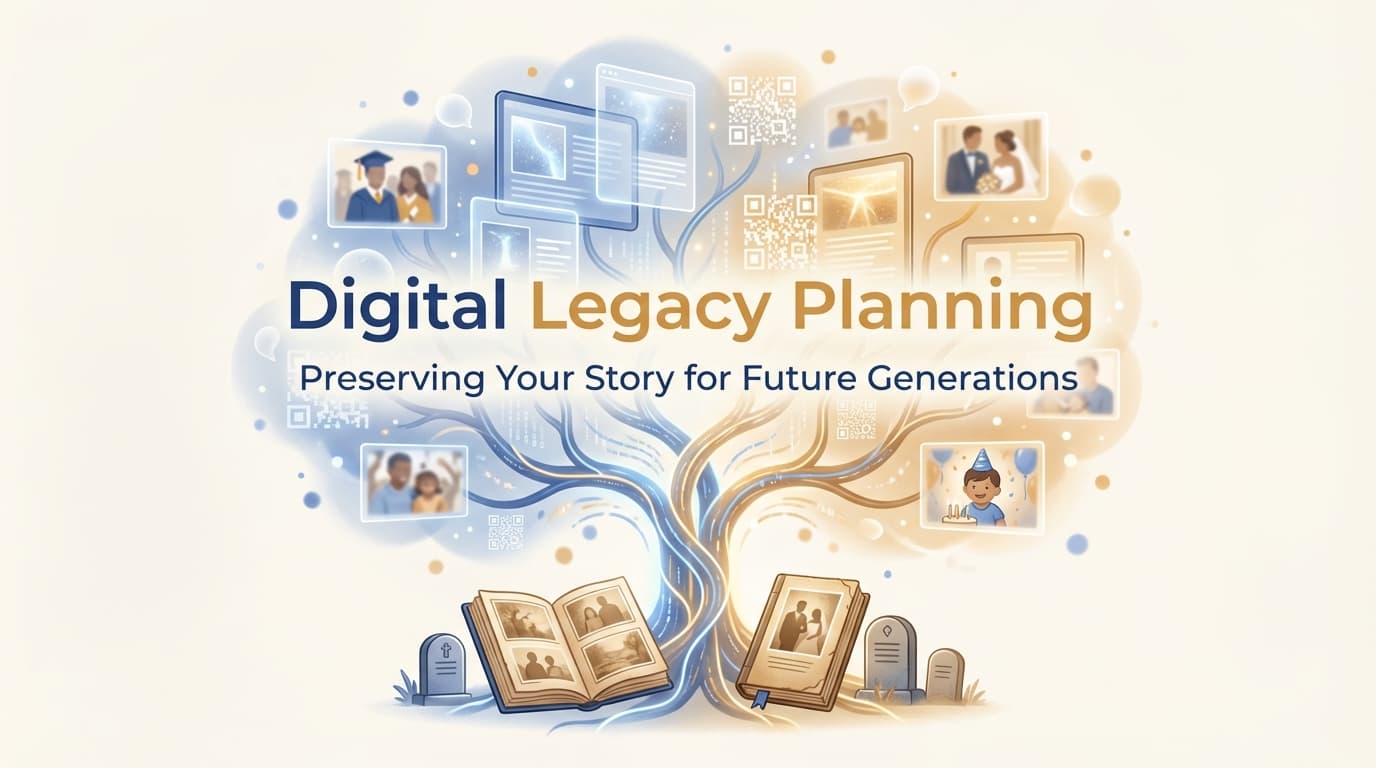
A visual guide to digital legacy planning: from creating your digital inventory to preserving memories with QR code memorials.
For families managing memorial arrangements, QR code memorials represent the perfect intersection of tradition and technology. The physical monument remains a place of reverence and reflection, while the digital memorial page becomes a living, evolving tribute that grows richer over time as more family members contribute their memories. As funeral technology continues to evolve, these kinds of hybrid physical-digital solutions are becoming the standard for modern memorialization.
Linkora’s platform is built specifically for this purpose, offering families complete control over their memorial content, privacy settings, and the ability to invite multiple family members to collaborate on a memorial page. With GEDCOM family tree import support and multimedia capabilities, it bridges the gap between physical remembrance and comprehensive digital legacy preservation.
The Future of Digital Legacy: AI Memorials and Beyond
Looking ahead, the intersection of artificial intelligence and memorial technology is creating new possibilities that were once the realm of science fiction. In 2026, some memorial services are already experimenting with AI-powered chatbots trained on a person’s text messages, emails, and journals, allowing loved ones to have text-based conversations that feel remarkably like talking to the person they lost.
High-end digital legacy services now offer holographic projections and virtual reality environments where the deceased can be “present” in a digital space, providing a sense of proximity that traditional photos cannot match. While these technologies are still emerging, they point to a future where digital legacy planning is not just about preserving what existed, but about creating new ways for families to connect with the memories and personalities of those they have lost.
However, it is important to approach these innovations thoughtfully. The foundation of any good digital legacy plan starts with the basics: securing your accounts, documenting your wishes, and choosing a platform that will reliably preserve your memories. Technologies like QR code memorials, which offer a proven and accessible way to connect physical and digital remembrance, provide a practical starting point before exploring more advanced options. If you are looking for meaningful ways to honor a loved one who has passed, combining physical remembrance gifts with digital memorials creates a deeply personal tribute.