
Free guide + worksheets
Green Burial Guide: gentler ways to return to the earth
What makes a burial green, what the law does and doesn't require, honest costs, and where aquamation and human composting are legal. With a fillable worksheet to compare providers.
Reviewed by the Linkora editorial teamUpdated October 202613 cited sources10 min read
- GBC cemetery tiers
- 3
- GBC cemetery tiers
- Aquamation states
- 26
- Aquamation states
- Composting states
- 14
- Composting states
The basics
What makes a burial green
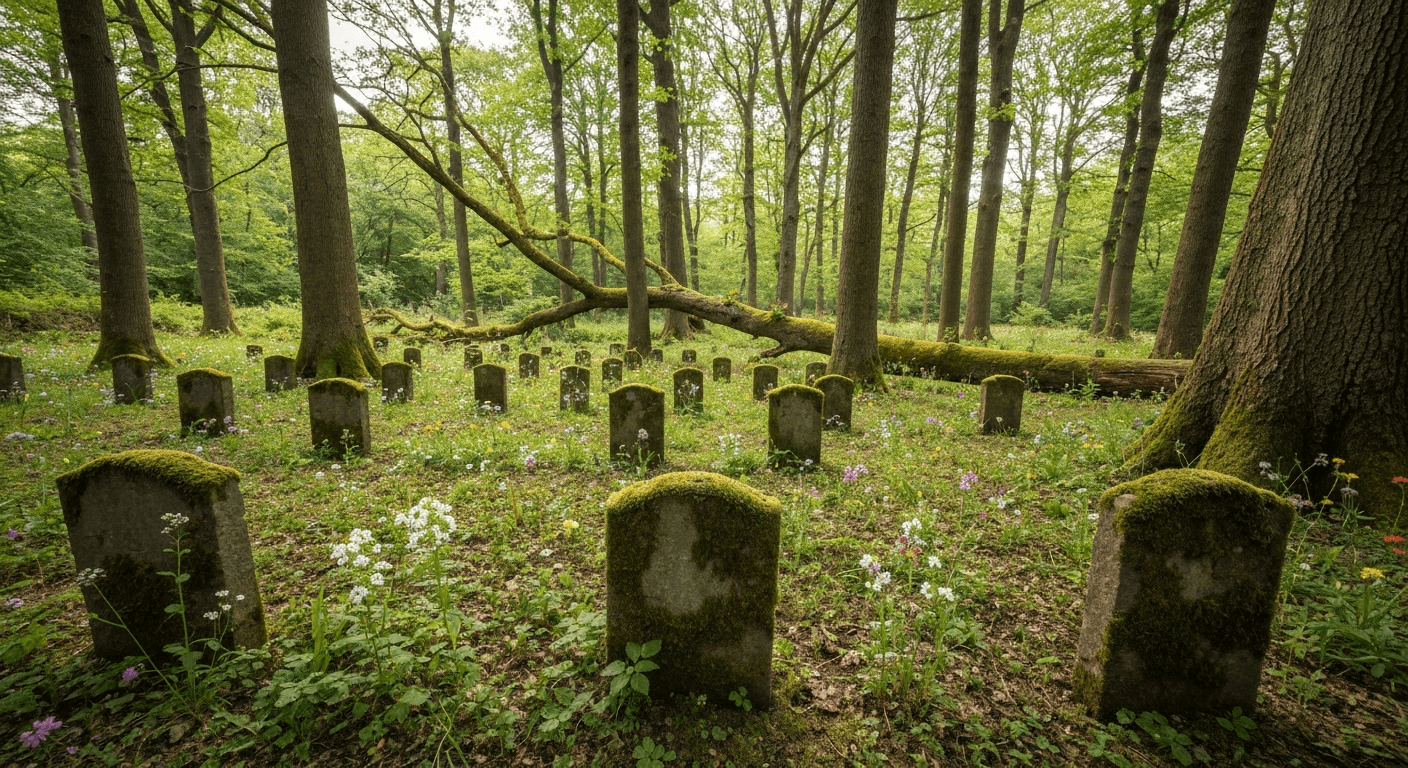
The Green Burial Council (GBC) describes green burial as placing the body directly in the earth, without embalming, using biodegradable materials [1]. It comes down to three choices:
- The body. No toxic embalming. Refrigeration, or washing and dressing at home, is used instead [1].
- The container. A shroud or a casket of pine, wicker or another biodegradable material, with no vault [1].
- The land. A cemetery that protects the ground, from a green section of a conventional cemetery up to a nature preserve [1].
Free printable PDF
Get the Green Burial Guide
A 10-page fillable PDF: the key facts with sources, a three-provider comparison worksheet, a line-item cost sheet, questions to ask, and a page to record your own green burial wishes.
We'll send the PDF plus a few short, helpful follow-ups. Unsubscribe anytime. Privacy
Side by side
Green vs. conventional burial at a glance
| Conventional burial | Green (natural) burial | |
|---|---|---|
| Body care | Embalming is common, but not legally required [3] | No toxic embalming; refrigeration or home care [1] |
| Container | Metal or hardwood casket | Shroud, pine, wicker or another biodegradable material [1] |
| Outer container | Concrete or metal vault, often a cemetery rule rather than a law [3] | None in GBC-certified cemeteries [2] |
| Marker | Upright headstone is typical | GPS, flat native stone or plantings; upright monuments are rare [2] |
| Cost | NFDA 2023 median $8,300, excluding cemetery costs [5] | Can be less, the same or more, depending on choices [2] |
About the environmental numbers. Estimates of what US conventional burials put in the ground each year vary widely. One GBC-attributed estimate cites more than 4 million gallons of embalming fluid and 1.6 million tons of concrete [9]. Another puts embalming fluid at about 800,000 gallons, with the same 1.6 million tons of concrete [10]. A single flame cremation has been estimated at about 534 pounds of carbon dioxide, a figure from one scientist [11]. Treat these as rough estimates, not precise measurements.
Certification
The three kinds of green cemetery
Tier 1 · Hybrid
A green section inside a conventional cemetery
The fewest requirements: no vaults, no toxic chemicals, biodegradable containers, and money set aside for long-term maintenance [1].Tier 2 · Natural
Land dedicated to natural burial
Everything in Hybrid, plus an Ecological Impact Assessment, protection for sensitive areas and limits on memorial markers [1].Tier 3 · Conservation
Burial that protects land for good
Everything in Natural, plus a conservation easement or land trust. Burial fees help fund conservation and restoration [1].
Beyond burial
Other lower-impact options
| Option | How it works | Where it's legal |
|---|---|---|
| Aquamation (alkaline hydrolysis) | Water and alkali break down the body in 3 to 16 hours, depending on equipment and body mass. It uses significantly less fuel than flame cremation [7]. | 26 states [7] |
| Human composting (natural organic reduction) | The body is placed in a vessel with plant material and becomes soil that can be returned to the family. | 14 states [8] |
| Burial at sea | At least 3 nautical miles from land, in water at least 600 feet deep. Notify the EPA within 30 days [6]. | Federal rules for US ocean waters [6] |
| Scattering cremated remains | On land, at sea or in a memorial garden. At sea, any depth beyond 3 nautical miles [6]. | On land, rules vary by state and landowner |
Costs
What it costs: think in line items
- Viewing and burial, 2023 [5]$8,300
- Viewing and burial, 2021 [5]$7,848
- Viewing and cremation, 2023 [5]$6,280
- Viewing and cremation, 2021 [5]$5,810
These are medians, not averages. They exclude cemetery costs such as the plot, opening and closing the grave, and a marker.
| Line item | With green burial you may | Why |
|---|---|---|
| Embalming | Leave it out | Not required by state law for every death; refrigeration usually works [3] |
| Vault or grave liner | Leave it out | Not used in GBC-certified cemeteries [2] |
| Casket or shroud | Pay less, the same or more | A simple shroud costs little; a handmade casket can cost more |
| Plot, opening and closing | Still pay | Every burial has cemetery costs |
| Transport | Pay more | The nearest green cemetery may be farther away |
Ask each funeral home for its General Price List. Under the FTC Funeral Rule you can buy only the goods and services you want [3]. The PDF has a cost sheet to fill in two quotes side by side.
Questions to ask
How to choose a provider
Bring these questions to every call or visit. The PDF turns them into a comparison worksheet for three providers.
- May I have your General Price List? You're entitled to one [3].
- Do you have refrigeration, so embalming isn't needed? [3]
- Will you handle a shroud or a casket we bought elsewhere? [3]
- Are you certified by the Green Burial Council, and at which tier? [1]
- How are graves marked, and are upright stones allowed? [2]
- Can our family take part: carrying, lowering or backfilling?
- What is the total, including opening, closing and any endowment or perpetual care fee?
Remembering
How graves are marked in natural cemeteries
Upright monuments are typically not found in green cemeteries [2]. Graves are often marked with GPS coordinates, a flat native stone or a planting. That can feel unfamiliar, so write down the exact location while it's fresh: the section, the GPS coordinates and directions from the entrance.
Planning ahead
Put your wishes in writing
Green burial takes more planning than most funerals: not every area has a green cemetery, and not every funeral home offers refrigeration or handles shrouds. Writing your wishes down gives your family time to find the right provider.
- Record your preferred disposition, cemetery tier, container, body care, ceremony and marker. The PDF has a page for this.
- Tell two people where the page is, and keep it separate from your will.
- Our End-of-Life Planning Binder has room for the rest: contacts, accounts and documents.
FAQ
Questions about green burial
Can’t find what you’re looking for? Read all FAQs or ask us directly.
Important Disclaimer
This content is for informational purposes only and does not constitute legal advice. Laws vary by jurisdiction. Consult a qualified attorney for advice specific to your situation.
This content is for informational purposes only and does not constitute financial advice. Consult a licensed financial advisor or accountant for advice specific to your circumstances.
Last reviewed: October 7, 2026
Sources
Where these facts come from
- [1]What Is Green Burial · Green Burial Council
- [2]Frequently Asked Questions · Green Burial Council
- [3]The FTC Funeral Rule · Federal Trade Commission
- [4]Statistics: consumer preferences and cremation rates · National Funeral Directors Association, 2025
- [5]2023 NFDA General Price List Study · National Funeral Directors Association, 2023
- [6]Burial at Sea · US Environmental Protection Agency
- [7]Alkaline Hydrolysis · Cremation Association of North America
- [8]Support Composting Legislation · The Order of the Good Death
- [9]The case for green burial (citing Green Burial Council estimates) · Slate, 2021
- [10]Dying Green: Have You Considered a Natural Burial · Oregon Environmental Council
- [11]Rest in compost: these green funerals offer an eco-friendly afterlife · National Geographic
- [12]Cemetery Provider Map · Green Burial Council
- [13]Funeral Homes Provider Map · Green Burial Council
Reviewed by the Linkora editorial team against the sources above. Last reviewed October 2026. Spotted something out of date? Tell us.
Keep exploring
Related free resources




From the blog
Stories and guides from the blog


Honor them in a way that lasts
A natural grave may be marked by a stone or a tree. A Linkora memorial keeps the rest: photos, stories, tributes and directions to the grave.
Send us a message
Fill out the form and we'll be in touch shortly.
By submitting you agree to our Privacy Policy