
TL;DR: Appropriate Funeral Attire at a Glance
- The default is conservative and dark. Black is traditional, but charcoal, navy, deep gray, and muted earth tones are equally appropriate in most American funerals today.
- Cover your shoulders, knees, and chest. Sleeves (or a wrap), hemlines at or below the knee, and a higher neckline keep the focus on the family, not your outfit.
- Match the occasion. Traditional funerals lean formal. Memorial services and viewings sit one notch more relaxed. Celebrations of life often invite color, with the family setting the tone.
- Religion and culture override defaults. Catholic, Jewish, Muslim, Hindu, and military funerals each carry their own expectations. When in doubt, ask the funeral home or a family member.
- Skip the loud and the casual. No bright prints, distressed denim, athletic wear, beach sandals, club-wear, or anything that pulls attention from the person being honored.
Why Appropriate Funeral Attire Still Matters
What you wear to a funeral is one of the few things you can fully control on a day defined by grief. It is also one of the easiest ways to show the family that you took the moment seriously. The right outfit is not about fashion or expense. It is a quiet signal that says, “I am here for you, and I respect what we are doing today.”
According to the National Funeral Directors Association’s most recent member survey, more than 60 percent of funeral directors say they regularly field questions from guests about dress code, and that number has climbed since the rise of less-formal services like the modern celebration of life. The lines have softened, but they have not disappeared. Confusion about what to wear is now one of the most common stressors for first-time funeral guests.
This guide walks you through every realistic scenario, from a traditional Catholic funeral to a beachside celebration of life, and answers the practical questions families and friends actually ask. You will know exactly what to wear, what to avoid, and how to adapt for season, religion, role, and budget. If you are also looking for the right words to bring along, our companion guide to heartfelt condolence messages covers what to say once you arrive.
One rule that covers 90 percent of cases: If the invitation does not specify a dress code, default to a clean, well-fitted outfit in black or another dark, solid color, with covered shoulders and a knee-length or longer hemline. You will never be the underdressed person in the room.
Universal Funeral Dress Code Principles
Across every region, faith, and family tradition in the United States, four principles hold up consistently. Apply these whenever you are unsure and you will be in safe territory.
1. Color: Dark, Muted, Solid
Black remains the default for a reason. It carries centuries of association with mourning, it does not draw the eye, and it always reads as respectful. That said, most modern American funerals fully accept charcoal gray, navy, deep brown, dark green, and muted plum. The family rarely cares about the exact shade. They care that you did not show up in coral or floral.
Avoid bright primaries (red, hot pink, electric blue, neon yellow), busy patterns, and anything with logos or graphic prints. A single small accent (a navy tie with a subtle pattern, a charcoal blouse with tonal stripes) is fine. A tropical print or a slogan tee is not.
2. Coverage: Modest by Default
Modesty at a funeral is not about prudishness. It is about removing your outfit from the conversation entirely. Practically, that means: shoulders covered (or covered with a wrap during the service), necklines that do not show cleavage, hemlines at or below the knee, and a back that is not cut low. If you would wear it to a club, a beach, or the gym, save it for another day.
3. Fit: Clean and Well-Tailored
An ill-fitting suit or a wrinkled dress draws attention even when the color is right. You do not need designer labels. You need clothes that fit, are pressed, and are clean. If your only black blazer is two sizes too big or your funeral dress is buried at the back of the closet, give it a quick steam the night before. A funeral is one of the few events where being noticeably underdressed is more disrespectful than being overdressed.
4. Restraint: Minimal Accessories
Keep jewelry simple. A wedding band, small studs, a watch, or a single delicate necklace is plenty. Skip the statement pieces, the loud cologne or perfume, and the strong makeup. The goal is to look like you, just turned down a notch.
Funeral guests under 40 say they have searched online for “what to wear to a funeral” before attending one (NFDA 2024 attendee survey)
Appropriate Funeral Attire for Women
The most-searched funeral outfit question every month is some variation of “what should a woman wear to a funeral.” The honest answer: anything modest, dark, and well-fitted. Below are the staples that work for nearly any traditional service.
The Classic Black Funeral Dress
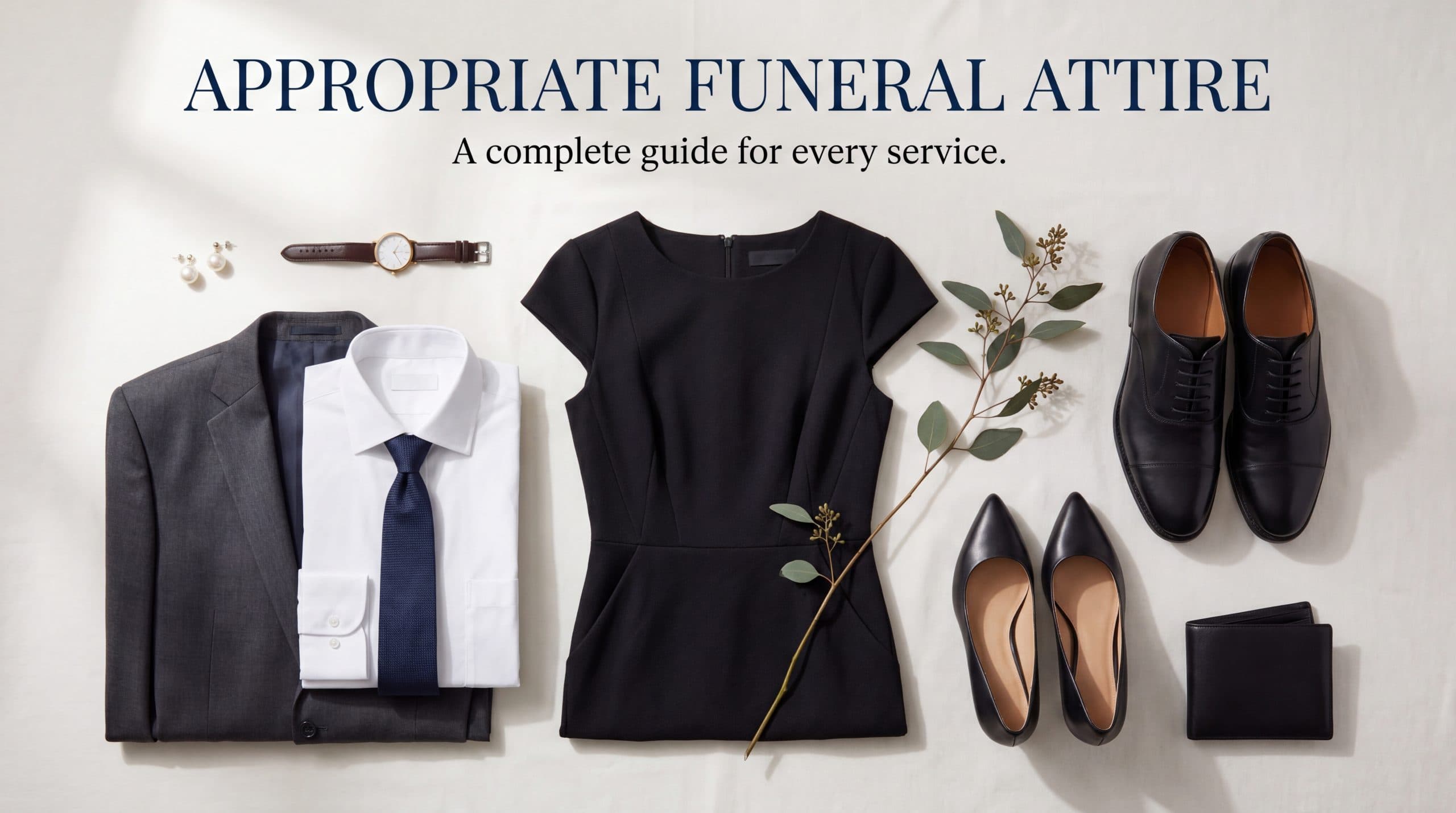
A simple black sheath, A-line, or shift dress that hits at or just below the knee is the most reliable funeral outfit you can own. Pair it with closed-toe black flats or low pumps and a cardigan, blazer, or shawl. If the service is in summer, choose breathable fabrics like cotton, linen blends, or lightweight crepe. A black midi dress with cap or three-quarter sleeves is appropriate year-round.
Skirt and Blouse, or Pantsuit
A knee-length or longer dark skirt with a modest blouse, or a tailored pantsuit, is a perfect alternative if dresses are not your style. Charcoal, navy, and dark gray all read as respectful. Tuck the blouse, add a thin belt, and skip anything see-through or sleeveless without a cover-up.
Plus-Size Funeral Outfits
The same principles apply across every size. Look for stretch crepe sheath dresses, ponte knit A-lines, wide-leg trouser suits, or a long-sleeve dark midi paired with a structured blazer. Brands that carry true extended sizing (Eloquii, Universal Standard, Lane Bryant, Torrid, and most major department stores) all stock funeral-appropriate options under $100. The fit matters more than the cut, so prioritize a piece that drapes cleanly over a trendy silhouette.
Footwear and Outerwear
Closed-toe shoes are the rule. Black or dark leather flats, low block heels, loafers, or ankle boots all work. Save stilettos for another day, both for comfort during a long service and because they tend to read as evening wear. Layer with a black or charcoal coat in winter, or a wool wrap and lightweight blazer in milder weather.
Quick budget tip. If you do not own a black dress and need one quickly, almost every department store stocks a sub-$60 sheath in standard and plus sizes. A clean fit at $50 will always look better than a designer piece that does not sit right.
Appropriate Funeral Attire for Men
The men’s funeral dress code is, if anything, simpler than the women’s. The default is a dark suit, a white or pale dress shirt, a conservative tie, and polished leather shoes.
The Dark Suit
Black, charcoal, or navy. A two-button single-breasted suit in any of these colors covers the vast majority of services. If you only own one suit, a charcoal worsted wool will get you through funerals, weddings, interviews, and most weeknight occasions for years. Make sure the jacket fits across the shoulders and the trousers break cleanly at the shoe.
Shirt and Tie
A crisp white or pale blue dress shirt is the safest pairing. Add a solid black, charcoal, or muted navy tie. Avoid novelty ties, bright colors, and shiny silks. A small subtle pattern (knit, micro-grid) is fine.
Shoes, Belt, and Accessories
Polished black leather oxfords or derbies, matched with a black leather belt and dark dress socks. No sneakers, no boat shoes, no loafers without socks, no athletic watches. A simple watch and a wedding band are all the jewelry you need.
When You Cannot Wear a Suit
Not everyone owns a suit. If you do not, wear dark dress trousers, a button-down shirt (white, pale blue, or pale gray), and a dark sport coat or blazer. A dark sweater over a collared shirt also reads as respectful. The goal is the silhouette of a suit, even if you assemble it from separates.
What to Wear By Type of Service
Not every gathering after a death follows the same dress code. The American funeral landscape has fragmented into half a dozen distinct service types, and each carries slightly different expectations. Here is how to read each one.
Traditional Funeral Service
The standard church or funeral home service. Default to formal, dark attire. Suit and tie for men, dress or skirt suit for women. This is the most conservative end of the spectrum and the safest place to overdress slightly.
Visitation, Wake, or Viewing
A visitation or viewing usually happens the evening before the funeral, often at a funeral home, with an open or closed casket. Dress is one notch more relaxed than the funeral itself. Dark separates, a sweater and dress trousers, a long-sleeve dress (no need for a full suit) are all appropriate. If the viewing flows directly into the funeral, default to full funeral attire so you do not have to change.
Memorial Service
A memorial service is usually held without the body present, sometimes weeks or months after the death. The dress code is typically “smart casual to semi-formal.” Dark, solid colors are still the safest choice, but you can relax the formality (loafers instead of oxfords, knit dress instead of sheath, no need for a tie unless requested).
Celebration of Life
This is where dress codes have changed the most in the past decade. A celebration of life is intentionally less somber than a traditional funeral, and the family often invites guests to dress for the personality of the deceased: their favorite color, their team’s jersey, or simply “smart casual, no black required.” Read the invitation carefully. If the family asks for color, wear color. If they ask for white, wear white. If the invitation is silent, default to dark business casual rather than full funeral formal. Our complete guide to planning and attending a celebration of life walks through every variation.
Graveside or Committal Service
Often shorter and held outdoors, sometimes immediately after the funeral. Formal attire is still appropriate, but practical adjustments matter: a coat in winter, sturdy shoes for grass or gravel, a hat or umbrella for sun and rain. Skip the high heels here.
Repast or Reception
The gathering after the service, usually at a family home, restaurant, or banquet hall. You can stay in your funeral attire, or remove the jacket and tie if the setting is informal. The repast is when guests typically share words of comfort and stories with the immediate family.

Quick reference: appropriate funeral attire by service type, with color and formality guidance for women and men.
Religious and Cultural Considerations
Religion and culture often override the default Western funeral dress code. If you are attending a service outside your own tradition, a five-minute call to the funeral home or to a member of the family will save you from any awkwardness. Below are the most common American variations.
Catholic Funeral Attire
A Catholic funeral Mass is one of the most traditional services in American religious life, and the dress code reflects that. Women typically wear a knee-length or longer dark dress or skirt suit, with shoulders covered for the church portion. Men wear a dark suit, white shirt, and conservative tie. Avoid sleeveless tops, low necklines, and short hemlines inside the church. There are no veils or head coverings required for guests, but a wrap or shawl is welcome.
Jewish Funeral Attire
Jewish funerals tend to happen quickly, often within 24 to 72 hours of death, and the dress code is conservative. Men wear a dark suit and a kippah (yarmulke), which is usually provided at the entrance. Women wear a modest dark dress or skirt suit, with shoulders and knees covered, and married women often wear a head covering. Open-toed shoes are generally discouraged, and leather is sometimes avoided during the seven-day shiva period that follows.
Muslim Funeral Attire
Modesty is paramount at a Muslim janazah service. Women wear long, loose-fitting clothing in dark, muted colors, with arms and legs fully covered, and a head scarf (hijab) is expected inside the mosque. Men wear long trousers, a long-sleeve shirt, and often a head covering. Both men and women remove their shoes before entering the prayer hall.
Hindu and Sikh Funeral Attire
White is the traditional color of mourning in many Hindu and Sikh communities, the opposite of the Western convention. Guests wear simple white or off-white clothing, with women in modest salwar kameez, sari, or kurta, and men in white kurta-pajama or a long-sleeve shirt with light trousers. Avoid black, red, and bright prints. Head coverings are expected in a gurdwara (Sikh temple).
Military and First Responder Funerals
For full-honors military funerals, civilian guests wear traditional dark funeral attire. Veterans and active-duty service members in attendance often wear their uniform. Police and firefighter funerals follow similar conventions, with department members in dress uniform and civilian guests in standard funeral wear.
When the Family Requests Specific Colors
It is increasingly common for families to request a specific color (the deceased’s favorite, the local sports team, or simply “no black”). Honor the request. Wearing red to a celebration of life when the family asked for red is the dress-code equivalent of a hug.
Seasonal Funeral Attire
Summer Funeral Outfits
Hot weather does not change the dress code, only the fabric. Choose a lightweight cotton, linen blend, or crepe dress with sleeves or a wrap, or a tropical-weight wool suit (yes, “tropical weight” wool exists and breathes better than most synthetics). A knee-length midi dress with three-quarter sleeves works in nearly any summer service. Carry a small folding fan or bottled water for outdoor portions, and keep makeup minimal so it does not run.
Winter and Cold-Weather Funerals
Layer thoughtfully so you can move between an overheated chapel and a bitter graveside without redoing your outfit. A wool dress or suit, a long dark coat, dress gloves, and a simple scarf cover most situations. Boots are appropriate at the graveside if the ground is wet or snowy. Avoid puffer jackets in bright colors over funeral attire if you can; a dark wool coat reads more respectfully even if the puffer is warmer.
Outdoor and Beachside Services
Some celebrations of life are held outdoors, at a vineyard, a state park, or a beach. The family invitation usually sets expectations. Default to “garden party” formality: a knee-length sundress in a muted color, a linen suit, or a sport coat with dress trousers. Skip flip-flops, even on sand; opt for leather sandals or low wedges. A hat for sun protection is welcome and dignified.
What NOT to Wear
The “do not wear” list is shorter than the “do wear” list, but it is the part most guests get wrong. Skip every item below unless the family has explicitly requested it.
- Bright or neon colors: red, hot pink, electric blue, fluorescent anything. The exception is a family-requested color.
- Loud prints: tropical, floral, animal, graphic. A small subtle pattern is fine; a Hawaiian shirt is not.
- Casual or athletic wear: jeans, leggings, hoodies, sweatpants, gym sneakers, baseball caps, flip-flops, slides.
- Revealing clothing: mini skirts, low necklines, backless tops, sheer fabrics, bodycon dresses, crop tops.
- Club or evening wear: sequins, satin in jewel tones, stilettos, plunging necklines, body jewelry.
- White, unless requested: in most Christian and Western traditions, white is reserved for the family or the immediate next of kin.
- Strong scents: heavy perfume or cologne in close quarters can trigger headaches and nausea, especially among elderly guests.
- Anything wrinkled, stained, or ill-fitting: the difference between respectful and disrespectful is often a steamer and a lint roller.
Practical Guidance: A Pre-Funeral Checklist
Use this checklist the night before any service. It takes 15 minutes and covers nearly every common stumble.
Night-before checklist:
- Confirm the type of service (funeral, memorial, celebration of life, viewing) and any color or dress-code request from the family.
- Check the venue (church, funeral home, outdoor, graveside) and the weather forecast.
- Choose a dark, modest, well-fitting outfit. Lay it out fully, including shoes and outerwear.
- Steam or iron anything wrinkled. Lint-roll dark fabrics. Polish or wipe down shoes.
- Pack a small bag with tissues, mints, sunglasses, a phone charger, and a sympathy card if you have not delivered one.
- Plan to arrive 15 minutes early to avoid rushing in mid-service.
- Silence your phone before you walk in; turn it off entirely if a religious leader requests it.
Once you have the outfit handled, the second most-asked pre-funeral question is what to bring and what to say. Our guide to writing meaningful sympathy cards covers the words. If you are attending the service of someone you knew well, you may also be asked to share a brief story or remembrance, and our eulogy examples and speech guide walks through how to prepare.
Beyond the Day: Honoring a Life That Lasts
The right outfit gets you through the service. What lasts longer is what comes next, the photos, the stories, the memories the family revisits years from now. More families today are choosing to bridge the in-person tribute with a permanent digital memorial, where guests, distant relatives, and future generations can return to view photos, watch tributes, and add their own remembrances long after the funeral ends.
Linkora’s QR code memorial platform lets families turn any monument or marker into a living digital tribute that visitors can access by scanning a small QR plate. There is no app to download. The full life story, with photos, videos, family tree, and milestones, lives on a private memorial page that the family controls. For relatives who could not travel to the service, or for the children and grandchildren who will visit a graveside decades from now, it is a way to keep the memory accessible long after the flowers are gone.
If you are the family member responsible for the service, building a digital memorial in the days after the funeral can also become a small, meaningful project that gives you something gentle and constructive to focus on, while the rest of the world feels far away. Many families tell us the act of curating photos and writing a few paragraphs is itself part of the grieving process described in the stages of grief.
Frequently Asked Questions About Funeral Attire
Do I have to wear black to a funeral?
No. Black is the safest default in most American funerals, but charcoal gray, navy, deep brown, dark green, and muted plum are equally appropriate. The only exception is when the family explicitly requests a specific color, in which case you should follow their wishes. Hindu and Sikh funerals often expect white instead of black.
What should a woman wear to a celebration of life?
A celebration of life is usually less formal than a traditional funeral. If the family has not specified a color or dress code, default to a knee-length dress, a midi skirt with a blouse, or tailored pants with a structured top in a muted but not necessarily black color (navy, dusty rose, soft sage, taupe). If the family has requested color, the deceased’s favorite team’s jersey, or a specific theme, follow it. Closed-toe shoes are still recommended.
Is it appropriate to wear pants or a pantsuit to a funeral?
Yes, absolutely. Tailored dark pants with a blouse and blazer, or a full pantsuit in black, charcoal, or navy, is fully appropriate for women at any modern American funeral. The “dress required” expectation is a holdover from earlier generations and is no longer the standard. Fit and color matter far more than whether you choose a dress or trousers.
What should kids wear to a funeral?
Children should wear their nicest, cleanest clothing in dark or muted colors. For boys, that often means dark dress trousers with a button-down shirt and a sweater or sport coat. For girls, a simple dark or navy dress or a skirt and blouse. Avoid bright cartoon prints, light-up sneakers, or anything noisy. Babies and toddlers can wear soft, neutral colors. Comfort matters; a fidgety child in itchy formalwear helps no one.
Can I wear jeans to a memorial service or celebration of life?
Generally no, even at a casual celebration of life. The exception is when the family explicitly invites jeans, often for outdoor or themed services that match the deceased’s personality (a ranch celebration, a beach gathering, a motorcycle club tribute). If jeans are invited, choose dark, clean, well-fitting denim with a dressier top and shoes. When in doubt, dark dress trousers or chinos read more respectfully than jeans.