
TL;DR
- Swedish death cleaning, or döstädning, means gradually clearing out your own belongings while you are still able, so the people who love you are not left sorting through decades of it after you die.
- Margareta Magnusson, who wrote the book that made the practice famous, suggests starting around 65. In practice, any move, diagnosis, or empty nest is a reasonable trigger.
- The order matters more than the speed. Start with the unemotional categories: clothes, duplicate kitchenware, the garage, paperwork. Photographs, letters, and heirlooms come last.
- The dot system is the most useful tool in the method. Green sticker to keep, red sticker to release, yellow for undecided. It lets family see your intentions without a conversation you may not want to have yet.
- The step most people skip is the digital one. Photos, accounts, passwords, and the stories behind the objects are now the hardest part of an estate to sort out, and the easiest part to lose entirely.
What Swedish Death Cleaning Actually Means
The Swedish word is döstädning. Dö means death, städning means cleaning, and the compound is far less grim in Swedish than the direct translation sounds in English. It describes the ordinary, unhurried work of going through your own possessions in the later part of your life and deciding what stays, what goes, and what you want someone to know about the things you keep.
The practice went global after Margareta Magnusson published The Gentle Art of Swedish Death Cleaning in 2017. Magnusson, an artist who describes her own age as somewhere between eighty and one hundred, wrote it after clearing out the homes of her parents and, later, her husband. She had done the job enough times to understand what she was leaving behind for her own five children, and she decided not to leave it.
Here is the distinction that most decluttering advice misses. Minimalism asks what you want your home to feel like. Swedish death cleaning asks a different question entirely: what will this room look like to the person who has to empty it in a week, while grieving, while also handling the death certificate, the bank, and the funeral home? It is decluttering with a specific reader in mind. That reframing is why people find it strangely freeing rather than depressing.
Magnusson’s own test for any object is simple and worth memorizing: will anyone I know be happier if I save this? Not “do I like it,” not “is it worth something.” Will someone be happier. Most things fail that test immediately, and the few that pass it deserve a story attached.
Why It Is a Kindness, Not a Morbid Hobby
People hear the word death and assume the practice is about mortality. It is really about labor. Someone has to empty the house. Right now, that someone is usually an adult child in their fifties who took bereavement leave, flew in, and has a few days before the listing agent wants the property cleared.
The cost of that work is not small. Industry pricing guides put the national average for an estate cleanout in 2026 at roughly $1,250, with most families landing somewhere between $500 and $3,000. A large or complex property runs to $15,000 or more, and severe hoarding situations can reach $25,000. That is real money coming out of an estate, and it buys nothing except the removal of things nobody wanted.
What most American families spend on an estate cleanout in 2026, before a single sentimental decision is made
The financial cost is the easier half. The harder half is that every object becomes a decision, and every decision has to be made by someone who is exhausted and sad and does not know what any of it meant to you. Was the chipped blue bowl your grandmother’s, or did it come from a yard sale in 1994? Nobody knows. So it goes in a box, and the box goes in a garage, and the guilt moves house.
Death cleaning is the practice of answering those questions in advance, while you are the only person who can. It pairs naturally with the paperwork side of the job, which is why many people run it alongside an end of life planning checklist covering wills, directives, and account access. The two efforts protect the same person: whoever ends up holding the keys.
When to Start
Magnusson’s answer is around 65. That is a reasonable default, but age is a weaker signal than circumstance. The better triggers are the moments when your relationship with your house changes:
- A downsize or a move. You are touching everything anyway. Do not pay to transport things you already know you will not use.
- The last child moves out. Two bedrooms just became storage. This is the single most common starting point.
- Retirement. You suddenly have the one resource the job was consuming, which is unhurried time.
- A diagnosis, yours or a spouse’s. Difficult, but this is when the practice does the most good, and when your memory of what things mean is most worth capturing.
- You just cleared out a parent’s house. Nearly everyone who has done that job once starts death cleaning within a year. The experience is its own argument.
There is no version of this that is too early, only versions that are too late. If you have recently been through it from the other side, our guide on what to do when a parent dies covers the first-year sequence that makes the case better than any statistic can.
The Method, in Order
Swedish death cleaning is not a weekend project and it is not supposed to be. Magnusson worked at hers for years. What makes it succeed is sequence, not intensity. Emotional difficulty rises as you go, so you build momentum on the easy categories before you reach the ones that will stop you.
1. Start where nothing is sentimental
Clothing you have not worn in two years. Duplicate kitchen equipment. The garage, the shed, the basement shelf of paint cans. Linens for beds you no longer own. These categories have volume, which makes progress visible, and almost no emotional weight, which makes decisions fast. Clearing them also frees the physical space you will need to sort the harder things later.
2. Move to the large furniture
Big pieces are the second easiest call because their fate is practical. Will anyone in the family take the dining set? Ask now, plainly, and accept the answer. A great deal of unnecessary sadness comes from assuming children want furniture they have already politely declined twice.
3. Then paperwork and records
Old tax returns, warranties for appliances you replaced, manuals, statements. Shred what is expired and consolidate what matters into one findable place. This step overlaps almost exactly with the work an executor will have to do, so anything you organize now is time you are giving back. If you have named someone, our guide to the executor of an estate explains what they will actually be looking for, and the estate executor checklist is worth handing them in advance.
4. Sentimental items last, always
Photographs, letters, jewelry, children’s artwork, the things that carry the story. If you start here you will not finish, because the first shoebox of letters will take an afternoon and end the project. Save it for when you have already made a hundred easier decisions and have some practice.
The Dot System and Other Tools That Work
The most practically useful device in the whole method is the dot system, sometimes called the röd prick system. You buy a sheet of colored stickers and you mark things as you go:
| Sticker | Meaning | Why it helps |
|---|---|---|
| Green | Keep, and it is spoken for | Signals which pieces have a named destination in the family |
| Red | Release: sell, donate, or discard | Gives family explicit permission, which removes the guilt |
| Yellow | Undecided, revisit later | Lets you keep moving instead of stalling on one object |
The dots do something subtle and important. They let you communicate your intentions to your family without sitting anyone down for a conversation about your death. A red sticker on a cabinet is not a morbid announcement. It is a small mercy, delivered quietly, that means you are allowed to let this go.
The second tool is the throw-away box. Magnusson keeps one, and the idea is elegant: a single labeled box for the things that are meaningful only to you. Old diaries, a certain bundle of letters, the ticket stub. You look at them when you want to. The label tells your family they may discard the entire box unopened, without reading it and without feeling like they threw away part of you. It resolves the problem of private things that deserve privacy.
One rule that saves the most grief: never gift an object to a family member without asking first, and never assume silence is a yes. An unwanted heirloom does not disappear. It just becomes someone else’s burden, stored in someone else’s garage, with the same guilt attached.
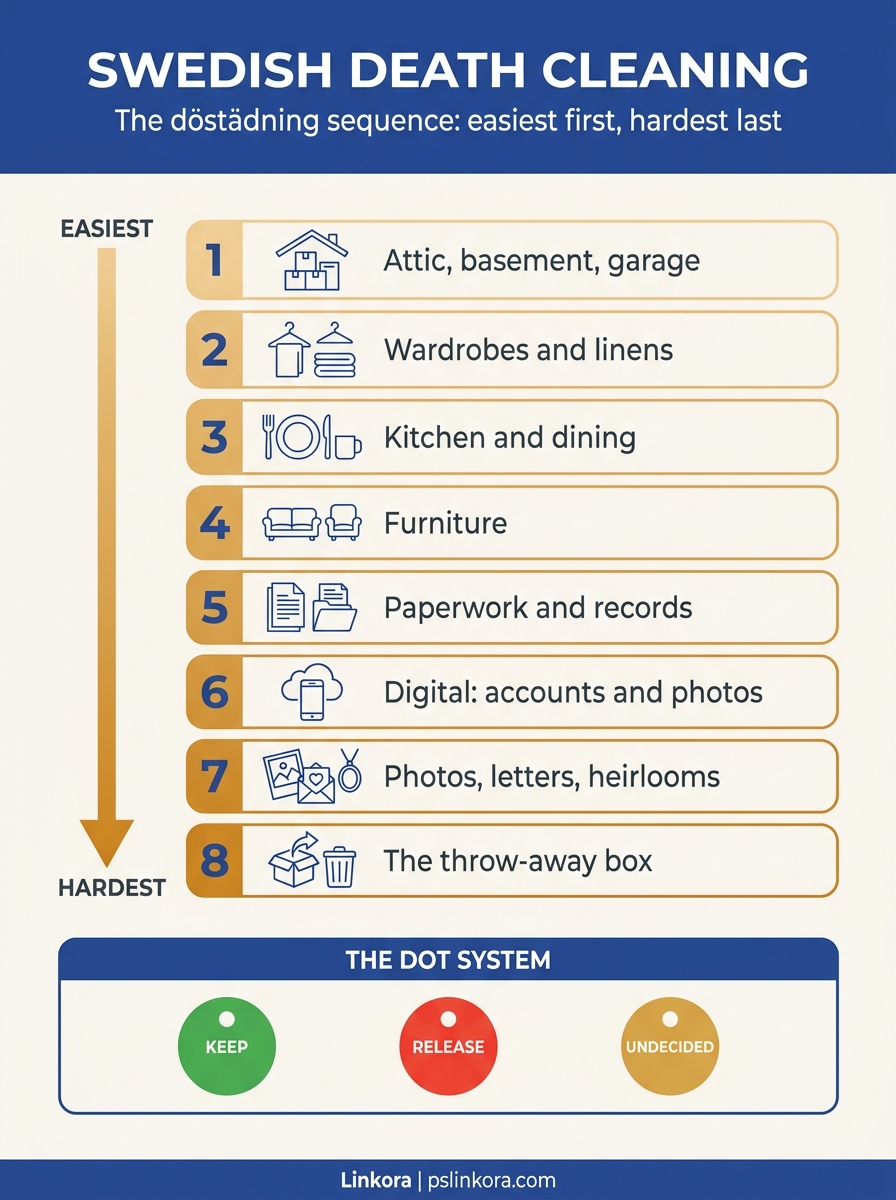
The döstädning sequence: easy categories first, sentimental and digital belongings last.
The Hardest Part: Things You Cannot Throw Away
Ask anyone who has tried this what stopped them and the answer is the same. Not the clothes. Not the garage. It is the box of photographs, the wedding dress, the father’s watch, the drawer of school reports.
These items are hard because they are not really objects. They are storage devices for memory, and getting rid of the object feels like agreeing to forget. That instinct is worth taking seriously rather than arguing with. The useful move is to separate the two things that have been fused together: the memory and the material.
Three approaches that genuinely work:
- Photograph the object, keep the image. Especially effective for bulky things: furniture, uniforms, trophies, a workbench. The photo holds the memory at a fraction of the volume.
- Keep one, not twelve. One teacup from the set, not the set. One drawing from each school year, not the whole portfolio. Representative, not exhaustive.
- Write down why it matters, and attach it. This is the single highest-value habit in the entire practice. An object with no story is clutter to the next person. An object with two sentences taped to the bottom becomes an heirloom.
If you are looking for ways to honor a person or a relationship without keeping the physical object, our roundup of meaningful ways to remember someone who has passed away covers alternatives that hold up better over time than a storage unit does.
Death Cleaning Your Digital Life
Magnusson wrote her book before most families’ memories moved onto phones. This is now the largest gap in the practice, and it is the part that causes the most trouble after a death.
Consider what a typical estate looks like today. Forty thousand photos on a phone, most of them unlabeled and unsorted. A cloud account that nobody else can log into. Email holding the only record of subscriptions and accounts. Social profiles that will keep suggesting the person’s birthday to their friends. Two-factor authentication tied to a phone number that gets disconnected within the month.
Physical clutter is at least visible. Digital belongings are invisible, locked, and quietly deleted by providers after periods of inactivity. Families routinely lose entire photo libraries not because anyone decided to discard them, but because nobody could get in.
Do these four things and you will have done more digital death cleaning than most people ever manage: (1) name a legacy contact in your Apple and Google accounts, which both platforms support natively; (2) put your passwords in one manager and make sure one trusted person can reach it; (3) pull your genuinely irreplaceable photos out of the stream and into one clearly labeled folder; (4) write names and dates on the photos while you still recognize the faces.
That last one deserves emphasis. Every family has a box of photographs of people nobody can identify anymore. It happens in exactly one generation. The information was never written down, and then the person who knew it died. Labeling photographs is the cheapest, most durable thing you can do for your descendants, and it takes an afternoon.
For the full sequence, including account inventories and what platforms actually allow after a death, see our guide to digital legacy planning and the printable digital legacy checklist.
There is a natural endpoint to this work. Once you have chosen the photographs worth keeping and written down the stories that go with them, they need somewhere to live that is not a hard drive in a drawer. A memorial web page is built for precisely that job: photos, dates, tributes, and a life story held in one place the whole family can reach. Linkora connects that page to a QR code on the monument itself, so the story is not stored somewhere a future grandchild would have to know to look. They scan the stone and the whole person is there. You can see how other families have used a memorial page before deciding what to include.
A Room-by-Room Starting Order
If you want a concrete sequence rather than a philosophy, work in this order. Each stage is deliberately harder than the one before it.
| Stage | Where | The question to ask |
|---|---|---|
| 1 | Attic, basement, garage, storage unit | Have I opened this box in five years? |
| 2 | Wardrobes and linen closets | Have I worn or used this in two years? |
| 3 | Kitchen and dining | How many of these do I need for the life I have now? |
| 4 | Furniture and large items | Has anyone actually said they want this? |
| 5 | Files, paperwork, financial records | Would my executor find this in ten minutes? |
| 6 | Digital: accounts, passwords, photo libraries | Could anyone but me get into this? |
| 7 | Photographs, letters, heirlooms | Does anyone else know why this matters? |
| 8 | The throw-away box | Is this only for me? |
Keeping a written record as you go is more valuable than it sounds, both as a memory aid and as a way of processing what you are letting go of. Some people find it easier as journaling than as list-making, and our guide to starting a grief journal has prompts that work just as well for this.
Talking to a Parent About Death Cleaning
Handing your mother a book about death cleaning is a recognized way to start an argument. If you are the adult child in this situation, a few things reliably work better.
Lead with curiosity rather than logistics. “Where did this come from?” opens a door that “what should we do with all this?” closes. Most parents want to tell you about their things far more than they want to dispose of them, and the storytelling is what makes the sorting possible later.
Do your own first. It is difficult to be lectured about clutter by someone whose own basement is full. Starting your own death cleaning changes the conversation from a request into a shared project.
Go in small sessions. Two hours, one category, then stop and have lunch. Marathon sessions produce exhaustion and rash decisions, and rash decisions are what people regret. And record what you learn while you are there, because those explanations are the part that cannot be recovered later. Turning them into something durable, whether that is notes, an audio recording, or eventually a written tribute, is arguably the whole point of the exercise.
Mistakes Worth Avoiding
- Starting with the photographs. It ends the project on day one. Every experienced organizer says the same thing.
- Treating it as a single event. Döstädning is meant to run over years. A one-weekend blitz produces regret and does not stick.
- Distributing heirlooms without asking. Willing the piano to a daughter who lives in a third-floor walk-up creates a problem, not a gift.
- Ignoring the digital estate entirely. The most irreplaceable things most families own are now the least protected.
- Keeping the object but not the story. An unlabeled heirloom becomes anonymous within one generation. Two sentences prevents it.
The Point of Any of This
The reason death cleaning has resonated so far outside Sweden is that it is not really about tidiness. It is about the difference between leaving a mess and leaving a message.
A house full of unsorted belongings tells your family nothing except that there is work to do. A house that has been gently death cleaned tells them what mattered to you, gives them permission on everything else, and hands them a small, curated set of things with the stories still attached. One of those is a burden. The other is closer to a last act of care.
You do not have to finish. Almost nobody does. But every drawer you sort, every photograph you label, and every password you write down is a decision your family will not have to make on the worst week of their lives.
Frequently Asked Questions
What is the difference between Swedish death cleaning and regular decluttering?
The audience. Ordinary decluttering is done for yourself, to make your home more pleasant or more functional right now. Swedish death cleaning is done for the people who will have to empty your home after you die. That changes the questions you ask. Instead of “does this spark joy,” you are asking “will anyone be happier that I kept this,” and “would my family know what this is.” It also changes the pace. Decluttering is usually a project with an end date, while döstädning is meant to unfold slowly over years, and it includes tasks decluttering never touches, such as labeling photographs, documenting where accounts and passwords are, and telling people the stories behind the objects you keep.
What is the red dot system in Swedish death cleaning?
It is a colored-sticker method for marking your decisions on objects as you make them, sometimes called the röd prick system. A red dot means the item can be sold, donated, or discarded after you are gone. A green dot means keep, usually because it has already been promised to a specific person. A yellow dot means you have not decided yet, which lets you move on rather than stall. The real value is not organizational, it is emotional: the dots tell your family what you wanted without requiring you to have a difficult conversation about your death, and a red sticker gives them explicit permission to let something go without guilt.
At what age should you start Swedish death cleaning?
Margareta Magnusson suggests around 65, but she is clear that the practice can begin at any age and that earlier is better than later. In practice, circumstance is a more useful trigger than a birthday. The most common starting points are a downsize or move, retirement, the last child leaving home, a health diagnosis, or having just cleared out a parent’s house yourself. That last one converts more people than the book does. There is no such thing as starting too early, because anything you sort now is time and money you are giving back to your family later.
What is the hardest thing to get rid of when death cleaning?
Photographs, letters, and inherited items, consistently. They are difficult because they are not really objects, they are containers for memory, so discarding one feels like agreeing to forget the person or the period attached to it. The method’s answer is to separate the memory from the material: photograph bulky sentimental items and keep the image, keep one representative piece rather than the whole set, and write down why something matters and attach the note to it. For the private things that are meaningful only to you, Magnusson recommends a labeled throw-away box your family may discard unopened, without reading it and without guilt.
Is there a Swedish death cleaning TV show, and is it on Netflix?
There is, and it is not on Netflix. The Gentle Art of Swedish Death Cleaning is a Peacock original series, narrated and executive produced by Amy Poehler, which ran for one season of eight episodes. Each episode follows three Swedish “death cleaners” (an organizer, a designer, and a psychologist) as they help an American household work through its belongings and, more to the point, talk honestly about death. A great many people search for it as “Swedish death cleaning Netflix,” which is the most common mix-up around the show. The book by Margareta Magnusson came first, in 2017, and remains the fuller explanation of the method.