
TL;DR
- Get permission from the cemetery first, then check the stone for cracks, flaking, or sugaring. If it fails that check, do not clean it. Some stones are too fragile to survive being helped.
- Water and a soft brush handle most jobs. The National Cemetery Administration says plainly that most headstones can be cleaned with water alone.
- Never use bleach, vinegar, muriatic acid, Comet, a wire brush, a Magic Eraser, or a pressure washer. Every one of them damages stone, and several leave salts behind that keep working on the marker for years.
- For algae, moss, and lichen, use a biocidal cleaner such as D/2 Biological Solution, the product recommended by both the National Park Service and the Association for Gravestone Studies. Soak the stone with water first, then apply, then rinse. Results keep developing for weeks.
- Clean above 40°F, never before a freeze, and no more than once a year. The goal is a readable stone, not a new-looking one.
Before You Touch Anything
Most people looking up how to clean a headstone have already been to the cemetery, seen a stone gone dark and green, and felt something between guilt and irritation. The name is hard to read. The dates have filled in with grime. It looks neglected in a way that feels like it reflects on the family.
That instinct is a good one. The method most people reach for is not. Bleach, a stiff brush, and forty minutes of scrubbing will make a stone look better on the drive home and measurably worse in five years. The National Park Service, whose preservation researchers wrote the federal guidance on this, opens its recommendations with an uncomfortable fact: even careful cleaning removes a small amount of original stone, and improper cleaning accelerates decay. There is no version of this where you clean a marker and nothing happens to it.
So the real question is not how to get a headstone as clean as possible. It is how to get it readable again while taking as little of it with you as you can. That reframing changes almost every decision below, and it is the reason the federal guidance on how to clean a headstone reads more like a list of prohibitions than a set of instructions.
Ask the cemetery first, every time. Most cemeteries own the ground and set rules on what may be done to markers on it. Some require permission, some require supervision, and some prohibit public cleaning entirely. If the marker is a government-furnished veteran headstone, it stays federal property no matter which cemetery it stands in, and the Department of Veterans Affairs requires the landowner’s permission before cleaning. A two-minute phone call to the cemetery office also tells you whether the stone has known condition problems, which is information you want before you arrive with a bucket. The same office can usually tell you the rules on flowers, flags, and other cemetery decorations while you have them on the line.
Step One: Decide Whether the Stone Can Be Cleaned at All
This is the step almost every online guide skips, and it is the one that actually protects the marker. Before any water touches it, look at the stone in good light and run a dry hand over the face.
Stop and call a professional conservator if you see any of the following:
- Sugaring. The surface has a grainy, granulated texture and sheds fine grit when touched. This is marble losing its mineral binder. Scrubbing accelerates it dramatically.
- Flaking or spalling. Thin sheets or chips lifting away from the face, often along the edges or around lettering.
- Cracks running through the stone, particularly ones you can slide a fingernail into. Water driven into a crack and then frozen will widen it.
- Instability. The stone rocks, leans, or has separated from its base. Cleaning a stone that is about to fall is dangerous to you and to it. Report it to the cemetery instead.
- Previous repairs. Old cement patches, iron pins, or adhesive joints react badly to water and chemicals.
The VA states this bluntly for the markers it issues: even gentle cleaning is not recommended for headstones showing severe surface erosion or cracks. A dirty stone that still reads is in better shape than a clean stone that has lost its inscription. If the stone fails this inspection, the most useful thing you can do is photograph the inscription while it is still legible and preserve the information somewhere it will outlast the granite.
Step Two: Know What Kind of Marker You Have
Material determines method. Getting this wrong is how well-meaning families strip patina off bronze or etch a marble face. If you are unsure what you are looking at, our guide to the main types of grave markers walks through the differences, and a monument dealer can usually identify a stone from a photo.
Marble
Common on stones from roughly the 1780s through the 1930s. Soft, porous, calcium carbonate, and chemically vulnerable. Marble dissolves in acid, which is why vinegar and lemon juice are catastrophic here rather than merely unhelpful. It is also the material most prone to sugaring. Marble takes the gentlest approach of anything in the cemetery.
Granite
The standard for modern monuments and most stones set after about 1900. Hard, dense, far less porous than marble, and considerably more forgiving. Granite tolerates biocidal cleaners well and holds a polish. It still does not tolerate wire brushes or pressure washers, and the polished face scratches more easily than people expect. If you are researching a replacement or an addition, our breakdown of what headstones cost covers granite grades and what drives the price.
Bronze
Flat markers and plaques, extremely common in memorial parks that mow flush to the ground. Bronze is metal, not stone, and the rules invert. That blue-green patina is oxidation, it is protective, and removing it exposes bare metal to weather. The VA notes that pre-1970s bronze was never sealed and will carry a patina that cleaning will not remove and should not try to. Mild soap, warm water, a soft brush, and an annual coat of quality paste or microcrystalline wax is the whole program. Our guide to bronze memorial plaques covers finishes and long-term care in more detail.
Sandstone, limestone, and slate
Mostly pre-1850 and mostly fragile. Sandstone delaminates in sheets. Slate is strong across its face and splits along its layers. These are conservator territory. A brush and water at most, and often nothing at all.
The maximum cleaning frequency the National Park Service recommends for historic headstones. Overcleaning is its own form of damage.
Step Three: Gather the Right Supplies
The full kit is short and cheap, and half of it is water.
- Clean water, and more than you think. Five gallons per stone is a reasonable starting estimate. Many cemeteries have a spigot; many rural ones do not. Bring jugs if you are unsure.
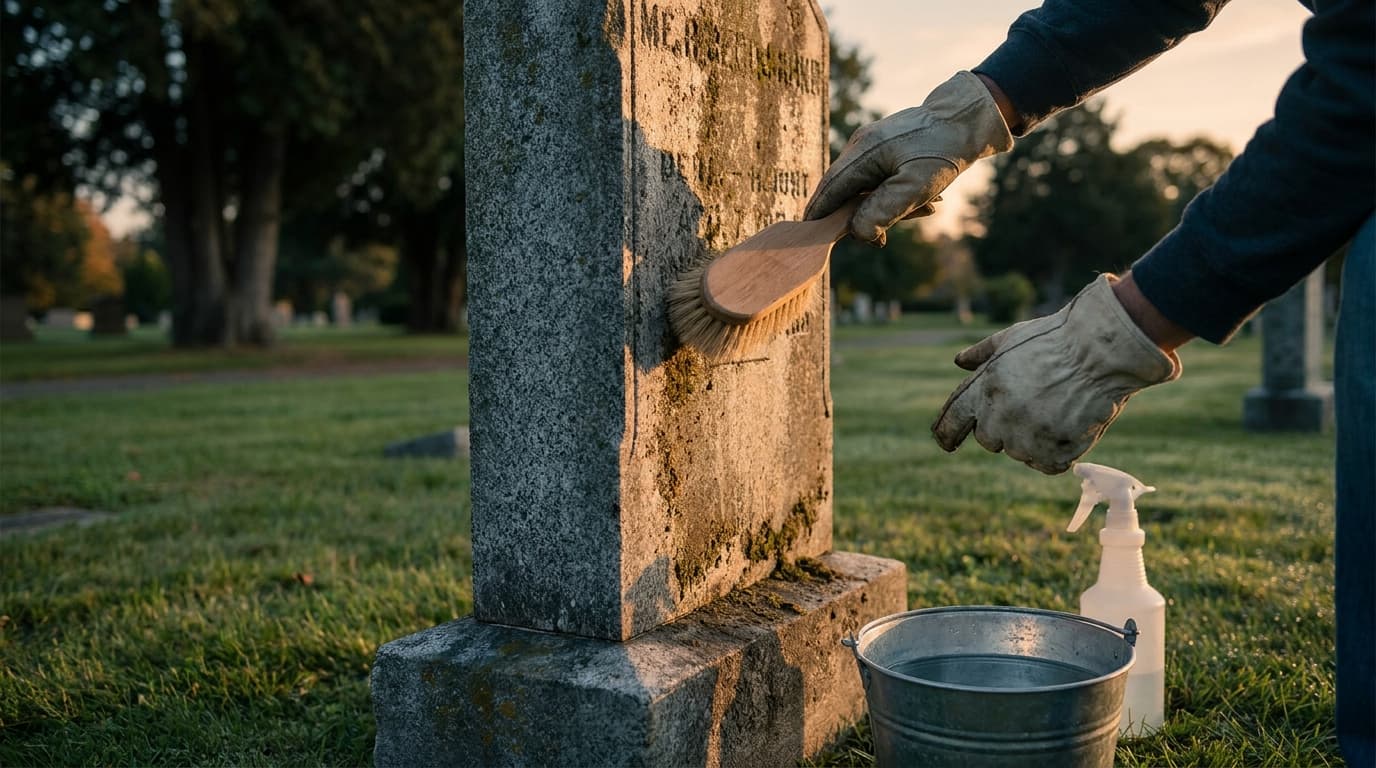
- Soft-bristle brushes, natural or nylon only. No plastic bristles, no metal, no wire, ever. Vegetable brushes and soft horse grooming brushes are exactly right and cost a few dollars at a farm supply store. Tape over any metal ferrule or rough edge so it cannot touch the stone.
- Soft wooden or plastic picks for lettering and carved detail. A popsicle stick, a bamboo skewer, or a soft toothbrush. Nothing metal goes into an inscription.
- A hand-pump or spray bottle. A garden sprayer works well. Keep it dedicated to this and never use one that has held herbicide.
- Cleaner, only if needed. Water first. If water is not enough, see the next section.
- Gloves and eye protection, plus a kneeling pad. You will be down there a while.
Notably absent: the pressure washer. Consumer units run between 750 and 3,000 psi. The National Park Service puts the safe ceiling for a headstone at roughly 500 psi at twelve inches, below what most machines can even throttle down to, and the VA flatly prohibits the public from power washing government-furnished markers. It cuts into the stone and erases lettering, and the damage is invisible on the day you do it.
Step Four: Choose a Cleaner (or Don’t)
Start with water. The VA’s guidance is unambiguous: most headstones and markers can be cleaned with water alone. Soak, brush gently, rinse. For a stone that is simply dirty rather than biologically colonized, that is often the entire job.
If water is not enough, step up to a neutral pH, non-ionic detergent. Orvus, Vulpex, and plain Ivory Liquid are the products federal guidance names. These lift greasy soiling without leaving salts in the stone’s pores.
If the stone has algae, moss, mildew, or lichen, you need a biocide, because scrubbing biological growth off only removes what you can see. The biofilm underneath is full of proteins and sugars that feed regrowth, and fungal filaments can penetrate the pore structure of the stone itself. D/2 Biological Solution is the product recommended by both the National Park Service and the Association for Gravestone Studies, and its development was partly funded through the VA’s National Cemetery Administration. Enviro Klean BioWash, Prosoco ReVive, Cathedral Stone Bio-Cleaner, and Wet & Forget appear on the VA’s list of acceptable alternatives. All are quaternary ammonium compounds rather than oxidizers, which is the distinction that matters.
Never use these, on any marker, at any dilution: household bleach or anything containing sodium hypochlorite, calcium hypochlorite, sodium perborate, sodium percarbonate, sodium persulfate, tetrasodium pyrophosphate, or urea peroxide. Muriatic or hydrochloric acid. Vinegar or any acidic cleaner, which dissolves marble and strips bronze patina. Concentrated ammonia, sodium hydroxide, potassium hydroxide, or calcium hydroxide. Abrasive powders like Comet or Ajax. Melamine foam erasers, which are fine abrasives despite marketing that suggests otherwise. Pool shock. Oven cleaner. Wire brushes and power tools of any kind.
The bleach problem deserves a sentence of its own because it is the single most common mistake. Bleach appears to work, and it does kill surface growth. It also leaves soluble salts inside the porous stone. Those salts dissolve when it rains, migrate through the pore network, and recrystallize as it dries, exerting pressure from the inside that can exceed the strength of the stone. The damage shows up years later as spalling and sugaring, long after anyone connects it to the afternoon someone helped.
Step Five: The Actual Cleaning, In Order
Everything up to here has been preparation. This is how to clean a headstone in practice, and the order genuinely matters. Pick a day above 40°F with no freeze forecast for the next 48 hours. This is not fussiness. Cleaning saturates a porous stone with water, and water that freezes inside stone expands and breaks it.
- Clear the area. Remove leaves, cut back grass grown over the base, and brush off loose debris by hand. Do not use a string trimmer near the stone; mower and trimmer scars are one of the most common forms of preventable marker damage.
- Test first. Apply your chosen cleaner to a small, inconspicuous patch, usually low on the back. Let it dry completely and inspect. Biocides work slowly, so give a test patch several days if you can. This step feels like an unnecessary delay right up until the moment it saves a stone.
- Soak the stone thoroughly with clean water. Do not skip this and do not rush it. A saturated stone cannot absorb much cleaner, which keeps the product working on the surface where you want it and makes it far easier to rinse out afterward. This one habit prevents most cleaner-related damage.
- Apply the cleaner evenly, following the manufacturer’s dilution exactly. Stronger is not better and voids any assurance the product carries. Spray lettering from two or three angles so it reaches into the grooves.
- Work bottom to top. Counterintuitive, but essential. Cleaner running down a dry stone leaves streaks that can be permanent. A wet lower section cannot streak.
- Agitate gently in small circles with the soft brush, in sections of a foot or so. Light pressure. If you are leaning into it, you are removing stone rather than soil. Use the wooden pick and toothbrush for carved lettering and any decorative work.
- Keep it wet the whole time. Never let the cleaner dry on the surface.
- Rinse thoroughly, then rinse again. More residue is left behind than people expect, and residue is the thing that causes trouble later. Rinse each section as you finish it and give the whole marker a final flush at the end.
- Walk away. This is the hardest instruction. With a biocidal cleaner the stone will look only modestly better when you leave. It keeps lightening for days, and the full result can take two weeks or more as dead growth weathers off. Do not come back the next morning and scrub it again because it is not white yet. It was never going to be white.

What About the Lettering?
Faded inscriptions are usually why families start this project in the first place. A few things worth knowing.
On granite, the letters are typically sandblasted and often painted or lithichromed. That paint wears off over decades. Repainting is a legitimate monument service, but it is not a DIY job with craft paint, and many cemeteries require it be done by an approved dealer. Ask the cemetery, then ask a monument dealer.
On weathered marble, letters go shallow and shadowless. The old trick of chalking or shaving-creaming an inscription to read it is discouraged now, because both leave residue in the pores. If you simply need to read a stone, the reliable method is free and leaves nothing behind: visit in raking light near sunrise or sunset, or hold a mirror or piece of white foam board to bounce low-angle light across the face. Shadows do the work that abrasion used to.
And once you have read it, write it down. Photograph the stone straight on in that raking light, record the full inscription, and put it somewhere that is not just your phone. Weathering is not reversible, and the inscription itself is often the only remaining record of a name, a relationship, or a date. Our headstone inscriptions resource is a useful companion if you are also planning wording for a new marker.
A Realistic Maintenance Rhythm
Families tend to swing between doing nothing for fifteen years and then doing far too much in one Saturday. A steadier rhythm protects the stone better and takes less effort.
| How often | What to do |
|---|---|
| Every visit | Clear leaves and debris by hand. Note anything new: a lean, a crack, a chip, growth spreading. |
| Seasonally | Rinse with plain water. Trim grass at the base by hand so mowers stay clear. |
| Annually, at most | Full cleaning if needed. Wax bronze markers. Photograph the stone to track condition over time. |
| As required | Call a conservator or the cemetery for anything structural: leaning, separation, cracks, failed repairs. |
Shade and moisture drive most of the regrowth. A marker under heavy tree cover will green over faster than one in open sun no matter what you do, and that is a fact to accept rather than a problem to solve with stronger chemicals.
If the Cemetery Is Far Away
The practical reality behind a lot of these searches is distance. American families move, and the family plot is often three states from anyone left to tend it. There are roughly 100,000 to 145,000 cemeteries in the United States depending on how you count, and a great many of them contain markers that no living relative has stood in front of in twenty years.
A few workable options. Many monument dealers offer cleaning and restoration as a paid service, which is worth it for fragile or historic stones regardless of distance. Local genealogical and historical societies sometimes coordinate volunteer cleaning days and welcome a donation from a distant family. Find a Grave and BillionGraves have photo-request systems where nearby volunteers will photograph a marker for you, which is at minimum a way to check its condition. And for a government-furnished veteran marker, the NCA’s Memorial Products Service handles replacement of headstones that have become illegible or damaged, at no cost to the family. Our guide to veteran burial benefits covers what the VA provides more broadly.
The Part Cleaning Cannot Fix
Here is what nobody tells you until you are kneeling in the grass with a brush: you can do this perfectly and still be left with a very clean stone that says almost nothing.
A headstone holds a name, two dates, and if there was room, a line. That was never the whole plan. It is simply all the granite would hold. The stories, the photographs, the voice, the reason anyone chose that particular line for the bottom of the stone, all of that lived in the people who remembered, and it moves one generation further away each time someone dies. Grandchildren inherit the plot. They rarely inherit the stories.
This is the specific gap a digital memorial closes. A small QR code plate mounted on the base of the monument, or set into a nearby marker, links to a page that holds what the stone cannot: photographs across a whole life, video, the obituary and the service, and the recollections other people add over the years. Anyone visiting scans it with a phone camera. No app, no login, no account. Families keep full control over what appears and who can see it, and the page keeps growing long after the stone is finished.
It also solves the distance problem in a way a cleaning trip cannot. Relatives who will never make it to the cemetery can still visit, contribute a photo, and read what everyone else remembered. If you are weighing the idea, our comparison of QR code memorials against traditional obituaries covers the practical differences, and how QR codes on headstones actually work answers the durability and weatherproofing questions most families raise first. You can also browse real memorial examples to see what the pages look like.
Monument dealers and cemeteries increasingly offer this at the point of sale rather than as an aftermarket add-on. If you run a monument business, our partner overview for monument dealers explains how the program works and what it adds to an average sale.
Frequently Asked Questions
What is the best thing to clean a headstone with?
Clean water and a soft natural or nylon bristle brush, in most cases. The VA’s National Cemetery Administration states that most headstones and markers can be cleaned with water alone. If water is not enough, move up to a neutral pH non-ionic detergent such as Orvus, Vulpex, or Ivory Liquid. Only if the stone has algae, moss, mildew, or lichen do you need a biocidal cleaner, and D/2 Biological Solution is the product recommended by both the National Park Service and the Association for Gravestone Studies. Always pre-soak the stone with water before applying anything, and rinse thoroughly afterward.
Can I use Dawn or Clorox to clean a headstone?
Not Clorox, and Dawn is not the right choice either. Bleach and bleach-type products leave soluble salts inside porous stone; those salts recrystallize with each wet-dry cycle and exert pressure that causes flaking and sugaring years later. Federal guidance explicitly lists sodium hypochlorite among the compounds never to use. Dawn is an ionic detergent that can leave residue in stone pores, so preservation guidance points to neutral pH non-ionic products like Orvus or Vulpex instead, or plain Ivory Liquid if that is what you can find. Mild dish soap is acceptable on bronze markers, which follow different rules from stone.
Can I use a Magic Eraser or a pressure washer on a headstone?
No to both. Melamine foam erasers are fine abrasives; they work by sanding away a microscopic layer of whatever they touch, which on a headstone means original stone and the crisp edges of the lettering. Pressure washers are worse. Consumer models run 750 to 3,000 psi, while the National Park Service puts the ceiling for headstones at roughly 500 psi at a twelve-inch distance, and the VA prohibits the general public from power washing government-furnished markers entirely. High-pressure water cuts into the surface and erodes inscriptions, and the damage is not visible on the day it happens.
How do you make an old gravestone look new again?
You do not, and preservation professionals are direct about this. The VA states that the goal of cleaning is to remove pollution soiling, lichen, dirt, and sap, not to make a marker look like new. A century-old marble stone has weathered, and the methods aggressive enough to erase that weathering also erase the surface and the inscription. What you can realistically achieve is a marker that is clean, readable, and free of biological growth. If a stone is genuinely too far gone to read, the answer is replacement or professional conservation rather than harder scrubbing. For government-furnished veteran markers, the NCA will replace an illegible headstone at no cost to the family.
How often should a headstone be cleaned, and when?
No more than once a year for historic stones, and less often if the marker does not need it. The National Park Service is explicit that overcleaning should be avoided, because every cleaning removes a little original material. Timing matters as much as frequency: clean only when temperatures are above 40°F and no freeze is expected within 48 hours, since cleaning saturates porous stone and trapped water that freezes will expand and damage it. Markers in damp, shaded spots under trees regrow biological growth faster and may need attention more often than ones in open sun, but the annual ceiling still applies.